Reminder: Why I Love Entrepreneurship

Thursday I attended the Demo Camp at the Creative Destructive Lab at the Rotman School of Management at the University of Toronto. The Lab is focused on converting innovation to entrepreneurship selecting concepts with merit and guiding the founders through the process of getting to market. In the process the goal is to encourage the brightest and best to stay in Canada. The first program was completed in June. It is a competitive environment as it should be. Last September when the Lab was in it`s gestation period there were 76 project submitted. Of these the G7 founding partners selected the 18 that they felt had the most merit. The groups were assigned specific targets to carry out over a six week period at which time they met with the partners again. The one with the weakest performance was dropped. By June on completion of the program there were ten projects left. In less than a year the survivors have created over $ 65 million in equity with more to come. Great performance for a program in its infancy. Great things are destined to come out of this program. It`s already started.

I am very proud to have been invited to become a partner of the CD Lab. Not as one of the G7 partners who will continue to run the program in conjunction with the founders Professor Ajay Agrawal and Jesse Rogers but as one who is passionate about entrepreneurship and willing to help these people with phenomenal potential in whatever way I can. There are many levels and forms of entrepreneurship. The common bonds are the personal issues and fundamental business issues that every entrepreneur has to address from team building to funding. The transition from innovator to entrepreneur is difficult at the best of times but the pace at the Lab as for any accelerator is fast and furious. Understanding what to expect on these basic challenges can facilitate the transition and keep things in perspective.

Which brings me back to the title of this post. The adrenalin of the Demo Camp was contagious. Ajay and Jesse along with the G7 partners are building a culture of success. The combination of seeing the progress that was made last year as reported by the charter participants along with over twenty new pitches to show what is on the horizon was compelling and just plain exciting. There is a developing worldwide race to attract talent. Keeping our own is critical. Attracting sources from other countries nearly as important. Canada has introduced a new visa program to attract innovators who can confirm capital to support their programs BUT the key to attracting others is to keep our own, build a world class ecosystem and foster the culture of success. The Creative Destruction Lab will be an important factor in the process. Very exciting !!!!

Similar Posts

  • Why Branding is a threat to the middle class

    In theory as Globalization evolves resources will be allocated in the most efficient way possible ensuring that goods will be produced on the lowest cost basis to the benefit of all. In a perfect global system labour will shift around until the transition is complete and the rewards for labour will equalize around the global network. During the transition while wage rates in higher earning countries are frozen or rise slowly as wage rates in other areas catch up, those living in the higher wage countries will benefit from low cost goods during the transition. All of this takes place without impediments or barriers to free and open competition. Entrepreneurs will drive the progress by ferreting out opportunities across the global system.

    In practice as we continue to embrace such a global system, the rewards to labour in the low wage countries are lagging while much of the benefit of low cost goods are not reaching the consumer. Instead the rich are becoming the super rich while the middle class is facing the reality of returning to an historical norm with relative rewards well below those achieved in the west for the past sixty years during which consumerism has flourished. In an evolving era of Big Data where the status quo is becoming a moving target while character traits such as adaptability and resilience are becoming more critical, the business behemoths of the world are getting richer by controlling markets. Much of this control stems from branding and creating the allusion that branded goods are inherently superior. At the same time effective marketing has mislead us that these behemoths are so critical that they are ‘too Big to Fail’. Branding has effectively created near monopolies effectively providing barriers to entry for aspiring entrepreneurs in the process by limiting their upside and increasing their challenges

    Mammoth organizations operating on ten year plans are not appropriate for our fast paced Global economy. However control over markets allows them to achieve innovation and flexibility through outsourcing and acquisition. Oh these in themselves do create upside for entrepreneurs who can launch a startup and find an eager buyer for their initial success. However the odds against success are greater and fewer of us are likely to get there. It is certainly possible for a limited few to build new brands creating new members of the super rich club. However overall we have abandoned core economic principles such as the Law of Diminishing Returns and the Optimum Size of the firm in favour of uninformed consumerism and market control through brands owned and managed by what are effectively huge bureaucracies. Is there a tipping point ahead? Surely social media and instant communication are a threat to the dominance of brands – OR are they just additional instruments of control?

    Globalization has brought large numbers into the global work force, increasing the supply of labour. Technology through robotics and mechanization is reducing the demand for labour. Together these factors create downward pressure on wage rates. Upward mobility for the individual is in decline. Capital is securing the lion’s share of the rewards. Job stability is one of the status quos that is disappearing. For all of these reasons the individual must become his or her own brand. The most important skill you can learn today is the ability to create and manage your career.

  • 10+ Reasons Why We are on the Doorstep of “Brave New World

    In one of my favourite and most thought provoking novels, Aldous Huxley used the future (2540 AD) as the setting and  developed characters in his science fiction novel to express the fear of losing individual identity in the fast-paced world of that future. Unlike Orwell who offered a pushback to communism, Huxley focused more on technology and the ultimate impact of continuing the fast pace evolving out of the Industrial Revolution. So is that future almost upon us? Here are some of the key elements of Huxley’s Brave New World:

    Abolition of natural reproduction – Children are educated via appropriate subconscious messages to mold the child’s self-image appropriate to their caste.- Discouragement of critical thinking – Discouragement of individual action and initiative – An abundance of material goods – (presumably because of advanced technology) conditions of work are not onerous – Citizens are conditioned to promote consumption. People enjoy perfect health and youthfulness until death at age 60. The World State is a benevolent dictatorship headed by ten World Controllers which has established a stable global society where the population is permanently limited. The basis of that stability is the conditioning of citizens to accept their station in life.

    As a serial entrepreneur who values individualism driven by hope and accomplishment as essential to the human condition the weight of logic tells me that we are all too close to Huxley’s world and long before 2540. Here are more than enough reasons to be concerned. All of them relate to two dominant trends – rapid change and  globalization.

    1. The Era of Big Data is here – too much to know and digest

    2. Wealth Disparity – economic rewards are accruing to capital – real wages are stagnant or in decline

    3. Declining upward mobility – the middle class is in decline trending towards historical norms more limited chances for improvement – Huxley’s caste system?

    4. Precarious employment – job stability is simply disappearing — those that don’t take control over their careers will flounder

    5. Machine Learning- we are about to handle even more control of our research and knowledge creation to machines. Artificial Intelligence is the next big thing.

    6. Cloning – the science exists – the implications are many

    7. Stem cell development – we can already grow new organs  – test tube babies are there for the taking. The key to perfect health may well lie in stem cell research.

    8. World population is out of control –  in Huxley’s world, a problem solved by limiting life

    9. Control of knowledge – with Big Data and Machine Learning will we only know what we are told and will God simply become the internet? Look it up – it must be so?

    10. Surveillance – Snowdon  has shown that  we are being watched – this will only get worse and soon

    11. Corporatism – we don’t live under free market capitalism – large corporations control global markets and reap the profits – we can thank ourselves for embracing branding to facilitate this – Too Big to Fail puts a deadly premium on Big

    12. Multi-nationals – these same corporations driven by profit maximization are pursuing interests that eliminate national interests as they build stronger global foundations for controlling markets. All the time individuals are being encouraged to consume at record rates.

    I’m fairly sure I know what Huxley would think. How about you?


  • Ten Things These Books Will Do For You

    June-October 2014 including Family E 235Series: The Entrepreneurial Edge
    Book one: Everyday Entrepreneur – making it happen
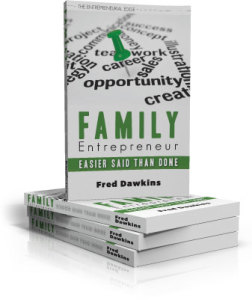
    Book two: Family Entrepreneur – easier said than done
    Book three: Ageless Entrepreneur – never too early, never too late

    Ten Things These Books Will Do For You

    1. Get you out of a mental rut and into new opportunities
    2. Show you a path to self-determination
    3. Increase your earning power
    4. Enable you start a business, manage your career or accomplish your bucket list
    5. Make you a problem solver
    6. Enable you to build teamwork in your business and at home
    7. Explain the dynamic of the fast paced global economy we live and work in
    8. Prepare you for all of the fundamental issues you will face in a business
    9. Provide common sense solutions you can accomplish
    10. Inspire you to strike out, create your own brand and control your career

    “Fred Dawkins has written a wonderful book about entrepreneurship unlike any other on the market. He brilliantly uses his storytelling skills to illuminate his subject in a way that makes the book a joy to read. You’re so wrapped up in the story that you may not realize how much you’re learning until you’ve turned that last page.”
    — TERRY FALLIS, AWARD-WINNING AUTHOR OF THE BEST LAID PLANS AND UP AND DOWN.

    “Fred has pulled together a wealth of knowledge and advice crucial to the successful entrepreneur in a highly readable fashion. It is a must-read for aspiring and seasoned entrepreneurs who are facing today’s complex, volatile, and uncertain world. I especially appreciate the emphasis on thinking globally and adapting proactively. We have seen too many examples of yesterday’s winner relying on old models to their detriment. It isn’t easy … but it is exciting and gratifying to create your own business and work to see it flourish. The summary at the end of the book should be bookmarked on every entrepreneur’s computer.”
    — Dr. Sherry Cooper, former executive VP and chief economist for BMO
    and author of three books, including The New Retirement: How it Will Change Our Future

    Utilizing his exemplary storytelling skills, Fred Dawkins has written an excellent book about entrepreneurship in a family setting environment and the many challenges that it places on the entrepreneur and the family
    – Jeff Sheehan- author of HIRED! Paths to Employment in the Social Media Era

  • Entrepreneurs: Lessons from ‘Own the Podium’

    With the Vancouver Olympics on the horizon the Canadian Olympic Committee supported by the Government recognized a need to change the status quo – a need to disrupt the traditional methods and find a way to achieve the winning performances expected from the host country. The situation demanded an entrepreneurial approach based on opportunity and determination. The opportunity was hosting the games – the determination to win existed with the athletes but the momentum to surpass previous achievement came from the Own the Podium program that created an ecosystem promoting pride, confidence and results. It worked – in Vancouver the Canadian team set a record for the most gold medals won at a winter Olympics and collected more total medals than they had ever won in a single Olympics. The key was creating a culture that nurtured success and established that success as a new normal, an expectation. In the simplest terms a philosophy or mindset focused on making things happen- the essence of being entrepreneurial.

    On an individual basis this program is a great example of breaking free of prison thinking and letting your determination take you through to success. But Own the Podium is far more significant than that. It is a great example of the collective creating the support system that produces individual success to the benefit of the entire country. We must do the same in the business world. Did you know that over 350,000 Canadians live and work in Silicon Valley? Why? Because the Valley offers the most highly developed tech ecosystem the world has ever seen. Do you also know that there is a worldwide competition for talent going on? Governments around the world are building programs to attract entrepreneurs to their countries. Canada has already introduced a fast track system to provide visas and a path to citizenship for entrepreneurs/innovators who can attract venture capital investment from Canadians. However if we can just keep our best and most brilliant home we can do well in this talent war and improve our prospects and results. We need to Own the Podium in tech development and in entrepreneurship.

    We have a good start with programs like MaRS , Communitech and The Creative Destruction Lab at the Rotman School but we need the collective will and the support of government to build an ecosystem that is second to none and that brings out the very best from the natural ability that exists here. If one per cent of our total population representing a much higher percentage of our intellectual capital are living in California than we have the tools here but we are both losing them and underutilizing them. More or less like our Olympic performance prior to Vancouver. If we can do it in sport we can do it in business.


  • Is Entrepreneurship for you?

    Most of what the average person reads about entrepreneurship sustains the mystique. We revere the outstanding successes achieved by extreme entrepreneurs from Edison to Jobs. Reading about these giants colors our perception of entrepreneurship. We admire their achievements but consider them beyond reach. Their stories sustain misleading myths about entrepreneurship that combine to keep capable people from embracing an entrepreneurial career. Here are some of the distortions that deceive us:
    – Entrepreneurs are born and cannot be made
    – Entrepreneurs are gamblers who take reckless risks to achieve high rewards
    – Entrepreneurs work 24/7 and have little or no personal life
    – Entrepreneurs need to fail in order to succeed
    These established stereotypes derive from two specific types of entrepreneurs. First are the misfits or rebels who either cannot or will not conform; the gamblers to whom few of us can relate. Second and even more prominent are the tech entrepreneurs immersed in the world of venture capital where risk is high, failure is frequent and the rewards for success are dramatic. However Silicon Valley is not the center of the universe and these are not the definitive entrepreneurs; they are but two types of many, both removed from the traditional economy and the rock solid problem solvers that collectively form the engine that drives the economy. Those are the achievers that make things happen especially creating jobs while big business is chasing lower costs around the globe.
    Let’s set the record straight
    Entrepreneurship can be taught. It should be taught and it is being taught
    Becoming an entrepreneur is all about the mindset not the skillset. Entrepreneurs find the way to make things happen they don’t always know the way. This is a teachable philosophy, entirely appropriate in a world dominated by change which generates knowledge and new problems at a phenomenal rate. Finally after fifty years of a flawed model focused on turning out executives for large corporations, colleges and universities have turned their attention to promoting and encouraging entrepreneurship
    Entrepreneurship is not about the risk you take but the results that you achieve
    It’s a startling paradox. Too many good opportunities die prematurely because so many potential entrepreneurs are risk averse. At the same time businesses are failing because of absurd risks fostered by the idea that being an entrepreneur is nothing more than a gamble. Entrepreneurs succeed through determination not by taking unwarranted risk. Managing your risk as you embrace it is critical. Not all ideas are opportunities and every opportunity is not viable.
    Entrepreneurs need to find balance and will make mistakes and have regrets if they don’t
    Having a work ethic is critical. During your startup phase and later when you encounter bumps in the road you will work long hours with great satisfaction. But as things progress and you don’t find balance you are missing something – failing to build your team, keeping too much control or limiting your own development. Both you and your business will suffer. Never forget: you are your most valuable human resource. Balance is a subjective decision but dividing your time does not preclude you from succeeding as an entrepreneur.
    Entrepreneurs do manage their risk and avoid failure – if they fail they learn and move on
    Describing failure as an essential part of success is pure rationalization. Admittedly many entrepreneurs are motivated by the fear of failure more than the rewards of success. Avoiding failure is a powerful source of determination. We do learn from failing because we take the time to analyze it. Success is elating and it masks our faults. Entrepreneurial infallibility is another myth that leads to bad decisions and setbacks that result from forgetting the basics.
    What is an entrepreneur?
    Most of us will never reach achievements like Steve Jobs or Mark Zuckerberg. That does not demean what we do achieve. Society needs to recognize a broad definition of entrepreneurship at every level and value entrepreneurship of every type because in a world dominated by globalization and technology the one thing that we can count on is change across every element of our economy. Resilience and adaptability are important entrepreneurial qualities that allow us to embrace the ongoing pressure for change. In the simplest terms entrepreneurs are problem solvers who consistently make things happen. They are agents of change in an era of change. They are disruptors at a time when the status quo is a moving target. Do you want to be part of the solution or part of the problem? We can all become more entrepreneurial in our beliefs, break out of prison thinking and think outside the box. The alternative is personal stagnation and uncertainty evolving from lack of job stability, declining upward mobility and the shift in income distribution toward the rich. The most important skill you can develop is the ability to create and manage your own career,
    Do understand: we can’t all be innovators but for every innovation there will be thousands of entrepreneurs finding applications for it that solve everyday problems producing jobs and independence in the mainstream economy. Being first is over rated. Doing things better and different often brings greater opportunity. Remember that coffee shops existed in London in 1650 but Starbucks found a new appeal and a great market niche for this old product that resonates in today’s economy.
    Believe in your own ability. You can establish the mindset of an entrepreneur. You can eliminate the word ‘can’t’ from your vocabulary. You can approach problems by skipping right over the question “if” it can be solved and skip directly to the question “how” it will be solved. You can find opportunity and you can analyze to make sure that opportunity is viable. All of this can be done within the context of the traditional economy and you don’t have to be a tech genius to do it. Technology is not a threat but offers a great tool for you to use. We are entering a new era of entrepreneurship which means it really should be an option for almost anyone.

Leave a Reply