There are quite a number of trends converging that I believe will significantly influence our future. Most of these increasingly appear to be irreversible. These include:
So many factors that we see but ignore. Why?
.the deeply entrenched partisanship that makes the governing of America anything but optimal producing ineffective decision-making
the growing power of China
the Chinese investments in Africa and South America
the power struggle between the U.S. and China
the U.S. decision to ignore the potential of Africa
by 2100 the world population is projected to be 12 billion
9 billion of these people will be Asian or African
with the exception of Africa, the world population will be aging
the impending expansive impact of AI
the impact of AI on wealth and employment
the destructive and unsustainable imbalance in the distribution of wealth
the inability of governments to deal with so many of the critical issues threatening the world as we know it
the possibility of power brokers in the private sector, frustrated by the impotence of government, attacking issues from overpopulation to climate change
the evident decline of the American empire
the current tariff war will be resolved -neither the U.S. or China are ready for an economic divorce
by 2032 one of them will be
much of the world will welcome the decline of American economic imperialism
climate change will reconfigure the most desirable places for human to live
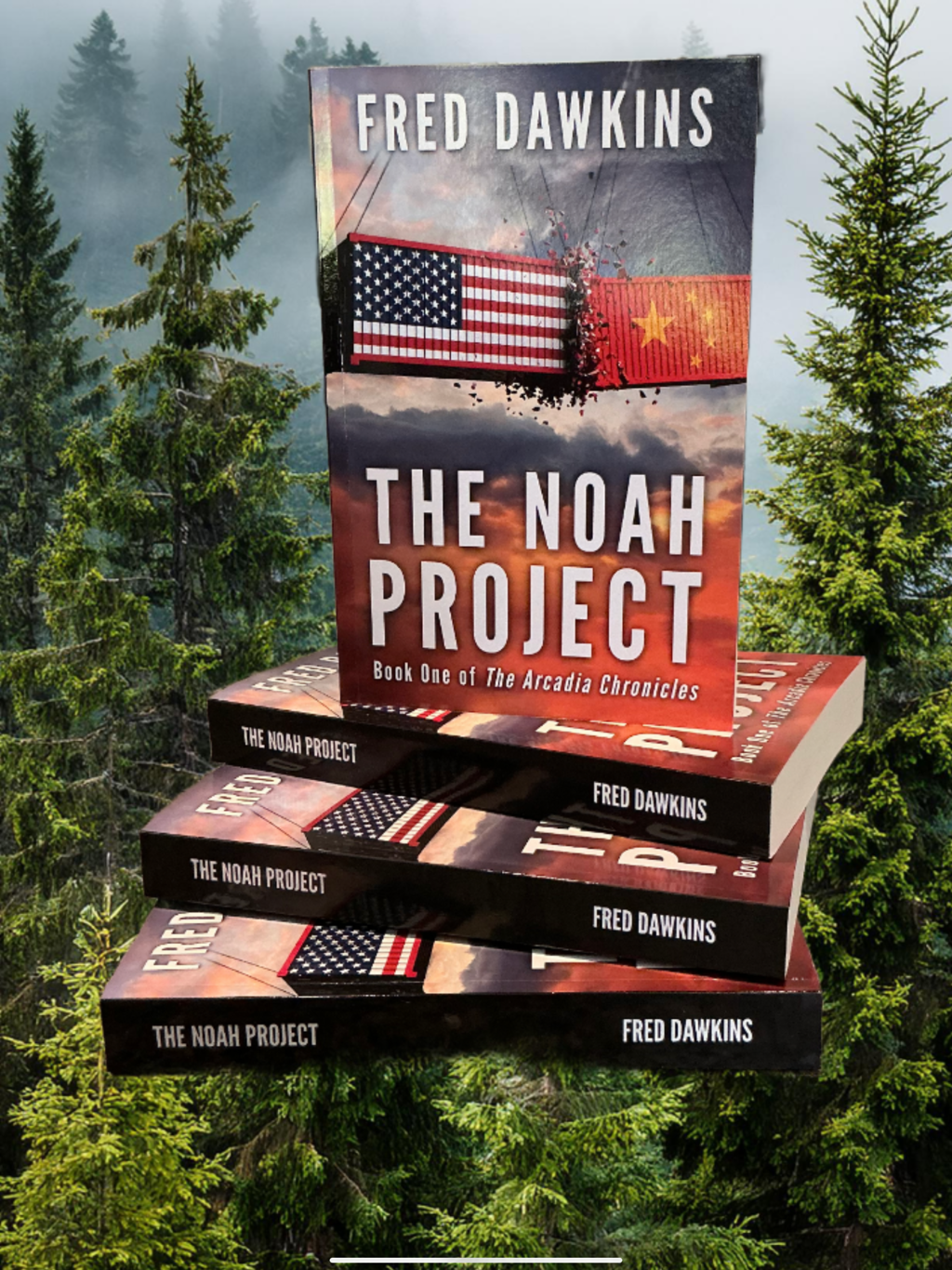
All of these and more help define the world as I portray it in ‘Noah’ in just seven plus years. When you read Noah, and you should, your inevitable conclusion will be that this could happen.
Creative Destruction was a term first popularised by economist Joseph Schumpeter. The premise is that innovation and technology will ensure progress on the basis of replacing old industries, markets and economic structures with new more efficient concepts. The architects who accomplish this are entrepreneurs who think outside the box, question existing systems and introduce new ways and means. Never has this been more relevant with the impending impact of AI putting us on the cusp of what many believe will be a major revolution. Some believe it will bring about comparable change to that fostered by the Industrial Revolution. Regardless this change will be led by the key leaders that Schumpeter relied upon: entrepreneurs and tech genii.
Enter Donald Trump, certainly a disrupter but only in a literal sense. The proverbial bull in the China shop. The antithesis of the dynamic innovators that Schumpeter championed. A man apparently stuck in the past. A strong proponent of returning to the ‘good old days’ of the 1890’s, his model for what the U.S. should be. Let’s call that ‘Destructive Reduction.’
Subtraction by reduction. Attacking allies. Breaking trade agreements. Withdrawing from international organisations. Renouncing treaties. Axing social benefits. Deporting immigrants. Recklessly slashing jobs within the bureaucracy. Reductions without analysis in an ill-fated attempt reduce the national debt, offset quickly by tax cuts in his ‘Big Beautiful Bill’. The man hates complexity. Give him a one pager and a burger and he’s ready to act. Rationality be damned. Right to a fault? ON and ON Don!
Admittedly AI may help him with the odd element in this quixotic attack on well, just about everything. Forgotten is that the firm foundation of growth for the past hundred years for the U.S. has been research and development. For the past fifty years and more the U.S. has spent roughly 40% of the amount spent on R & D across the entire world. It’s been a proven formula for wealth creation and economic success. So what does the Big D do? He cuts the funding for leading research institutions like Harvard. This is perverse logic but then logic had been abandoned in a flurry of executive orders with the size of the signature rivalling that of John Hancock.
I wonder who will fill the many voids created by this executioner of trust? Trump’s drift toward isolationism, based on groundless economics, creates great opportunity for none other than China. A country that quietly invests in areas that the U.S. largely chooses to ignore like Africa and South America. Areas that have been insulted by the Big D. Projections show that by 2100 there will be twelve billion people on Earth. Nine billion of those will reside in Africa or Asia. Every continent but Africa will be facing ageing populations. China has a plan. It has a much longer window than anything America conceives. China will quietly encourage the decline of the American Empire, if you can call it one. Donald has given their plan a nice boost.
The world is changing. Are we ready? These are the questions that make my novel The Noah Project a wake up call to action.
There will always be a debate as to whether entrepreneurship is a teachable skill or an inherent trait. The simple answer is both. Like any other human attribute there are naturals – people to whom taking risk and asserting control is simply their norm. I strongly believe that entrepreneurship is a mindset – both a philosophy that can be taught and a series of life choices for which we can prepare. As such it has never been more important. On a macro level our economy needs entrepreneurs to ensure adaptability and resilience in a rapidly changing world. On a micro level each and every one of us must become our own brand facing the reality of precarious employment in a global economy where the rewards are shifting towards capital and away from labour. From Norman Vincent Peale to Dale Carnegie to Tony Robbins people have been promoting key ideas that are critical to entrepreneurs. Adaptability, resilience and determination applied to viable scenarios. My series The Entrepreneurial Edge focuses on bringing real life experience into workshop environments to introduce key ingredients and real life experiences all focused on preparing people for careers as entrepreneurs or at least encouraging them to think like entrepreneurs in taking control over their careers.
Every college and university is trying to teach entrepreneurship. How effective are these programs? Not as effective as they need to be. Entrepreneurship can be taught but it can’t be forced. Most of these programs are focused on incubators and accelerators. We are teaching venture capitalism not entrepreneurship. Too many of these students think that raising capital is the issue and that once they raise capital they have crossed the finished line when in reality they have just stated the race. Revenue generation is the key to success and maintaining control of your business. All things are possible if you can create sales.
The more successful programs involve mentors but once again many of them come from the venture capital world more focused on burn rate and going public than founding a sustainable business. Governments encourage entrepreneurship for job creation. Venture capital in the tech area makes millionaires on occasion and creates jobs in Asia when they do so. To teach entrepreneurship effectively we have to focus more on the mainstream economy where entrepreneurs create jobs in their backyard where they can identify opportunities that Big Business rejects or ignores.
I chose the title Everyday Entrepreneur – Making it Happen for the first book in my series because I want to reach a very broad audience who need both encouragement and guidance into self-determination through entrepreneurial thinking. The Tech community dominates the dialogue and gets all the handholding. That focus is too narrow and does not help the thousands of potential entrepreneurs who can apply tech solutions to myriad of business problems creating jobs in the process.
Fred Dawkins
Written by
Fred Dawkins
0 comments
Fred Dawkins
Be the first to comment and start the conversation!
Donald Trump has trapped himself within competing mutually exclusive goals. He wants to reduce the burden of the national debt. That goal is reflected in his pressuring Chairman Powell to reduce interest rates as well as the failed attempt by Musk and DOGE to reduce the cost of government. He has been confounded by bond rates staying strong. He does not do well with complexity. He is the poster boy for the ‘quick fix’. That ain’t happening!
That beautiful word ‘tariff’ isn’t producing the results he wanted. Was it ever really a trade strategy or just a revenue grab ultimately paid by the American public on a regressive basis. As a trade strategy it has failed. Those 120 countries lined up to make deals favourable to the U. S. have been dragging their feet, anything but compliant.
Now we have the BBB damned by Musk as ‘abominable’. But even Musk has caved after a brief interlude of lucidity. The impact on the debt level is predictable and disastrous. This man does not understand complexity. Anything beyond a one page summary appears to be beyond his comprehension. The BBB may cause the first rejection by his minions but more he likely will shepherd it through by intimidating the gutless republican controlled congress. It will become the LLLL – A ‘Lasting Large Loathsome Liability – politically for Trump and financially for the country.
Ten years ago to the day I posted the piece that I’ve copied below. It seems that I was fairly prescient then which adds some credibility to the future that I’ve set out in The Noah Project. My thesis at the time was that we were much closer than most of us realised to the world order that Aldous Huxley foretold almost a hundred years ago. Ironically Brave New World was published in 1932 while The Noah Project takes place in 2032. How much has changed since Huxley put pen to paper.
10 + REASONS WHY WE ARE ON THE DOORSTEP OF “BRAVE NEW WORLD by F.C. Dawkins * June 14th 2015
In one of my favourite and most thought-provoking novels, Aldous Huxley used the future (2540 AD) as the setting and developed characters in his science fiction novel to express the fear of losing individual identity in the fast-paced world of that future. Unlike Orwell who offered a pushback to communism, Huxley focused more on technology and the ultimate impact of continuing the fast pace evolving out of the Industrial Revolution. So is that future almost upon us? Here are some of the key elements of Huxley’s Brave New World:
Abolition of natural reproduction – Children are educated via appropriate subconscious messages to mold the child’s self-image appropriate to their caste.- Discouragement of critical thinking – Discouragement of individual action and initiative – An abundance of material goods – (presumably because of advanced technology) conditions of work are not onerous – Citizens are conditioned to promote consumption. People enjoy perfect health and youthfulness until death at age 60. The World State is a benevolent dictatorship headed by ten World Controllers which has established a stable global society where the population is permanently limited. The basis of that stability is the conditioning of citizens to accept their station in life.
As a serial entrepreneur who values individualism driven by hope and accomplishment as essential to the human condition the weight of logic tells me that we are all too close to Huxley’s world and long before 2540. Here are more than enough reasons to be concerned. All of them relate to two dominant trends – rapid change and globalization.
1. The Era of Big Data is here – too much to know and digest
2. Wealth Disparity – economic rewards are accruing to capital – real wages are stagnant or in decline
3. Declining upward mobility – the middle class is in decline trending towards historical norms more limited chances for improvement – Huxley’s caste system?
4. Precarious employment – job stability is simply disappearing — those that don’t take control over their careers will flounder
5. Machine Learning- we are about to handle even more control of our research and knowledge creation to machines. Artificial Intelligence is the next big thing.
6. Cloning – the science exists – the implications are many
7. Stem cell development – we can already grow new organs – test tube babies are there for the taking. The key to perfect health may well lie in stem cell research.
8. World population is out of control – in Huxley’s world, a problem solved by limiting life
9. Control of knowledge – with Big Data and Machine Learning will we only know what we are told and will God simply become the internet? Look it up – it must be so?
10. Surveillance – Snowdon has shown that we are being watched – this will only get worse and soon
11. Corporatism – we don’t live under free market capitalism – large corporations control global markets and reap the profits – we can thank ourselves for embracing branding to facilitate this – Too Big to Fail puts a deadly premium on Big
12. Multi-nationals – these same corporations driven by profit maximization are pursuing interests that eliminate national interests as they build stronger global foundations for controlling markets. All the time individuals are being encouraged to consume at record rates.
I’m fairly sure I know what Huxley would think. How about you?