|

Creative Destruction vs Trump’s Destructive Reduction.

Creative Destruction was a term first popularised by economist Joseph Schumpeter. The premise is that innovation and technology will ensure progress on the basis of replacing old industries, markets and economic structures with new more efficient concepts. The architects who accomplish this are entrepreneurs who think outside the box, question existing systems and introduce new ways and means. Never has this been more relevant with the impending impact of AI putting us on the cusp of what many believe will be a major revolution. Some believe it will bring about comparable change to that fostered by the Industrial Revolution. Regardless this change will be led by the key leaders that Schumpeter relied upon: entrepreneurs and tech genii.

Enter Donald Trump, certainly a disrupter but only in a literal sense. The proverbial bull in the China shop. The antithesis of the dynamic innovators that Schumpeter championed. A man apparently stuck in the past. A strong proponent of returning to the ‘good old days’ of the 1890’s, his model for what the U.S. should be. Let’s call that ‘Destructive Reduction.’

Subtraction by reduction. Attacking allies. Breaking trade agreements. Withdrawing from international organisations. Renouncing treaties. Axing social benefits. Deporting immigrants. Recklessly slashing jobs within the bureaucracy. Reductions without analysis in an ill-fated attempt reduce the national debt, offset quickly by tax cuts in his ‘Big Beautiful Bill’. The man hates complexity. Give him a one pager and a burger and he’s ready to act. Rationality be damned. Right to a fault? ON and ON Don!

Admittedly AI may help him with the odd element in this quixotic attack on well, just about everything. Forgotten is that the firm foundation of growth for the past hundred years for the U.S. has been research and development. For the past fifty years and more the U.S. has spent roughly 40% of the amount spent on R & D across the entire world. It’s been a proven formula for wealth creation and economic success. So what does the Big D do? He cuts the funding for leading research institutions like Harvard. This is perverse logic but then logic had been abandoned in a flurry of executive orders with the size of the signature rivalling that of John Hancock.

I wonder who will fill the many voids created by this executioner of trust? Trump’s drift toward isolationism, based on groundless economics, creates great opportunity for none other than China. A country that quietly invests in areas that the U.S. largely chooses to ignore like Africa and South America. Areas that have been insulted by the Big D. Projections show that by 2100 there will be twelve billion people on Earth. Nine billion of those will reside in Africa or Asia. Every continent but Africa will be facing ageing populations. China has a plan. It has a much longer window than anything America conceives. China will quietly encourage the decline of the American Empire, if you can call it one. Donald has given their plan a nice boost.

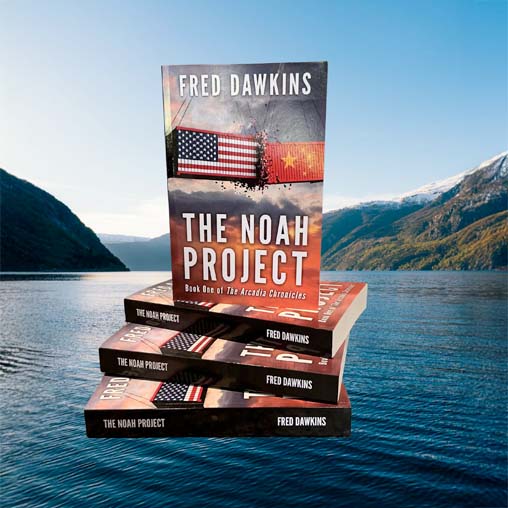
The world is changing. Are we ready? These are the questions that make my novel The Noah Project a wake up call to action.

Similar Posts

  • Ten Things These Books Will Do For You

    June-October 2014 including Family E 235Series: The Entrepreneurial Edge
    Book one: Everyday Entrepreneur – making it happen
    Book two: Family Entrepreneur – easier said than done
    Book three: Ageless Entrepreneur – never too early, never too late

    Ten Things These Books Will Do For You

    1. Get you out of a mental rut and into new opportunities
    2. Show you a path to self-determination
    3. Increase your earning power
    4. Enable you start a business, manage your career or accomplish your bucket list
    5. Make you a problem solver
    6. Enable you to build teamwork in your business and at home
    7. Explain the dynamic of the fast paced global economy we live and work in
    8. Prepare you for all of the fundamental issues you will face in a business
    9. Provide common sense solutions you can accomplish
    10. Inspire you to strike out, create your own brand and control your career

    “Fred Dawkins has written a wonderful book about entrepreneurship unlike any other on the market. He brilliantly uses his storytelling skills to illuminate his subject in a way that makes the book a joy to read. You’re so wrapped up in the story that you may not realize how much you’re learning until you’ve turned that last page.”
    — TERRY FALLIS, AWARD-WINNING AUTHOR OF THE BEST LAID PLANS AND UP AND DOWN.

    “Fred has pulled together a wealth of knowledge and advice crucial to the successful entrepreneur in a highly readable fashion. It is a must-read for aspiring and seasoned entrepreneurs who are facing today’s complex, volatile, and uncertain world. I especially appreciate the emphasis on thinking globally and adapting proactively. We have seen too many examples of yesterday’s winner relying on old models to their detriment. It isn’t easy … but it is exciting and gratifying to create your own business and work to see it flourish. The summary at the end of the book should be bookmarked on every entrepreneur’s computer.”
    — Dr. Sherry Cooper, former executive VP and chief economist for BMO
    and author of three books, including The New Retirement: How it Will Change Our Future

    Utilizing his exemplary storytelling skills, Fred Dawkins has written an excellent book about entrepreneurship in a family setting environment and the many challenges that it places on the entrepreneur and the family
    – Jeff Sheehan- author of HIRED! Paths to Employment in the Social Media Era

  • Teaching Entrepreneurship

    There has been a rush to embrace entrepreneurship over the past ten years, especially since 2008. Every college, every university now offers courses in a discipline once perceived by the public as reserved for misfits, gamblers and tech high rollers. Of course that’s one of the many myths and misconceptions about entrepreneurship. Those mystical entrepreneurs so far removed from the average life have always been but a small percentage of those who take control over their lives and pursue opportunities at any level

    Another of these misconceptions is that you can only become a true entrepreneur through trial and error gaining experience along the way. You could just as well say that about any group or profession. None of us are totally happy if our lawyer is conducting his first case. How many of us would enjoy the prospect of surgery if we found out that our surgeon was a novice. Of course like any other endeavour we entrepreneurs gain insight and judgement from as Nike says just doing it. However there is something to be said for better preparation through shared experiences. We need far more mentors teaching and sharing ideas with would be entrepreneurs.

    My series The Entrepreneurial Edge is focused on doing that. You see I tell stories with characters that are making important life decisions that centre around being entrepreneurs. Would be entrepreneurs at any age and at any level of education relate well to these stories full of real life anecdotes from a forty five year career as a serial entrepreneur. Having run workshops on the book I find it works well with high school students right up to PHD graduates and from business novices up to people that have been in business for years. If you are an academic teaching or a business coach mentoring, the first book Everyday Entrepreneur will enhance your efforts.

    In a world dominated by rapid change, still dealing with economic uncertainty, where job stability has vanished in the face of multiple jobs over the course of one’s work life, entrepreneurial thinking is critical whether within your own business, working within a large organization or most critical in managing your career. In the face of government gridlock and inefficiency social entrepreneurship is becoming essential for solving societal problems My goal in writing the series is to encourage as many people as possible to consider entrepreneurship and put aside the myths and misconceptions preventing them from making the leap of faith in their ability to solve problems and make things happen. In the process I hope to better prepare them by sharing experiences and potential problems in advance. Most of all I hope to help them understand the philosophy of being an entrepreneur – success is much more about the mindset than the skillset.

    Fred Dawkins is an author and serial entrepreneur, currently writing a series on entrepreneurship for Dundurn Press. He is also a partner at the Creative Destruction Lab at the Rotman School of Management at the University of Toronto

  • Entrepreneurship: The Catalyst that puts all other resources to work

    We have been in uncharted economic territory since well before we hit the wall in 2008. While we’re treading water reasonably well we are not finding the corrections that must follow every major downturn. Maybe it would help if we moved passed the Keynes vs. Friedman debate that still dominates economic theory.

    Keynes died in 1946. We are starving for new economic thought to act as the driving force for new and appropriate economic policy. What other discipline has produced such a lack of innovation in the past seventy years? The question begs asking: with the onset of econometrics in the 60s and 70s did we confine our economists to conduct statistical analysis and prepare projections? Even In those areas, economics is a behavioural science so negative projections are almost always softened so as not to become self fulfilling.

    Regardless in today’s fast paced global economy we need new theory and very different action plans. We need to revamp our organizational structures to incorporate greater resilience and adaptability. There is a pressing need to redefine capitalism or at least to reel it in so that the strong trend to increase the rewards for capital while reducing the rewards to labour don’t wreak social disaster . Frankly too Big to Fail is simply Too Big! Large corporations are truly multinational and chase profits above all else. Just look at the reward systems of the largest corporations. These same corporations are hoarding cash because they cannot move fast enough to build from the bottom up. The have to grow through acquisition buying up successful startups. In that sense entrepreneurs offer a lifeline for Big Business which also gains much needed flexibility by contracting out to independents. We have abandoned fundamental microeconomic theories like the Law of Diminishing Returns and the Optimum Size of the Firm, lost in a culture of control enhanced by market dominance founded upon effective branding.

    All of this points to a much greater emphasis on entrepreneurial thinking and entrepreneurs as our economic saviours. It will be entrepreneurs who invest locally who will solve many structural issues. Entrepreneurship has become the economic wonder drug of the 21st century. For individuals this is the key to their economic well being and any hope of upward mobility. In our modern world dominated by globalization, technology and inherent rapid change enhanced by Big Data, we do need to establish new sound economic principles rather than continuing to make it up as we go.

  • A New Era of Entrepreneurship

    Whatever happened to the optimum size of the firm? You know the size at which the company was it’s most efficient? most productive” most manageable? Economies of scale did dictate making the firm larger UNTIL the company hit the law of diminishing returns meaning the optimum size had just been passed. It seems that somewhere along the line it was decided that the best way to compete in an evolving global economy was to keep getting bigger regardless of inefficiency and loss of control. Ironic isn’t it. Free enterprise following the example of bureaucratic Big Government. Build behemoths. If you get big enough there’s no way to get rid of you. But how? Well in order to make this happen create a wage pyramid so that those at the top who have very little idea what’s going on below them make outrageous salaries well beyond any possible contribution they can make to the organization. Sound good so far?

    But what happens if things really do get negative? Don’t worry as long as you get big enough your cousin Big Government will have to bail you out. If small companies or individuals get hurt in the process they’re, well, collateral damage, just not as important as Big Business is to the world-expendable. This approach is pretty much out of touch with reality. Businesses do not last forever. Just look at the original list of the Fortune 500 to see how many have survived. In this era of 24/7 hyper-connectivity manifested in an ever increasing rate of change their life expectancy is going down. Size does matter but it’s becoming “Too Big to Survive”. Flexibility and Adaptability are the essential traits of business today. Social media is critical to deal with this new fast paced reality. The real watch words should be “Too Small to Fail”.  Entrepreneurs focused on opportunity, flexible enough to change quickly,, in touch with their business and all the key players are designed for the current environment.

    Technology has opened up communication around the world making global business possible for small well lead companies who can gravitate to that desirable optimum size. For Big Business more independent divisions under a corporate umbrella, sized properly, will help but the era of domination by huge entities will weaken. Careers with one organization have already disappeared. We are a society of individuals. The most important skill for an individual will be the ability to create your own job. We are entering a New Age of Entrepreneurism.

  • Give yourself the gift that keeps on giving

    Times are changing – in fact change is the operative word and it’s the one constant we have in every element of our lives.  Western society has been entrenched in the concept of stability since we entered the Great Depression. As businesses grew larger we embraced a culture of control and systems in order to achieve stability. We valued certainty and pensions for our retirement above self improvement and upward mobility. Oh we still strived for both but within the framework of those organizations that were stable. We came to expect easy entry into the work force and a life long job ending in the golden years of a well funded retirement. A great dream that no generation has achieved. Even the baby boomers received a setback with the recession of 2008 and reduction in their savings at a time when they needed them

    Now we live in an era where the largest organizations can and do fail or falter from GM to RIM we have learned the lesson that the status quo has become a fleeting allusion.

    It’s time to give yourself the gift of entrepreneurial thinking.

    Only you can do it. Abandon prison thinking. Ignore the reasons that prevent you from accomplishing things whether personal or professional. Approach your problems from the mindset of ‘how’ you are going to solve them not ‘if’ you’ll be  able to solve them.

    Entrepreneurial thinking can be applied to every element of your life and it leads to another gift: self-determination

    Frankly this is a must. In your business life the most important skill you can learn in the 21st century is the ability to create and manage your career. Is your personal life any different? If we don’t take control we will limit ourselves to a life of mediocrity with decreasing real wages. limited upward mobility, low satisfaction and increasing frustration

    It’s time to trade in stability for agility!

    The attributes that dictate success today are resilience and adaptability which happen to be the characteristics of entrepreneurs.

    So as you reflect on this holiday season consider giving yourself the gift of an open mind – one that is open to possibilities and determined to find solutions.

    All the best for the holiday season

    Fred Dawkins, Author of Everyday Entrepreneur and the just released Family Entrepreneur


  • When will President Trump’s Big Beautiful Bill’ become the ‘Large Loathsome Liability’?

    Donald Trump has trapped himself within competing mutually exclusive goals. He wants to reduce the burden of the national debt. That goal is reflected in his pressuring Chairman Powell to reduce interest rates as well as the failed attempt by Musk and DOGE to reduce the cost of government. He has been confounded by bond rates staying strong. He does not do well with complexity. He is the poster boy for the ‘quick fix’. That ain’t happening!

    That beautiful word ‘tariff’ isn’t producing the results he wanted. Was it ever really a trade strategy or just a revenue grab ultimately paid by the American public on a regressive basis. As a trade strategy it has failed. Those 120 countries lined up to make deals favourable to the U. S. have been dragging their feet, anything but compliant.

    Now we have the BBB damned by Musk as ‘abominable’. But even Musk has caved after a brief interlude of lucidity. The impact on the debt level is predictable and disastrous. This man does not understand complexity. Anything beyond a one page summary appears to be beyond his comprehension. The BBB may cause the first rejection by his minions but more he likely will shepherd it through by intimidating the gutless republican controlled congress. It will become the LLLL – A ‘Lasting Large Loathsome Liability – politically for Trump and financially for the country.

Leave a Reply