Ten Things These Books Will Do For You

June-October 2014 including Family E 235Series: The Entrepreneurial Edge
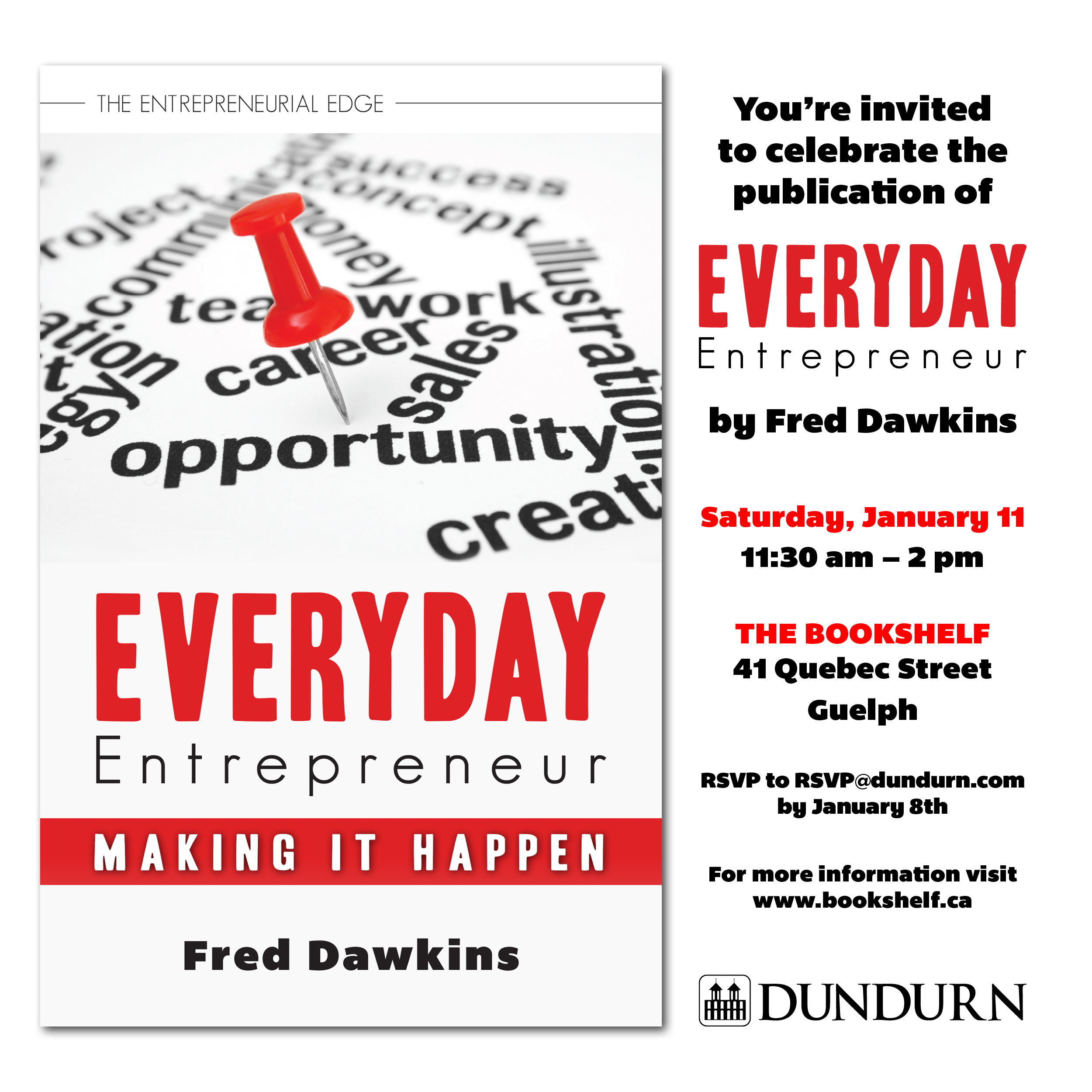
Book one: Everyday Entrepreneur – making it happen
Book two: Family Entrepreneur – easier said than done
Book three: Ageless Entrepreneur – never too early, never too late

Ten Things These Books Will Do For You

1. Get you out of a mental rut and into new opportunities
2. Show you a path to self-determination
3. Increase your earning power
4. Enable you start a business, manage your career or accomplish your bucket list
5. Make you a problem solver
6. Enable you to build teamwork in your business and at home
7. Explain the dynamic of the fast paced global economy we live and work in
8. Prepare you for all of the fundamental issues you will face in a business
9. Provide common sense solutions you can accomplish
10. Inspire you to strike out, create your own brand and control your career

“Fred Dawkins has written a wonderful book about entrepreneurship unlike any other on the market. He brilliantly uses his storytelling skills to illuminate his subject in a way that makes the book a joy to read. You’re so wrapped up in the story that you may not realize how much you’re learning until you’ve turned that last page.”
— TERRY FALLIS, AWARD-WINNING AUTHOR OF THE BEST LAID PLANS AND UP AND DOWN.

“Fred has pulled together a wealth of knowledge and advice crucial to the successful entrepreneur in a highly readable fashion. It is a must-read for aspiring and seasoned entrepreneurs who are facing today’s complex, volatile, and uncertain world. I especially appreciate the emphasis on thinking globally and adapting proactively. We have seen too many examples of yesterday’s winner relying on old models to their detriment. It isn’t easy … but it is exciting and gratifying to create your own business and work to see it flourish. The summary at the end of the book should be bookmarked on every entrepreneur’s computer.”
— Dr. Sherry Cooper, former executive VP and chief economist for BMO
and author of three books, including The New Retirement: How it Will Change Our Future

Utilizing his exemplary storytelling skills, Fred Dawkins has written an excellent book about entrepreneurship in a family setting environment and the many challenges that it places on the entrepreneur and the family
– Jeff Sheehan- author of HIRED! Paths to Employment in the Social Media Era

Similar Posts

  • Globalization, Branding and The Entrepreneur

    The appeal and benefits of pursuing a global economy lie in the theory of comparative advantage whereby global completion will ensure that goods and resources will be allocated in the most efficient way, ensuring the most cost effective production of goods and services to the benefit of all. Yet the more we open ourselves up to globalization the greater becomes the discrepancy in wealth distribution which contradicts the theory. Oh to be sure there is a growing middle class in the highly populated eastern countries like India and China but in effect we are just averaging out the wealth of the poor – improving in the eastern world and declining in the west while those at the top accumulate huge fortunes. Upward mobility  on any kind of scale may be in jeopardy.

    Life should be getting better for all of us. Instead large corporations are controlling the marketing of most products largely through effective branding  which allows them to keep the lion’s share of the benefits of low cost production in the form of huge profits rather than either paying a fair price or passing along the benefits to the end user. At the same time the demand for labour is shrinking in relative terms through technology and mechanization undermining wage structures around the world. These large corporations have abandoned their identity as national firms in favour of becoming global entities. They are routed in a culture of control and increasingly rely on acquisitions and outsourcing to give them the innovation and flexibility needed in a fast paced world economy immersed in rapid change. As long as they can control the market they retain control of the profits.

    So how do we break this system and allow the mass sharing of the efficiencies being gained? The hope lies in entrepreneurs digging in the corners, finding comparative advantages and getting low cost products to market. The problem is that there are barriers to get products to market and if you manage to break through your company soon joins the club bringing in huge profits.  Rather than breaking the system, those that succeed are embracing it. Greed is a powerful motivation in the face of dynamic achievement. So as it stands now entrepreneurial success lies in pursuing startups and selling out or by leapfrogging through this stage and becoming one of the Bigs. Neither of these trends will break the current trend on wealth distribution which is moving back towards the historical norm.

    On a macro level entrepreneurs are the main hope to break the culture of control but there are no guarantees that will happen. On an individual level, pursuing a career as an entrepreneur may be the only ticket to upward mobility. That is why the most important skill anyone can master today is the ability to create and manage their own career. We must all adopt the mindset of the entrepreneur.

  • Entrepreneurs: Lessons from ‘Own the Podium’

    With the Vancouver Olympics on the horizon the Canadian Olympic Committee supported by the Government recognized a need to change the status quo – a need to disrupt the traditional methods and find a way to achieve the winning performances expected from the host country. The situation demanded an entrepreneurial approach based on opportunity and determination. The opportunity was hosting the games – the determination to win existed with the athletes but the momentum to surpass previous achievement came from the Own the Podium program that created an ecosystem promoting pride, confidence and results. It worked – in Vancouver the Canadian team set a record for the most gold medals won at a winter Olympics and collected more total medals than they had ever won in a single Olympics. The key was creating a culture that nurtured success and established that success as a new normal, an expectation. In the simplest terms a philosophy or mindset focused on making things happen- the essence of being entrepreneurial.

    On an individual basis this program is a great example of breaking free of prison thinking and letting your determination take you through to success. But Own the Podium is far more significant than that. It is a great example of the collective creating the support system that produces individual success to the benefit of the entire country. We must do the same in the business world. Did you know that over 350,000 Canadians live and work in Silicon Valley? Why? Because the Valley offers the most highly developed tech ecosystem the world has ever seen. Do you also know that there is a worldwide competition for talent going on? Governments around the world are building programs to attract entrepreneurs to their countries. Canada has already introduced a fast track system to provide visas and a path to citizenship for entrepreneurs/innovators who can attract venture capital investment from Canadians. However if we can just keep our best and most brilliant home we can do well in this talent war and improve our prospects and results. We need to Own the Podium in tech development and in entrepreneurship.

    We have a good start with programs like MaRS , Communitech and The Creative Destruction Lab at the Rotman School but we need the collective will and the support of government to build an ecosystem that is second to none and that brings out the very best from the natural ability that exists here. If one per cent of our total population representing a much higher percentage of our intellectual capital are living in California than we have the tools here but we are both losing them and underutilizing them. More or less like our Olympic performance prior to Vancouver. If we can do it in sport we can do it in business.


  • Everyone Needs to Think Like an Entrepreneur!

    The more I write and speak about entrepreneurship the more I realize how mainstream the topic has become. Whether you know it or not you and everyone else has to become more entrepreneurial in their thinking. We live in a fast paced global society that requires all of us to be resilient and adaptable. Those are the critical attributes that make us entrepreneurial. Entrepreneurship applies to far more than business and business issues. We are talking about a mindset not a skillset. A mindset focused on solving problems. A mindset grounded in determination to make things happen. It’s about being proactive not reactive. Most important it is about self-determination!

    In an extremely competitive global world, in the era of Big Data, we can never know enough and we will never understand much of what we know. We cannot have the answers but the answers will always be there for us to find. There is no time for prison thinking. If you think like an entrepreneur you will find the way and that’s just as true about your personal life as it is about your career. As for that part of your life, in the face of declining job stability and the entrenchment of wealth disparity, the most important skill you can learn today is the ability to create and manage your career. There is a very good reason that every college, every university and now even secondary schools are offering courses in entrepreneurship.

    When I wrote my first book Everyday Entrepreneur I had the ambitious goal of doing for entrepreneurship what David Chilton did for financial planning with The Wealthy Barber – to write a book that applied to all of us in a form that everyone could read understand and enjoy. The jury is still out but the endorsements received are encouraging that I have come close. The second book in my entrepreneurial series Family Entrepreneur comes out later this month. Dealing with the dichotomy of family and business brings entrepreneurial thinking into both settings. Remember family was the first “crowd” and still offers funding and nurturing for many entrepreneurs in a startup situation.

    I am extremely grateful for the opportunity to mentor and encourage would be entrepreneurs both in their business and private lives. It is really all about taking charge of your life in the midst of a roller coaster world. You have to learn to capitalize and enjoy the highs while defending against the lows. Entrepreneurial thinking is the tool to do it.

    Fred Dawkins is a serial entrepreneur who is best known as one of the co-founders of the olde Hide House in Acton Ontario to which “it’s worth the drive”. He is a partner in The Creative Destruction Lab at the Rotman School of Management at the University of Toronto and is currently writing a series of books entitled The Entrepreneurial Edge published by Dundurn Press, which focuses on encouraging and preparing would be entrepreneurs for challenges in their careers and in their private lives.

  • Today’s Graduate and Entrepreneurship

    You are educated. Now what? The most important skill you can add today is the ability to create and manage your career. On the surface this is not the best time to graduate. The cost of education is very high, bringing student debt to record levels. Job stability is in decline. The distribution of wealth is skewed in favour of those at the top. Upward mobility is in jeopardy. The rate of change is increasing. All this means that your future is dependent on self-determination grounded in awareness of the world in which you live. In this environment, you are your own brand and must plan on reinventing yourself throughout your work life. Start engaging in entrepreneurial thinking right at the outset of your career. Whether you start a business, become a solopreneur, work in a large entity or engage in social entrepreneurship, you have to become adaptable and resilient in a world dominated by change. Entrepreneurial thinking is about a mindset not a skillset. Success is about finding a way not knowing the way. In the era of Big Data this is essential. We will never know enough or understand enough of what we know. So abandon prison thinking and get started.

    Five ideas to reject:

    1. Education guarantees you a future. Sorry you don’t have it made: education never ceases and formal education just gives you more opportunities. There are no guarantees
    2. There are no jobs for graduates. There are barriers to entering the work force which are as insurmountable as we allow them to be. Resilience and adaptability start now.
    3. Government will solve the employment problem. Would you really choose government as your advocate to solve any problem?
    4. There is no future within small business. Life expectancy of all businesses is in decline. Strategic management of your career takes you where you can gain the most now!
    5. Millenials don’t make good hires. Maybe you place a higher value on social media contact and demand access during the day but technology is your ally making you more productive than older generations.

    Ten Reasons for Confidence:

    1. Technology, your ally, has lowered the cost of administration through the integration of many management tasks. A one pound portable laptop allows anyone to incorporate their accounting system, sales marketing network, all communication, research, collections and payments not to mentions a wide variety of personal needs. Add in mobility via a smartphone and you are always accessible and connected. You have the potential to do it all, as a disruptor within a large corporation or government agency or as an independent.
    2. Big Data is generating new problems at record rates. Every problem is an opportunity.
    3. Social networking, another ally, has increased the reach of individuals allowing market access on a much broader geographic scope. Services can be offered at great distance. Endorsements can be sought and received across the country or even worldwide. Credibility can be built quickly through performance. LinkedIn is a great tool to market your skills and pursue your career strategy.
    4. Websites can be both affordable and first class allowing an individual to build a professional image. Employee and entrepreneur alike can build their brand and market themselves.
    5. Outsourcing is an established practice by which governments and large corporations are achieving flexibility which rewards specialization right down to the individual level. Businesses may only want you part time so find several of them and keep them happy.
    6. Acquisition is a principal way for large entities to find innovation making startups, often founded on youth and enthusiasm a great opportunity if you can join the right team.
    7. Succession is a huge issue for hundreds and thousands of viable independent businesses in North America as the baby boom generation hits retirement depending on their business to fund their future. You can find a mentor leading you to acquire your own business through an earn out that funds his or her retirement.
    8. Size is simply becoming a liability – there are many small viable market niches that large companies and foreign sourcing will never fill. Adaptability, resilience and flexibility are essential in a world dominated by change.
    9. Opportunity is nowhere, opportunity is everywhere. Recognizing opportunity is the cornerstone of success in every aspect of your career.
    10. Determination was the key to graduating. It is also the key to managing your career.

    Starting your career is the first of many problems ahead. Every problem provides an opportunity. The solution to a successful career lies within your ability to create your own brand.

    Fred Dawkins is a serial entrepreneur with over 40 years’ experience and achievements in manufacturing, retail, land development, consulting and import/export. He holds a B Com in commerce and finance and a M.A. in economics from the University of Toronto. His business has allowed him to travel extensively, giving him insight into the emerging global economy and making him a passionate advocate of entrepreneurship in the 21st century.
    Everyday Entrepreneur [Dundurn Press] is the first book in Dawkins’ Entrepreneurial Edge series, and is currently available at all booksellers, including Amazon.com, Amazon.ca, Barnes & Noble and Chapters Indigo. His novel, 2020 Hindsight, explores major contradictory trends in society in a compelling contemporary fiction narrative, and is forthcoming as an e-book on Amazon.com.
    Website: https://fcdawkins.com/

  • 3 Signs Your Startup May Be Slipping

    Originally posted by Emily Barnes, The Creative Destruction Lab The Rotman School of Management, University of Toronto

    Businesses large and small can find it tough to spare a few moments to step back and look at the big picture. But immersed in the little details surrounding new product features and releases, you can easily miss a few telltale signs your startup is starting to spiral.

    Luckily, Fred Dawkins has done the legwork for you. Partner of the Creative Destruction Lab, serial entrepreneur and founder of The Old Hide House, Dawkins has turned his past experiences into a series of books about entrepreneurship, the first of which is Everyday Entrepreneur. He recently hosted a number of workshops in partnership with the Lab, touching on everything from the misconceptions of entrepreneurship, to the day-to-day trials and tribulations of an entrepreneur, to the increasingly important role of small business in the global economy and all that’s in between.

    If you can’t spare the few minutes to check in on that big picture, Dawkins asks that you at least watch for these three signs that your startup is on the out.

    YOUR STARTUP BECOMES YOUR LIFE.

    Undoubtedly, there’ll be an imbalance. There’s no denying that you’ll have to work long hours – especially in the startup phase and when you run into times of hardship.  Your social life will at times suffer, as will your relationships. But this anguish shouldn’t be a constant.

    This may seem erroneous if you’re in the early stage of running a business. Timing is everything, and if you launch too late – especially in tech – it can make or break your success. It’s a bit of a catch-22. But unless you’re an anomaly, if you’re working an innumerous amount of hours, you’re doing something wrong. It’s symptomatic, and signals a discord elsewhere in your business. How strong is your team? Are you delegating?

    Despite much popular literature that speaks to the contrary, you truly can maintain work-life balance as an entrepreneur.  Recharging your batteries is critical. Have your hobbies and have your venture. Sometimes the two will overlap. Even then, you must create that separation. When you lose sight of work-life balance, you also risk impairing your business’ vision. It’s important to step away from your company, if only for a few hours.

    CASH FLOW – IT NEVER LIES!

    If you’re going to be successful, you’ll first need to know and understand your numbers. Metrics aside, look to cash flow. It’s right on your doorstep. Omnipresent, it serves as the perfect warning mechanism. If you’re running low on cash, you’re doing something wrong.

    Too often, startups seem to bolt at the first sign of cash flow struggles, looking to investment for relief. Granted, it’s a quick and relatively easy fix (provided you can offer up a good pitch), but too many run into the open arms of deals that offer marginal amounts of cash for large chunks of equity.  It’s easy enough to relinquish control of your business because you have to – to bring in a partner or some easy money. But don’t make rash decisions without properly considering the long-term consequences. Do the math. Beware of commitments that’ll eat up your profits. Brick and mortar businesses tackle high overhead, hardware startups combat production costs, and SAAS businesses at first operate virtually cost-free. Remind yourself of this. In a startup press bubble that’s dominated by one funding announcement after another, it’s all too easy to start asking for money. Don’t forget about sales, the good ol’ fashioned revenue stream.

    There’s a lot to be said for natural growth and learning to manage within your means. Bootstrapping isn’t a requirement so much as an opt-in measure of control.

    YOU, THE FOUNDER, ARE THE BEST PERSON ON YOUR TEAM.

    Things are different when you transition from project to business. Parameters change, and your skillsets need to adapt along with them. But few people have the knowledge or experience necessary to carry an idea through to company, then onto global success. Don’t be afraid to hire people who know more than you do in specific areas.

    You’ll be tempted to keep a short leash on success, and find it difficult to relinquish control of even the most minor of tasks. Don’t impede success for the sake of ego. Sometimes you’ll need to let go of responsibility, and sometimes that also means you’ll need to cut off a slice of the equity pie. Your ego will take a hit, and your percentage of future earnings will too, but you’ll mend and the pie may just get bigger.

    Recognize your deficiencies. You can’t always keep pace with your company, or grow at the same rate it does – not everyone is that malleable. Hire those whose skillsets can compensate for the holes in your own. You are not your company and at some point your interests may diverge, so have an end game.

  • An Important Canadian Initiative – Rotman’s CD Lab

    Did you know that more than 350,000 Canadians live and work in Silicon Valley. That’s right more than one percent of our population and a much higher portion of our intellectual capital have left us for the world’s most prestigious and most productive ecosystem. This is both a problem and an opportunity but not one that government can solve or even try to solve. So how do we stem the tide?

    It’s not a quick fix. When we are producing world class talent they are inevitably attracted to the epicentre of success, achievement but most of all opportunity. It is the opportunity that we need to focus on. The Creative Destruction Lab does that. It creates opportunity here in Canada. The leader Professor Ajay Agrawal is a dynamo. He is the living evidence that entrepreneurship can be taught, an academic with the drive and mindset that can match anyone in the business community. The stated goal of the Lab is to generate equity – specifically to create $ 1 billion in equity in the first ten years. After the first two years approximately $ 130 million has been achieved. However the real goal is to keep the best and most brilliant we produce here in Canada, helping to build our own world class ecosystem and offering a valuable example to others that “Canada’s Got Talent” and I don’t mean the variety acts we see on the American TV show.

    Ventures receive the very best of mentorship. It is amazing to see how they evolve in less than one year. Watch for results – they have already started but many more will follow in the years to come

Leave a Reply