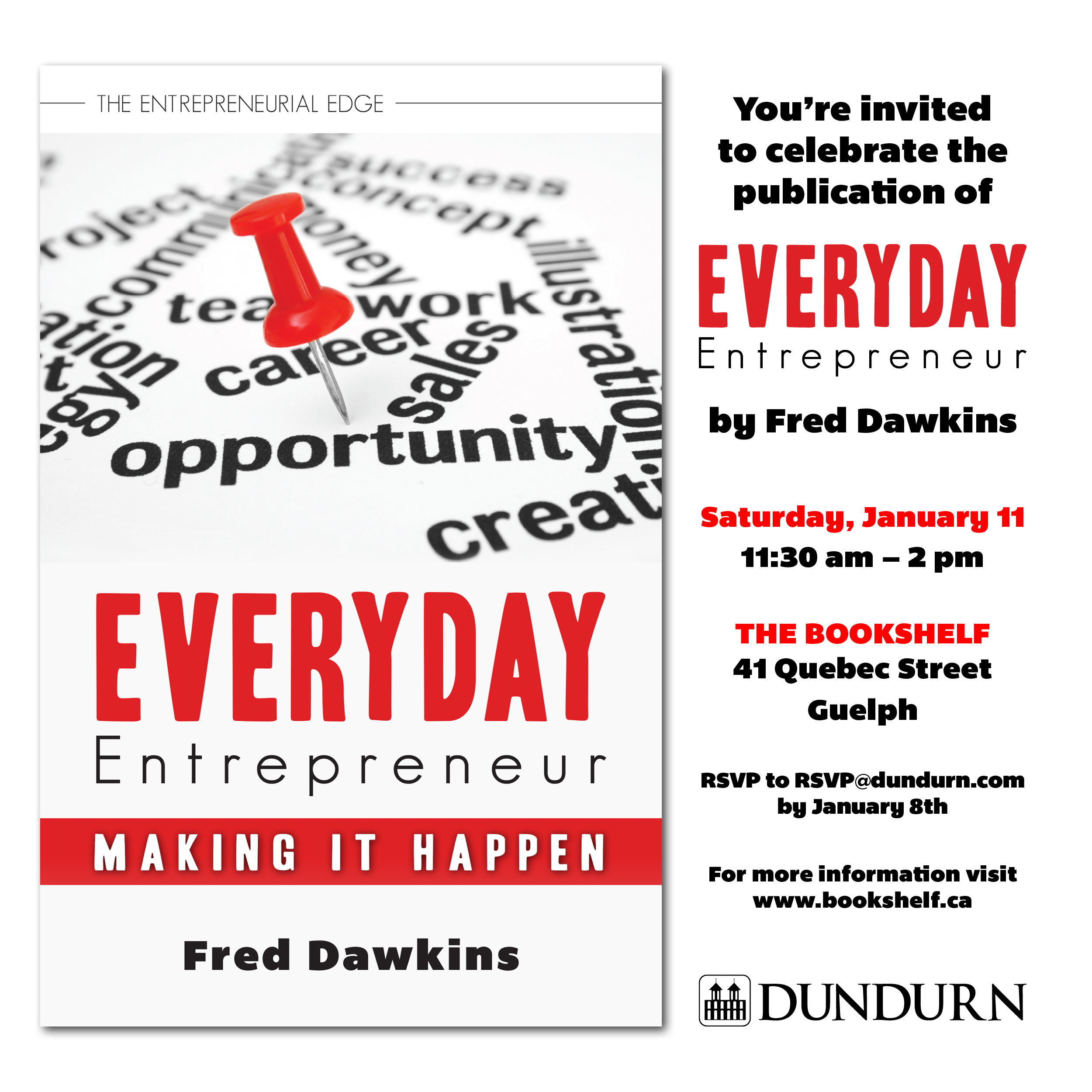
Invitation to Book Signing in Guelph on Saturday, January 11, 2014
Indisputable: We live in a global work space – an economy where timing is everything and competition comes from every which direction, blindsiding us, especially where Tech is concerned. There is tremendous pressure to be first out to fill a market niche and tremendous pressure on innovators around the world to become instant entrepreneurs OR to give up the lion’s share of the economic benefit of their innovation to others who can get them to market in a hurry.
If there is a lesson from the Blackberry debacle it’s that being first gives you a head start but the pack quickly turns to finding ways to do it different and better. There is no time to rest on your laurels. Your advantage is short lived- even much less than ten years ago when Blackberry was first riding high.
Are the expectations of the market achievable or are we simply seeing a new reality where companies come and go with a greatly reduced life expectancy. Apple did fail once. How much longer will it stay at the top this time?
When you visit an incubator/accelerator you will often see tired young people committed to a 24/7 work ethic, working in small space shared with other start-ups focused on perfecting their innovation with little understanding of the fundamentals required to operate a business or build a foundation for a company that can last. Did Blackberry ever establish that foundation? After all it was always in a dynamic state of rapid change initially positive but for the past three years negative.
Can humans really continue to cope with the rate of change that technology allows? Are we being forced to abandon stability in favour of short term success? Overall we find ourselves in an integrated global economy, still wrestling with the ongoing effects of the Great Recession, managed by leaders who are challenged at best, incompetent at worst, where the only sure thing is uncertainty.
For all of these reasons becoming an entrepreneur is an important option. The economic world will place increasing value on resilience and adaptability. In the face of instability and uncertainty the most important skill we may develop will be the ability to create our own job. Big will not be better. Small and flexible will become the key to individual success.
Fellow Entrepreneurs listen up! I read almost a book a day and rarely do I fall this deeply in love with the entire book. A delightful exception to that rule has been Everyday Entrepreneur. Fred Dawkins has a simplicity that is accessible by entrepreneurs at every level, including those who are paving new ways within organizations, not just those of us out in the business wilderness. If you want a fast read that you’ll be able to convert into massive action that will undoubtedly improve the way you do business then drop everything and read this book.
Sherri J Griffin
20 Year Training & Development Professional
“`The most important skill in the 21st century will be the ability to create your own job.” Fred Dawkins Author of Everyday Entrepreneur – my favorite new book – a quick read with all the common sense through the stories of people whose experiences ring so true to life. I suggest all students and young engineers I have worked with pick up a copy! You won`t be sorry!”
Maryam Latifpoor-Keparoutis
Senior Development Manager
College of Physical & Engineering Science (CPES)
University of Guelph
The more I write and speak about entrepreneurship the more I realize how mainstream the topic has become. Whether you know it or not you and everyone else has to become more entrepreneurial in their thinking. We live in a fast paced global society that requires all of us to be resilient and adaptable. Those are the critical attributes that make us entrepreneurial. Entrepreneurship applies to far more than business and business issues. We are talking about a mindset not a skillset. A mindset focused on solving problems. A mindset grounded in determination to make things happen. It’s about being proactive not reactive. Most important it is about self-determination!
In an extremely competitive global world, in the era of Big Data, we can never know enough and we will never understand much of what we know. We cannot have the answers but the answers will always be there for us to find. There is no time for prison thinking. If you think like an entrepreneur you will find the way and that’s just as true about your personal life as it is about your career. As for that part of your life, in the face of declining job stability and the entrenchment of wealth disparity, the most important skill you can learn today is the ability to create and manage your career. There is a very good reason that every college, every university and now even secondary schools are offering courses in entrepreneurship.
When I wrote my first book Everyday Entrepreneur I had the ambitious goal of doing for entrepreneurship what David Chilton did for financial planning with The Wealthy Barber – to write a book that applied to all of us in a form that everyone could read understand and enjoy. The jury is still out but the endorsements received are encouraging that I have come close. The second book in my entrepreneurial series Family Entrepreneur comes out later this month. Dealing with the dichotomy of family and business brings entrepreneurial thinking into both settings. Remember family was the first “crowd” and still offers funding and nurturing for many entrepreneurs in a startup situation.
I am extremely grateful for the opportunity to mentor and encourage would be entrepreneurs both in their business and private lives. It is really all about taking charge of your life in the midst of a roller coaster world. You have to learn to capitalize and enjoy the highs while defending against the lows. Entrepreneurial thinking is the tool to do it.
Fred Dawkins is a serial entrepreneur who is best known as one of the co-founders of the olde Hide House in Acton Ontario to which “it’s worth the drive”. He is a partner in The Creative Destruction Lab at the Rotman School of Management at the University of Toronto and is currently writing a series of books entitled The Entrepreneurial Edge published by Dundurn Press, which focuses on encouraging and preparing would be entrepreneurs for challenges in their careers and in their private lives.
Originally posted by Emily Barnes, The Creative Destruction Lab The Rotman School of Management, University of Toronto
Businesses large and small can find it tough to spare a few moments to step back and look at the big picture. But immersed in the little details surrounding new product features and releases, you can easily miss a few telltale signs your startup is starting to spiral.
Luckily, Fred Dawkins has done the legwork for you. Partner of the Creative Destruction Lab, serial entrepreneur and founder of The Old Hide House, Dawkins has turned his past experiences into a series of books about entrepreneurship, the first of which is Everyday Entrepreneur. He recently hosted a number of workshops in partnership with the Lab, touching on everything from the misconceptions of entrepreneurship, to the day-to-day trials and tribulations of an entrepreneur, to the increasingly important role of small business in the global economy and all that’s in between.
If you can’t spare the few minutes to check in on that big picture, Dawkins asks that you at least watch for these three signs that your startup is on the out.
YOUR STARTUP BECOMES YOUR LIFE.
Undoubtedly, there’ll be an imbalance. There’s no denying that you’ll have to work long hours – especially in the startup phase and when you run into times of hardship. Your social life will at times suffer, as will your relationships. But this anguish shouldn’t be a constant.
This may seem erroneous if you’re in the early stage of running a business. Timing is everything, and if you launch too late – especially in tech – it can make or break your success. It’s a bit of a catch-22. But unless you’re an anomaly, if you’re working an innumerous amount of hours, you’re doing something wrong. It’s symptomatic, and signals a discord elsewhere in your business. How strong is your team? Are you delegating?
Despite much popular literature that speaks to the contrary, you truly can maintain work-life balance as an entrepreneur. Recharging your batteries is critical. Have your hobbies and have your venture. Sometimes the two will overlap. Even then, you must create that separation. When you lose sight of work-life balance, you also risk impairing your business’ vision. It’s important to step away from your company, if only for a few hours.
CASH FLOW – IT NEVER LIES!
If you’re going to be successful, you’ll first need to know and understand your numbers. Metrics aside, look to cash flow. It’s right on your doorstep. Omnipresent, it serves as the perfect warning mechanism. If you’re running low on cash, you’re doing something wrong.
Too often, startups seem to bolt at the first sign of cash flow struggles, looking to investment for relief. Granted, it’s a quick and relatively easy fix (provided you can offer up a good pitch), but too many run into the open arms of deals that offer marginal amounts of cash for large chunks of equity. It’s easy enough to relinquish control of your business because you have to – to bring in a partner or some easy money. But don’t make rash decisions without properly considering the long-term consequences. Do the math. Beware of commitments that’ll eat up your profits. Brick and mortar businesses tackle high overhead, hardware startups combat production costs, and SAAS businesses at first operate virtually cost-free. Remind yourself of this. In a startup press bubble that’s dominated by one funding announcement after another, it’s all too easy to start asking for money. Don’t forget about sales, the good ol’ fashioned revenue stream.
There’s a lot to be said for natural growth and learning to manage within your means. Bootstrapping isn’t a requirement so much as an opt-in measure of control.
YOU, THE FOUNDER, ARE THE BEST PERSON ON YOUR TEAM.
Things are different when you transition from project to business. Parameters change, and your skillsets need to adapt along with them. But few people have the knowledge or experience necessary to carry an idea through to company, then onto global success. Don’t be afraid to hire people who know more than you do in specific areas.
You’ll be tempted to keep a short leash on success, and find it difficult to relinquish control of even the most minor of tasks. Don’t impede success for the sake of ego. Sometimes you’ll need to let go of responsibility, and sometimes that also means you’ll need to cut off a slice of the equity pie. Your ego will take a hit, and your percentage of future earnings will too, but you’ll mend and the pie may just get bigger.
Recognize your deficiencies. You can’t always keep pace with your company, or grow at the same rate it does – not everyone is that malleable. Hire those whose skillsets can compensate for the holes in your own. You are not your company and at some point your interests may diverge, so have an end game.

Entrepreneurship rests firmly on opportunity. But in the face of a rapidly changing global economy there is an overwhelming increase in entrepreneurship of necessity. Seniors need to extend their careers. Youth are struggling to launch theirs. Women are looking for flexibility to meet a combination of career and family needs. Individuals around the world are seeking freedom of opportunity. At the same time Big Business is pursuing profits around the world undermining the stability of employment markets. There is widespread decline in loyalty between employers and employees. Structural unemployment is a demoralizing prospect. One need only look to Detroit to see the impact.
The result? The most valued skill in the 21st Century may well be the ability to create your own job. Job creation rests clearly on individuals -first for themselves and then for others. It reflects the difference between Localization versus Globalization – small scale entrepreneurs find their opportunities locally creating jobs in areas that Big Business has abandoned for offshore savings. To compound this the fast paced rate of change driven by technology favours small flexible and adaptable businesses that adjust to changing circumstances. Large companies find their growth through acquisition not startups.
Around the world governments are finally recognizing the importance of entrepreneurs. Fortunately there is a great deal of talent that is suppressed and can be unleashed, whether through culture, education, gender , race, funding or other limitations. It will be up to government to remove the shackles Entrepreneurship has been the driving force behind the economic dominance of the Western world. It is the economic resource that puts other resources to work. Our economic future is moving to the hands of those who are driven to make things happen.
Most of what the average person reads about entrepreneurship sustains the mystique. We revere the outstanding successes achieved by extreme entrepreneurs — everyone from Edison to Jobs. Yet, reading about these giants colors our perception of entrepreneurship. We admire their achievements but consider them beyond reach. Their stories often sustain misleading myths about entrepreneurship that keep capable people from embracing an entrepreneurial career. People begin to believe that to travel down the entrepreneurial path, a person must be born with a particular mindset, take reckless risks to achieve high rewards, work all day, everyday and must fail to succeed. Don’t let these misconceptions scare you off.
Entrepreneurship can be taught, it should be taught and it is being taught.
After 50 years of a flawed model focused on churning out executives for large corporations, colleges and universities have turned their attention to promoting and encouraging entrepreneurship. These schools are focusing on teaching the entrepreneurial lifestyle; one focused on both the mindset and the skillset required to become an entrepreneur.
Entrepreneurship is not about the risk you take, but the results that you achieve
It’s a startling paradox. Too many good opportunities die prematurely because so many potential entrepreneurs are risk averse. At the same time businesses are failing because of absurd risks fostered by the idea that being an entrepreneur is nothing more than a gamble. Entrepreneurs succeed through determination not by taking unwarranted risk. Managing risk as you embrace it is critical. Not all ideas are opportunities and every opportunity is not viable. Managed risk is inherent in the lean startup focused on getting valuable feedback from potential end users before jumping into full scale operation.
Entrepreneurs need to find work/life balance and will have regrets if they don’t.
Having a strong work ethic and being willing to put in extended days when required is critical. During your startup phase and later when you encounter bumps in the road you will work long hours with great satisfaction. But as things progress you need to find balance by building your team, easing control and empowering your staff. You must recharge your batteries. Never forget: You are your most valuable human resource. Without balance your performance will suffer, your business will be restrained and your personal life will be sacrificed unnecessarily.
Failure is not essential. Entrepreneurs manage their risk and avoid failure.
Describing failure as an essential part of success is rationalization but many entrepreneurs are motivated by the fear of failure more than the rewards of success. Failure only happens when we either quit or are forced to give up. Mistakes are part of the learning curve. We do learn from them because we take the time to analyze them. Success is elating and it masks our faults. Continually improve by understanding what you do right and correcting what you do wrong in good times and in bad. If you do experience failure you can and will bounce back, many have.
Being an entrepreneur is within your reach.
You can become a problem solver who is determined to find a way to make things happen? Understand: we can’t all be innovators but for every innovation there will be thousands of entrepreneurs finding applications that solve everyday problems producing jobs and independence. Being first is over rated. Doing things better and different often brings greater opportunity
Believe in your own ability.
You can establish the mindset of an entrepreneur by eliminating the word ‘can’t’ from your vocabulary. You can approach problems by skipping right over the question “if” it can be solved and skip directly to the question “how” it will be solved. You can find opportunity and you can analyze to make sure that opportunity is viable. All of this can be done within the context of the traditional economy and you don’t have to be a tech genius to do it. Technology is not a threat but offers a great tool for you to use. We are entering a new era of entrepreneurship, which means it is an option for almost anyone. If you can’t carry the full weight of your own business bring entrepreneurial thinking to managing your career and performing your role as an employee. You won’t regret it.
No products in the cart.