Entrepreneurs Wanted

Entrepreneurship rests firmly on opportunity. But in the face of a rapidly changing global economy there is an overwhelming increase in entrepreneurship of necessity. Seniors need to extend their careers. Youth are struggling to launch theirs. Women are looking for flexibility to meet a combination of career and family needs. Individuals around the world are seeking freedom of opportunity. At the same time Big Business is pursuing profits around the world undermining the stability of employment markets. There is widespread decline in loyalty between employers and employees. Structural unemployment is a demoralizing prospect. One need only look to Detroit to see the impact.

The result? The most valued skill in the 21st Century may well be the ability to create your own job. Job creation rests clearly on individuals -first for themselves and then for others. It reflects the difference between Localization versus Globalization – small scale entrepreneurs find their opportunities locally creating jobs in areas that Big Business has abandoned for offshore savings. To compound this the fast paced rate of change driven by technology favours small flexible and adaptable businesses that adjust to changing circumstances. Large companies find their growth through acquisition not startups.

Around the world governments are finally recognizing the importance of entrepreneurs. Fortunately there is a great deal of talent that is suppressed and can be unleashed, whether through culture, education, gender , race, funding or other limitations. It will be up to government to remove the shackles Entrepreneurship has been the driving force behind the economic dominance of the Western world. It is the economic resource that puts other resources to work. Our economic future is moving to the hands of those who are driven to make things happen.
 

Similar Posts

  • Today’s Graduate and Entrepreneurship

    You are educated. Now what? The most important skill you can add today is the ability to create and manage your career. On the surface this is not the best time to graduate. The cost of education is very high, bringing student debt to record levels. Job stability is in decline. The distribution of wealth is skewed in favour of those at the top. Upward mobility is in jeopardy. The rate of change is increasing. All this means that your future is dependent on self-determination grounded in awareness of the world in which you live. In this environment, you are your own brand and must plan on reinventing yourself throughout your work life. Start engaging in entrepreneurial thinking right at the outset of your career. Whether you start a business, become a solopreneur, work in a large entity or engage in social entrepreneurship, you have to become adaptable and resilient in a world dominated by change. Entrepreneurial thinking is about a mindset not a skillset. Success is about finding a way not knowing the way. In the era of Big Data this is essential. We will never know enough or understand enough of what we know. So abandon prison thinking and get started.

    Five ideas to reject:

    1. Education guarantees you a future. Sorry you don’t have it made: education never ceases and formal education just gives you more opportunities. There are no guarantees
    2. There are no jobs for graduates. There are barriers to entering the work force which are as insurmountable as we allow them to be. Resilience and adaptability start now.
    3. Government will solve the employment problem. Would you really choose government as your advocate to solve any problem?
    4. There is no future within small business. Life expectancy of all businesses is in decline. Strategic management of your career takes you where you can gain the most now!
    5. Millenials don’t make good hires. Maybe you place a higher value on social media contact and demand access during the day but technology is your ally making you more productive than older generations.

    Ten Reasons for Confidence:

    1. Technology, your ally, has lowered the cost of administration through the integration of many management tasks. A one pound portable laptop allows anyone to incorporate their accounting system, sales marketing network, all communication, research, collections and payments not to mentions a wide variety of personal needs. Add in mobility via a smartphone and you are always accessible and connected. You have the potential to do it all, as a disruptor within a large corporation or government agency or as an independent.
    2. Big Data is generating new problems at record rates. Every problem is an opportunity.
    3. Social networking, another ally, has increased the reach of individuals allowing market access on a much broader geographic scope. Services can be offered at great distance. Endorsements can be sought and received across the country or even worldwide. Credibility can be built quickly through performance. LinkedIn is a great tool to market your skills and pursue your career strategy.
    4. Websites can be both affordable and first class allowing an individual to build a professional image. Employee and entrepreneur alike can build their brand and market themselves.
    5. Outsourcing is an established practice by which governments and large corporations are achieving flexibility which rewards specialization right down to the individual level. Businesses may only want you part time so find several of them and keep them happy.
    6. Acquisition is a principal way for large entities to find innovation making startups, often founded on youth and enthusiasm a great opportunity if you can join the right team.
    7. Succession is a huge issue for hundreds and thousands of viable independent businesses in North America as the baby boom generation hits retirement depending on their business to fund their future. You can find a mentor leading you to acquire your own business through an earn out that funds his or her retirement.
    8. Size is simply becoming a liability – there are many small viable market niches that large companies and foreign sourcing will never fill. Adaptability, resilience and flexibility are essential in a world dominated by change.
    9. Opportunity is nowhere, opportunity is everywhere. Recognizing opportunity is the cornerstone of success in every aspect of your career.
    10. Determination was the key to graduating. It is also the key to managing your career.

    Starting your career is the first of many problems ahead. Every problem provides an opportunity. The solution to a successful career lies within your ability to create your own brand.

    Fred Dawkins is a serial entrepreneur with over 40 years’ experience and achievements in manufacturing, retail, land development, consulting and import/export. He holds a B Com in commerce and finance and a M.A. in economics from the University of Toronto. His business has allowed him to travel extensively, giving him insight into the emerging global economy and making him a passionate advocate of entrepreneurship in the 21st century.
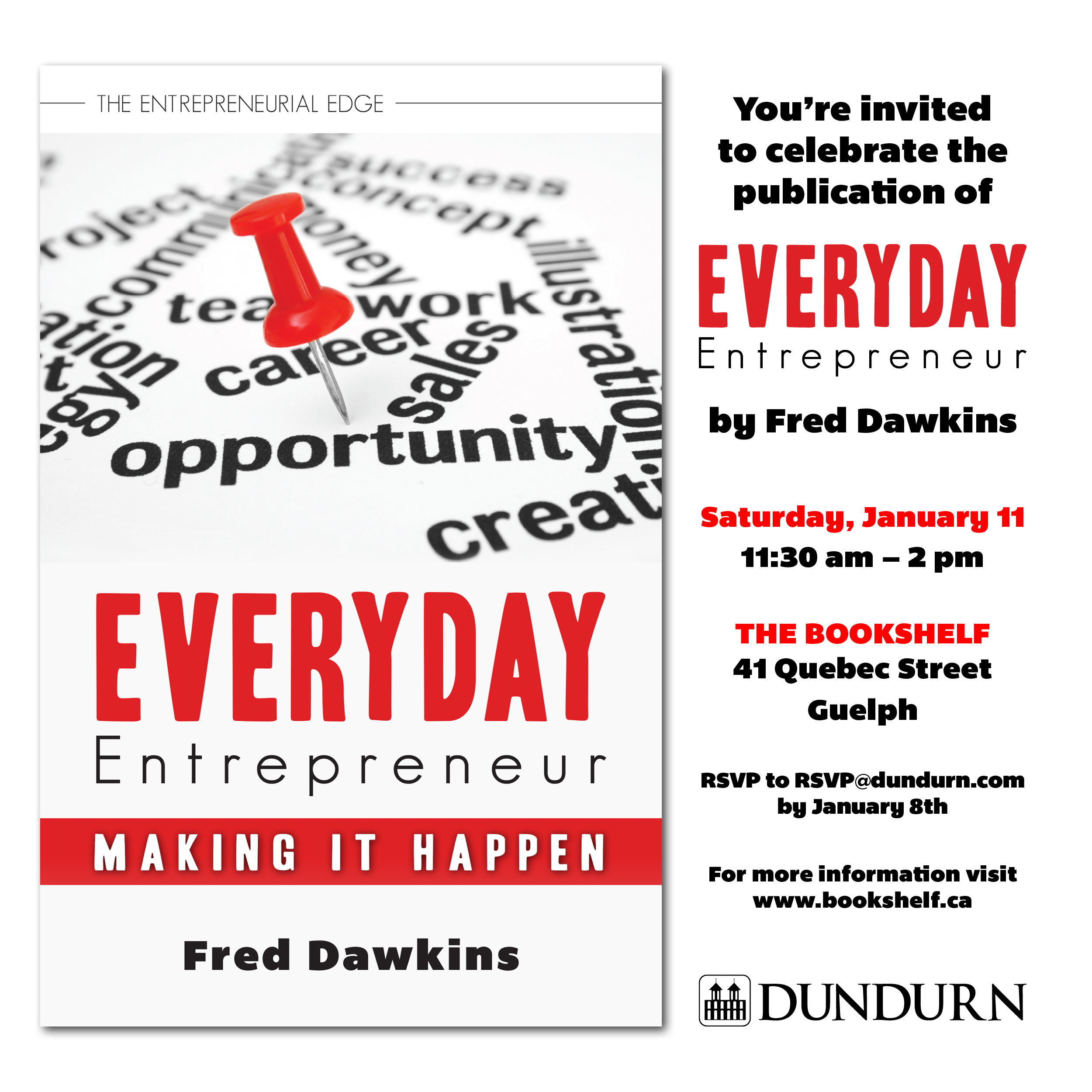
    Everyday Entrepreneur [Dundurn Press] is the first book in Dawkins’ Entrepreneurial Edge series, and is currently available at all booksellers, including Amazon.com, Amazon.ca, Barnes & Noble and Chapters Indigo. His novel, 2020 Hindsight, explores major contradictory trends in society in a compelling contemporary fiction narrative, and is forthcoming as an e-book on Amazon.com.
    Website: https://fcdawkins.com/

  • A New Era of Entrepreneurship

    Whatever happened to the optimum size of the firm? You know the size at which the company was it’s most efficient? most productive” most manageable? Economies of scale did dictate making the firm larger UNTIL the company hit the law of diminishing returns meaning the optimum size had just been passed. It seems that somewhere along the line it was decided that the best way to compete in an evolving global economy was to keep getting bigger regardless of inefficiency and loss of control. Ironic isn’t it. Free enterprise following the example of bureaucratic Big Government. Build behemoths. If you get big enough there’s no way to get rid of you. But how? Well in order to make this happen create a wage pyramid so that those at the top who have very little idea what’s going on below them make outrageous salaries well beyond any possible contribution they can make to the organization. Sound good so far?

    But what happens if things really do get negative? Don’t worry as long as you get big enough your cousin Big Government will have to bail you out. If small companies or individuals get hurt in the process they’re, well, collateral damage, just not as important as Big Business is to the world-expendable. This approach is pretty much out of touch with reality. Businesses do not last forever. Just look at the original list of the Fortune 500 to see how many have survived. In this era of 24/7 hyper-connectivity manifested in an ever increasing rate of change their life expectancy is going down. Size does matter but it’s becoming “Too Big to Survive”. Flexibility and Adaptability are the essential traits of business today. Social media is critical to deal with this new fast paced reality. The real watch words should be “Too Small to Fail”.  Entrepreneurs focused on opportunity, flexible enough to change quickly,, in touch with their business and all the key players are designed for the current environment.

    Technology has opened up communication around the world making global business possible for small well lead companies who can gravitate to that desirable optimum size. For Big Business more independent divisions under a corporate umbrella, sized properly, will help but the era of domination by huge entities will weaken. Careers with one organization have already disappeared. We are a society of individuals. The most important skill for an individual will be the ability to create your own job. We are entering a New Age of Entrepreneurism.

  • A New Year: Time to Consider Entrepreneurship

    Every New Year is a time for reflection – a time to review the past and a time to predict the future – a time  for assessment and a gateway to change. For many career change is the most important possibility to consider. Job stability is evaporating before our eyes. Inequity in the distribution of wealth in the western world  is returning to historical norms after a century of a growing and healthy middle class. So maybe this really is the time to consider becoming an entrepreneur.

    Entrepreneurship has become a hot topic and it should be. Why? Well here are a few reasons to consider. Globalization is great for consumption, not so wonderful for non-competitive labour in developed countries especially North America. Technology has accelerated the rate of change inherent in globalization making change itself the one constant we can expect in our economic future. Rigidity, structure and the status quo are the antithesis of change. We must constantly engage in a process of creative destruction, tearing down the old to renew with new and different products and approaches. The lifespan of the status quo is already much shorter as the rate of change accelerates. Stability in one’s life will depend on resilience and adaptability.

    The ability to create and manage your own career will be the most important skill you can learn.

    We are well into a New Era of Entrepreneurship. Governments have recognized this and the battle for talent is underway. Universities and Colleges around the world are introducing programs searching for the best ways to define and teach entrepreneurship. Is it economics? Is it business? Is it philosophy? Can it be taught? Must it be experienced? Everyone is searching for the formula to produce disruptors. Why? We need them to help bring about change at every level: To dig into the corners and find all the advantages that exist by opening up the global economy; To dig in the corners and create jobs in the face of comparative disadvantages because they are problem solvers and will invest locally when Big Business will run away; To challenge the status quo to bring about changes in the behemoths we call international corporations and Government. Society needs disruptors so that creates opportunity.

    But that’s not the reason to become one. Here are some personal reasons to take a long hard look at entrepreneurship: Independence; Upward mobility; Redefined security; Joie de vivre; Control and Satisfaction. Let’s face it in a 24/7 global world we are all taking risks and working long hours. Technology has us by the scrotum and is already squeezing. Why not take control of your career?

    Maybe our business schools have been working from a flawed model, focused on turning out executives rather than entrepreneurs. That is changing. Too Big to Fail is really to Big to Succeed. Big Companies rely increasingly on acquisition and outsourcing for their flexibility. Will that be enough?

    So as we approach 2014 there is much to consider. Entrepreneurship does not hold all the answers but it is moving into the forefront. Entrepreneurs are problem solvers at a time when we are generating new problems faster than ever before. Entrepreneurs act as a catalyst to stimulate the economy creating jobs out of chaos at a time when leadership is wallowing in a political quagmire.

    A New Year and a New Era – Definitely much to consider – Happy 2014 to all


  • Why Entrepreneurship is Critical on a Macroeconomic Level

    For the past fifty years our business schools have been working on a flawed model. We have focused on producing executives for large corporations; only recently have we introduced enthusiasm for entrepreneurship to our MBA programs. However we live in a world economy focused on globalization, revved up by the technological revolution and immersed in a 24/7 mindset. We have created an extremely fast paced environment requiring flexible management led by adaptable and resilient leaders – the essence of entrepreneurship.

    The misguided emphasis on turning out high paid executives has led to politically motivated policies like ‘Too Big to Fail’ which can be more properly labelled “Too Big to Succeed” or simply “To Big”. Like their second cousin Big Government these monolithic corporations need the impact of entrepreneurs – people who are disruptors that challenge the status quo in the face of a new global reality. They are too slow and unwieldy and are led by overpaid executives far removed from reality, Increasingly they rely on growth by acquisition and flexibility achieved by contracting out. They are part of our reality but not the part that will have the greatest influence and guide the inherent change built into the global economy. Entrepreneurs will pursue opportunity around the world and find the many niches that will move us to more efficient allocation of resources and lower cost of production across the entire world. At the same time in the west where we have structural issues such as high unemployment levels among unskilled workers, entrepreneurs will invest locally finding opportunity and create jobs that will put these resources to work. Government cannot do this effectively and big business has no interest in doing so.

    ‘Everyday Entrepreneur’ encourages entrepreneurship at all levels, focused on preparing entrepreneurs for the challenges they will face through a wide range of anecdotes helping them experience the realities of life as an entrepreneur in this ‘New Era of Entrepreneurship’.

    Praise for Everyday Entrepreneur

    “Fred Dawkins employs a likeable cast of characters and the simple setting of Canadian cottage country in July to convey a complex set of ideas ranging from the nature-versus-nurture debate (are entrepreneurs born or made?) to a variety of essential how-to entrepreneurship skills to specialty topics such as gender, leadership, negotiation, and team formation, as well as the important role of entrepreneurship in the global economy. His casual, easy-to-read writing style belies the critical importance of his subject matter. Not just potential entrepreneurs but also governments, big companies, and business schools in the West must adapt to the new reality of an increasingly educated and ambitious middle class in so-called developing countries and take immediate steps to reinvigorate our large population of underutilized problem-solvers in order to remain competitive and continue to enjoy increasing prosperity. As Sam would say: It is not a question of if, but rather how.”
    — Ajay Agrawal, Peter Munk Professor of Entrepreneurship at the University of Toronto’s Rotman School of Management, founder of the Creative Destruction Lab for entrepreneurs, and co-founder of The Next 36 entrepreneurship program.

  • 10+ Reasons Why We are on the Doorstep of “Brave New World

    In one of my favourite and most thought provoking novels, Aldous Huxley used the future (2540 AD) as the setting and  developed characters in his science fiction novel to express the fear of losing individual identity in the fast-paced world of that future. Unlike Orwell who offered a pushback to communism, Huxley focused more on technology and the ultimate impact of continuing the fast pace evolving out of the Industrial Revolution. So is that future almost upon us? Here are some of the key elements of Huxley’s Brave New World:

    Abolition of natural reproduction – Children are educated via appropriate subconscious messages to mold the child’s self-image appropriate to their caste.- Discouragement of critical thinking – Discouragement of individual action and initiative – An abundance of material goods – (presumably because of advanced technology) conditions of work are not onerous – Citizens are conditioned to promote consumption. People enjoy perfect health and youthfulness until death at age 60. The World State is a benevolent dictatorship headed by ten World Controllers which has established a stable global society where the population is permanently limited. The basis of that stability is the conditioning of citizens to accept their station in life.

    As a serial entrepreneur who values individualism driven by hope and accomplishment as essential to the human condition the weight of logic tells me that we are all too close to Huxley’s world and long before 2540. Here are more than enough reasons to be concerned. All of them relate to two dominant trends – rapid change and  globalization.

    1. The Era of Big Data is here – too much to know and digest

    2. Wealth Disparity – economic rewards are accruing to capital – real wages are stagnant or in decline

    3. Declining upward mobility – the middle class is in decline trending towards historical norms more limited chances for improvement – Huxley’s caste system?

    4. Precarious employment – job stability is simply disappearing — those that don’t take control over their careers will flounder

    5. Machine Learning- we are about to handle even more control of our research and knowledge creation to machines. Artificial Intelligence is the next big thing.

    6. Cloning – the science exists – the implications are many

    7. Stem cell development – we can already grow new organs  – test tube babies are there for the taking. The key to perfect health may well lie in stem cell research.

    8. World population is out of control –  in Huxley’s world, a problem solved by limiting life

    9. Control of knowledge – with Big Data and Machine Learning will we only know what we are told and will God simply become the internet? Look it up – it must be so?

    10. Surveillance – Snowdon  has shown that  we are being watched – this will only get worse and soon

    11. Corporatism – we don’t live under free market capitalism – large corporations control global markets and reap the profits – we can thank ourselves for embracing branding to facilitate this – Too Big to Fail puts a deadly premium on Big

    12. Multi-nationals – these same corporations driven by profit maximization are pursuing interests that eliminate national interests as they build stronger global foundations for controlling markets. All the time individuals are being encouraged to consume at record rates.

    I’m fairly sure I know what Huxley would think. How about you?


  • On Canada Day – Celebrating the CDL: A Critical Canadian Initiative

    With Joseph Rotman at the Creative Destruction Lab
    With Joseph Rotman at the Creative Destruction Lab


    Joseph Rotman invested a great deal to improve the future of this country. The Rotman School of Management at the University of Toronto is a lasting legacy showing both his commitment and what we as Canadians are capable of achieving. An important part of  that legacy is the CDL which is really just getting started.

    It is both enlightening and alarming to discover that more than 350,000 Canadians live and work in Silicon Valley. More than one percent of our population and a much higher portion of our intellectual capital have left us for the world’s most prestigious and most productive ecosystem. This is both a problem and an opportunity but not one that government can solve or even try to solve. So how do we stem the tide? There is no quick fix. We are producing world class talent and such talent is inevitably attracted to the epicentre of success, achievement but most of all opportunity. It is the opportunity that we need to focus on. The Creative Destruction Lab does that. It creates opportunity here in Canada. The leader and founder Professor Ajay Agrawal is a dynamo.

    Ajay is living evidence that entrepreneurship can be taught, an academic with the drive and mindset that can match anyone in the business community. When he approached the Rotman school to start this program he was told ‘you can use the facilities but you must find the funding yourself’. He has worked relentlessly ever since  to do just that in the process bringing in a very accomplished group of proven entrepreneurs to act as mentors. The stated goal of the Lab is to generate equity – specifically to create at least $ 1 billion in equity in the first ten years. After the first two years approximately $ 130 million has been achieved.

    Financial targets are how we keep score but the greater purpose is to keep the best and most brilliant we produce here in Canada, helping to build our own world class ecosystem and offering a valuable example to others. Ventures receive the very best of mentorship. It is amazing to see how they evolve in less than one year. Watch for results – they have already started but many significant ones are ahead in the years to come.

    As a partner of the Lab and member of the advisory board I am proud to point out that this program is not just another accelerator to help brilliant tech students bring their ideas to market. For me the Lab represents far more and has the opportunity to change and influence this country. We are traditionally small ‘c’ conservatives who let our brash cousins to the south take the outrageous risks and create the startling successes. We don’t lack for success stories but too often those successes happen outside our borders. Now when we are in an era where entrepreneurship is viewed as what I like to call the economic wonder drug of the 21st century, it is absolutely critical that Canadians embrace the mindset of an entrepreneur and become agents of change in a world where ironically change is the one constant. In that sense the Lab can be a leader and help change the narrative for Canada.

    For me the Lab has three main purposes. The first as already outlined is to produce successful, scalable ventures flourishing as sustainable businesses right here. The second very unique goal and  achievement  of the Lab stems from the way in which students of the Rotman MBA program are engaged with the ventures and the  mentors. We need these talented business minds creating new businesses and making them succeed in Canada. The Lab immerses them in the startup culture and introduces the potential for success outside the world of investment banking. In this new era of entrepreneurship when every university and college around the world is trying to teach entrepreneurship this may be the most effective way any of these institutions has found to date.

    The third and potentially greatest influence of the CDL program is as an example of what can be accomplished in Canada. We are building a pyramid of success. The ventures that go through the full program will be shining examples at the top of that pyramid. But there are many other levels of success below these which can be achieved and make an important contribution to our economy and our society. Not every success story relies on innovation. The potential multiplier of the Lab comes from encouraging all Canadians, at every level to adopt the mindset  that we can make things happen here and to apply innovation to a whole myriad of business solutions and applications. These potential ventures will be the foundation of the pyramid we hope to build and can have rippling effects across our economy for generations to come.

    This is exactly what Joseph Rotman hoped to accomplish and thanks to him, it is a real possibility when we sorely need it.

    With Joseph Rotman at the Creative Destruction Lab
    With Joseph Rotman at the Creative Destruction Lab

Leave a Reply