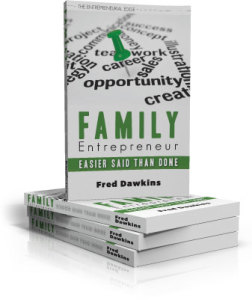
Why Entrepreneurs must have an end game

Much as we would like to, we never really love our parents as much as we do our children. Your business is exactly like a child. In the early or startup years it will depend completely upon you, looking to you for all the answers. You will always supply them with confidence, belying the uncertainty that you may feel as a first time owner just as you do as a first time parent. The child will look to you 24/7 in sickness and in health and as the parent you will always be there regardless of the problem, dropping everything else in the process. Your business and its components from customers to your team will do the same and like the parent you will be ready and willing to oblige. You cannot easily walkout on your children. Oh some due but for the majority it’s a non-starter. Same thing with your business. You are your business but try to remember your business is not you.

The middle years are the best when you have become comfortable within your developing family and confident in the decisions that must be made. Neither your child or your business will question you during this peak period. Things do get into a groove on both fronts but then comes the maturing years, the transition from total dependence  to independence. Tough for the parent to admit it’s time to let go and let the child mature  developing all of it’s capabilities, finding new methods and learning new things that the parent doesn’t know or understand.  So difficult to do but you the parent do it willingly in the best interest of your child. And so you must with your business. At some point you will become the limitation in your business. The day will come when it has outgrown you. It will not mature and reach it’s potential unless you let go. Easier said than done but be ready.

Like your first born that first business must move on to a new future. But then remember you can do it again. Maybe you already are. The second child is easier. There are tried and true practices that you know and understand. You can take that second child from gestation through birth to adolescence from startup to a thriving healthy entity. You can do this as many times as you can handle. And so you can with business. That’s what makes you a parent and that’s what makes you an entrepreneur. There are many mentors that can steward your child and your business into full maturity who cannot deal with the early years. You are the one who launches them from nothing and starts them along the path to maturity.

So recognize the need for that end game- when it is time to move on and begin again. It’s what you do best. The child will ask for you opinion. The business may ask you to consult. You will learn to enjoy both, but you will find your happiness doing it all over again.

Similar Posts

  • 3 Signs Your Startup May Be Slipping

    Originally posted by Emily Barnes, The Creative Destruction Lab The Rotman School of Management, University of Toronto

    Businesses large and small can find it tough to spare a few moments to step back and look at the big picture. But immersed in the little details surrounding new product features and releases, you can easily miss a few telltale signs your startup is starting to spiral.

    Luckily, Fred Dawkins has done the legwork for you. Partner of the Creative Destruction Lab, serial entrepreneur and founder of The Old Hide House, Dawkins has turned his past experiences into a series of books about entrepreneurship, the first of which is Everyday Entrepreneur. He recently hosted a number of workshops in partnership with the Lab, touching on everything from the misconceptions of entrepreneurship, to the day-to-day trials and tribulations of an entrepreneur, to the increasingly important role of small business in the global economy and all that’s in between.

    If you can’t spare the few minutes to check in on that big picture, Dawkins asks that you at least watch for these three signs that your startup is on the out.

    YOUR STARTUP BECOMES YOUR LIFE.

    Undoubtedly, there’ll be an imbalance. There’s no denying that you’ll have to work long hours – especially in the startup phase and when you run into times of hardship.  Your social life will at times suffer, as will your relationships. But this anguish shouldn’t be a constant.

    This may seem erroneous if you’re in the early stage of running a business. Timing is everything, and if you launch too late – especially in tech – it can make or break your success. It’s a bit of a catch-22. But unless you’re an anomaly, if you’re working an innumerous amount of hours, you’re doing something wrong. It’s symptomatic, and signals a discord elsewhere in your business. How strong is your team? Are you delegating?

    Despite much popular literature that speaks to the contrary, you truly can maintain work-life balance as an entrepreneur.  Recharging your batteries is critical. Have your hobbies and have your venture. Sometimes the two will overlap. Even then, you must create that separation. When you lose sight of work-life balance, you also risk impairing your business’ vision. It’s important to step away from your company, if only for a few hours.

    CASH FLOW – IT NEVER LIES!

    If you’re going to be successful, you’ll first need to know and understand your numbers. Metrics aside, look to cash flow. It’s right on your doorstep. Omnipresent, it serves as the perfect warning mechanism. If you’re running low on cash, you’re doing something wrong.

    Too often, startups seem to bolt at the first sign of cash flow struggles, looking to investment for relief. Granted, it’s a quick and relatively easy fix (provided you can offer up a good pitch), but too many run into the open arms of deals that offer marginal amounts of cash for large chunks of equity.  It’s easy enough to relinquish control of your business because you have to – to bring in a partner or some easy money. But don’t make rash decisions without properly considering the long-term consequences. Do the math. Beware of commitments that’ll eat up your profits. Brick and mortar businesses tackle high overhead, hardware startups combat production costs, and SAAS businesses at first operate virtually cost-free. Remind yourself of this. In a startup press bubble that’s dominated by one funding announcement after another, it’s all too easy to start asking for money. Don’t forget about sales, the good ol’ fashioned revenue stream.

    There’s a lot to be said for natural growth and learning to manage within your means. Bootstrapping isn’t a requirement so much as an opt-in measure of control.

    YOU, THE FOUNDER, ARE THE BEST PERSON ON YOUR TEAM.

    Things are different when you transition from project to business. Parameters change, and your skillsets need to adapt along with them. But few people have the knowledge or experience necessary to carry an idea through to company, then onto global success. Don’t be afraid to hire people who know more than you do in specific areas.

    You’ll be tempted to keep a short leash on success, and find it difficult to relinquish control of even the most minor of tasks. Don’t impede success for the sake of ego. Sometimes you’ll need to let go of responsibility, and sometimes that also means you’ll need to cut off a slice of the equity pie. Your ego will take a hit, and your percentage of future earnings will too, but you’ll mend and the pie may just get bigger.

    Recognize your deficiencies. You can’t always keep pace with your company, or grow at the same rate it does – not everyone is that malleable. Hire those whose skillsets can compensate for the holes in your own. You are not your company and at some point your interests may diverge, so have an end game.

  • What Readers are saying about Family Entrepreneur book 2 in The Entrepreneurial Edge series

    family-entrepreneur“Fred Dawkins sure can tell a story. I really enjoyed his previous one: Everyday Entrepreneur. Again with Family Entrepreneur, he gives us a great story and a pleasant read. He provides wisdom, comfort and learning about entrepreneurship from a family enterprise point of view. I kept thinking of those I know in that situation that would have benefited from reading it earlier in their life. If you are part of a family enterprise, here’s a chance to learn from Fred, an accomplished family entrepreneur, and make your life much more effective and rewarding.”

    Brendan Calder Entrepreneur in Residence and Adjunct Professor GettingItDone
    Rotman School of Management U of Toronto.

    After reading Family Entrepreneur: “In the age of Twitter, it warms the heart that ‘smallbizpreneurs’ still rule the roost and family business remains the proven formula”

    Peter C. Newman – Legendary Canadian journalist and author

    Author Fred Dawkins has penned another winner with Family Entrepreneur. The third party narrative style of storytelling allows for a variety of opinions to be put forward while maintaining an entertaining read. Chalked full of real life scenarios and challenges that face every business, the Family Entrepreneur will engage all entrepreneurs from every generation, whether in a family business or not.

    David Wojcik Host and Executive Producer BiZ TV Canada

    “Working in the Financial Services industry for fifty plus years, twenty seven as an Independent Financial advisor, I dealt with high net worth clients & many successful family businesses. The first book in this series was very good but I believe that this second one ought to become the bible for every entrepreneur & budding entrepreneur as it is full of very valuable, helpful & vital advice & is very cleverly written. It is a book that should be read over & over & dipped into whenever there is a query or problem”

    Frank Weisinger – Past National President of the Life Insurance Association (UK)

    “Recently I was in the process of selling my historically significant commercial building. During the negotiations with realtors and prospective buyers, poring over lists, namely needs, wants, and conditions, I was overwhelmed and sought a diversion. In Fred Dawkins book, “Everyday Entrepreneur” I quickly became immersed in the text. His counsel on the key elements in negotiations in Chapter 18, Planning and Control, awakened in me an appreciation for what was most important for me as well as for the buyer, and the need for flexibility to reach an agreement. I accepted that it truly was a process that had to evolve, and because of his advice I felt empowered and confident to negotiate the sale.”

    Elaine Tucker, Independent Business Owner

    Fred’s book is thought provoking, highly entertaining while being truly insightful. Readers are challenged on their own beliefs and characteristics regarding entrepreneurship, mentors, career, and family. At times, I was laughing and other times intrigued by the business concepts subtlety being offered. It is full of rich ideas on how to develop and maintain an entrepreneurial mindset and how to build a business the right way, avoiding the issues that have caused others to stumble. As a serial entrepreneur and business coach I highly recommend Fred’s “Family Entrepreneur” for those in business or thinking about starting one.

    Bill Simmel CEO& Founder Phoenix ONE Sales, Marketing, Management + Communications Inc.

    In his second book Family Entrepreneur Fred Dawkins uses the same intimate discussion format that made his first book, Everyday Entrepreneur so informative and such a great text for seminars. Fred’s experiences as a successful family entrepreneur form the bases of real life discussion for concepts such as funding through leadership and the pitfalls and opportunities of personal issues, entitlement, rewards and succession that have special significance in a family setting. Best expressed in his own words “Entrepreneurship is a life philosophy grounded in opportunity, fueled by determination and focused on results.” Whether a beginner, well into an entrepreneurial venture, or a professor of business, this book is a must. It’s great stuff.

    Dr. Freeman McEwen Dean Emeritus, University of Guelph

    Reading Fred Dawkins book ‘Family Entrepreneur, Easier Said than Done’ is like having an experienced business coach who’s already walked down the same road you’re traveling, right there with you. While reading this book you’re bound to sigh with relief as he examines all the mildly crazy things we do as family entrepreneurs (we are not alone!). You’ll raise your eyebrows, smack yourself on the forehead and underline text reflecting his simple solutions and powerful observations and you’ll feel a surge of motivation as you put them into play immediately. So accurate are his examples of family business dynamics that you’ll feel such a familiarity with Dawkins’ writing you’ll swear he’s been reading your email. Written in a storybook format that’s enjoyably easy to read, you’ll want to take this book along with you on your next vacation. I have a hunch it’s going to be a book I return to and recommend on a very regular basis.

    Sherri J Griffin 20 Year Training & Development Professional

    “This book is an exceptional read that paints the bigger picture of entrepreneurship through easy but important dialogue. I recommend anyone interested in starting a business or entrepreneurship in general read this and take notes.”

    Douglas Lusted CEO Linkett, The Next 36, First Cohort The Creative Destruction Lab at the Rotman School of Management, University of Toronto, Velocity Venture Fund Winner University of Waterloo

    Utilizing his exemplary storytelling skills, Fred Dawkins has written an excellent book about entrepreneurship in a family setting environment and the the many challenges that it places on the entrepreneur and the family, as well. As indicated in his subtitle, it is easier said than done. The book clearly articulates a number of the issues involved in running a business so that the primary owner can prosper yet not conflict with family values, expectations, including physical, as well as financial and emotional needs. He cleverly exposes how frequently family members butt heads during the running of a family business and how difficult it can be to resolve differences among family members. If you’re a small business or entrepreneur working with your family in your business, I would highly recommend that you read Family Entrepreneur. It will provide you with valuable insights on how you might be better able to deal with the challenges in running a “family” business.

    Jeff Sheehan- author of HIRED! Paths to Employment in the Social Media Era

    Family Entrepreneur: Easier Said than Done by serial entrepreneur Fred Dawkins tells real-life stories that reveal the good, the bad and the ho-hum of family businesses. In an engaging, easy-to-read format, Dawkins shows you how to find your own solutions to questions about business controls, succession, dispute resolution, gender stereotypes, or decision-making.

    Traditional family businesses are being disrupted as baby boomers retire. What are the new models to keep a business competitive and family ties strong? In Family Entrepreneur, memorable maxims guide the conversation and bring the reader into the conversation. A sister who functions as the COO of her brothers’ company but doesn’t get the credit or financial rewards. A brother who runs a business but can’t make critical decisions because their father left one-half of his company to each sibling. A brother who started his own very successful business and is being pressured by his parents to take his brother and sister into his own business. A mother who started her own fashion company and is now being overrun by her daughters.

    Dawkins speaks to all entrepreneurs and ‘want-to-be’ entrepreneurs – those who start a business to provide for their families, to fulfill their dreams, to profit from their innovations, to be their own boss. Hear how they make their decisions – should they stay in the company? sell it? start a new business? In my own field of veterinary medicine, these situations are a recurring theme.

    Focusing on family business and family dynamics, the Family Entrepreneur will give you the courage to tackle your own situation. Family relationships are complicated in the best of circumstances and running a company means constantly adapting to changing environments. Dawkins provides sage advice for anyone in a family business, emphasizing how important it is to face the issues head on as rationally as you can and not to allow emotion to dominate the conversation.

    Dawkins celebrates the family business as the original business incubator and encourages would-be entrepreneurs to take the leap (after careful looking at all the options!). The valuable insights will guide you no matter where you are on the entrepreneurial timetable.

    Dr. Elizabeth A. Stone | Dean, Ontario Veterinary College (OVC) | University of Guelph

    In the fast paced age of corporations and global multi-billion dollar industries – Family Entrepreneur is a riveting road map for all readers, regardless of their desire to become an entrepreneur, or to simply learn key tools which will drive creativity, leadership and success in business and life.
    Who said you can’t teach entrepreneurship? Effective and cleverly narrated through the eyes of a young female entrepreneur, Family Entrepreneur showcases the challenges, rewards and opportunities within life and family business from varying timelines. It’s easy to find one’s self and relate to the characters throughout the book. It reads like a novel, but is a sneaky and fun way of teaching the tools of the trade of family entrepreneurship – or for that matter – entrepreneurship in general.
    Maryam Latifpoor-Keparoutis, Senior Development Manager, College of Physical & Engineering Science (CPES), University of Guelph

  • Recent Quotes about Everyday Entrepreneur

    Fellow Entrepreneurs listen up! I read almost a book a day and rarely do I fall this deeply in love with the entire book. A delightful exception to that rule has been Everyday Entrepreneur. Fred Dawkins has a simplicity that is accessible by entrepreneurs at every level, including those who are paving new ways within organizations, not just those of us out in the business wilderness. If you want a fast read that you’ll be able to convert into massive action that will undoubtedly improve the way you do business then drop everything and read this book.

    Sherri J Griffin
    20 Year Training & Development Professional

    “`The most important skill in the 21st century will be the ability to create your own job.” Fred Dawkins Author of Everyday Entrepreneur – my favorite new book – a quick read with all the common sense through the stories of people whose experiences ring so true to life. I suggest all students and young engineers I have worked with pick up a copy! You won`t be sorry!”

    Maryam Latifpoor-Keparoutis
    Senior Development Manager
    College of Physical & Engineering Science (CPES)
    University of Guelph

  • What aspiring entrepreneurs can learn from the Alberta election

    Yesterday’s Alberta election produced a dramatic change but more than anything else it resulted from change and the inability of the PC party in Alberta to manage change.  One of the reasons so many experts maintain that failure is an integral part of succeeding as an entrepreneur is because we do learn from failure. We have to learn in order to recover so we take the time to analyze what we did wrong in order to avoid repeating the same mistake. Success masks our faults. It is rare for most of us to understand our weaknesses when we are getting results. Unfortunately for the electorate for a political party getting results means maintaining power as opposed to effective performance. When things are going well as they did for Alberta under the boom of the oil industry it was easy for politicians to look good and to develop some bad management practices. When a serious problem developed with falling oil revenues there was a huge need to adjust. We will never know whether the proposed budget was appropriate or not but remember when you have to provide customers, suppliers or employees with a bitter pill for the longer run good don’t turn around and immediately give them control to vote the new policy in or not.

    My mantra for the individual in today’s dynamic world is that the number one skill you can learn is the ability to create and manage your own career, with managing being the key to sustain meaningful success. We face an unprecedented rate of change. Every one of us must have the ability to recreate ourselves in the face of this one certainty: change is a constant, by definition the only thing we can count on besides death and taxes. Despite the perception of many that entrepreneurship requires risk this need not mean reckless risk but instead should refer to managed risk. The PCs had the time and needed it to prove that their budget could work in an economy under duress rather than risking a quick election on the outside chance they would get another majority giving them even more time. So among the small business lessons from yesterday’s election results are the following:

    1. Nothing lasts forever including good times in the oil industry

    2. Sustained success requires a relentless commitment to adapt even after a long track record of doing so.

    3. Managed risk produces results while reckless risk invites failure

    4. Knowing your weaknesses in good times and bad will sustain your success

    5. A change in leadership does not guarantee renewal of an organization

    I’ m sure there are more.

    Fred Dawkins is a serial entrepreneur and the author of a series entitled The Entrepreneurial Edge. The third book in that series Ageless Entrepreneur is available from booksellers across North America on May 9th 2015


  • Entrepreneurship- Who’s The Boss?

    Quite a number of my friends are professionals. Often they let me know how lucky I’ve been to own and operate companies with employees who keep churning out results even when I am at the cottage or on the golf course. For them time is money-they generate the revenue. They have to be there or nothing happens. I don’t even have to show up.

    The traditional idea is that once you get to be the boss, you coast while others do your bidding. Maybe that idea’s grounded in the reality that most people get promoted to their level of incompetence where performance falls off. Of course it’s delusional to think that you start your own business and find a gravy train of financial success, freedom and success, all with little effort. This rarely happens but we do revere examples when it does like some the instant successes that have materialized in the tech world. Frankly that type of success is equivalent to winning the lottery which isn’t going to happen for many. Unfortunately this is the romantic side of entrepreneurship- rare but appealing.

    If your goal is to get to be the boss and then take it easy , perhaps you should look to the public sector where that is at least a possibility. Being a true entrepreneur means living in a revolving door with each turn bringing a new problem to solve. If this lifestyle is meant for you , it’s like getting the business equivalent of a runner’s high, every day, all day. If not welcome to chaos. The faster the problems come the more you must thrive on the process. The last thing entrepreneurs want to do is sit idle while others do the work and get all the fun of problem solving.

    That’s why they succeed in startups but struggle in managing established businesses even though they may have built those same businesses. No matter how great your innovation, converting that project to a successful business requires entrepreneurship. Success takes determination, adaptability, resilience, commitment and the certainty that you will take the project to completion and make that project happen. It is not the project that makes an entrepreneur. It is definitely the process! Very few are content to level their business and enjoy the fruits of success. So if you are all about power, money or prestige maybe entrepreneurship isn’t for you. Being the boss is just a necessary evil.

  • Ontario Government Moves to Strengthen Business Climate

    Generally anything that makes government facilitate as opposed to over regulate is a positive step. The government of Ontario has just announced initiatives that could reduce red tape for businesses and create cluster developments to help drive regional economic growth and create jobs. Will these reforms ever see the light of day in a minority legislature flirting with an election or are they just pre-election temptations to attract votes away from the conservatives?

    Regardless both of these ideas focus on critical areas in the face of a fast paced global economy where all countries are fighting for talent and for markets. Governments at all levels need to become more efficient and more effective. Over regulation serves no purpose other than to increase the cost of government and limit the competitiveness of the private sector, discouraging investment in the province in the process. There is a place for regulation and there are important roles for government but the former needs to be reeled in while the latter needs to be more selective. One preferred area should be to co-operate with the private sector and academia to create ecosystems that foster business opportunities in a variety of areas where we can build comparative advantages. This is now a stated goal for Ontario.

    The most startling evidence of cluster development is Silicon Valley where 350,000 Canadians live and work. That’s right 1% of our population and a much higher percentage of our intellectual capital are resident in northern California. The Valley offers the most dominant ecosystem for an industry that exists, nurturing tech startups and venture capital investment at a phenomenal rate. It is not one that can easily be replicated and it’s been underway for over sixty years.

    In other words this project requires genuine commitment from all concerned. We can only hope that the Ontario government follows through and that the Feds add a level of support. We are in a new era dominated by change. The culture of government and business alike has to change. Government must move away from a culture of bureaucracy that has become an unbearable burden. Big business must move away from a culture of control to a culture of empowerment as change dictates that the status quo is short lived.

    These new initiatives serve as a reality check that we must become more competitive. Government can not be the agent of change that makes this happen but it can facilitate a co-ordinated approach by reducing the costs of doing business and helping to create ecosystems that support the efforts of the private sector. Let’s hope that all parties rally in support of these programs that will create jobs and point us toward a better future.

Leave a Reply