Ontario Government Moves to Strengthen Business Climate

Generally anything that makes government facilitate as opposed to over regulate is a positive step. The government of Ontario has just announced initiatives that could reduce red tape for businesses and create cluster developments to help drive regional economic growth and create jobs. Will these reforms ever see the light of day in a minority legislature flirting with an election or are they just pre-election temptations to attract votes away from the conservatives?

Regardless both of these ideas focus on critical areas in the face of a fast paced global economy where all countries are fighting for talent and for markets. Governments at all levels need to become more efficient and more effective. Over regulation serves no purpose other than to increase the cost of government and limit the competitiveness of the private sector, discouraging investment in the province in the process. There is a place for regulation and there are important roles for government but the former needs to be reeled in while the latter needs to be more selective. One preferred area should be to co-operate with the private sector and academia to create ecosystems that foster business opportunities in a variety of areas where we can build comparative advantages. This is now a stated goal for Ontario.

The most startling evidence of cluster development is Silicon Valley where 350,000 Canadians live and work. That’s right 1% of our population and a much higher percentage of our intellectual capital are resident in northern California. The Valley offers the most dominant ecosystem for an industry that exists, nurturing tech startups and venture capital investment at a phenomenal rate. It is not one that can easily be replicated and it’s been underway for over sixty years.

In other words this project requires genuine commitment from all concerned. We can only hope that the Ontario government follows through and that the Feds add a level of support. We are in a new era dominated by change. The culture of government and business alike has to change. Government must move away from a culture of bureaucracy that has become an unbearable burden. Big business must move away from a culture of control to a culture of empowerment as change dictates that the status quo is short lived.

These new initiatives serve as a reality check that we must become more competitive. Government can not be the agent of change that makes this happen but it can facilitate a co-ordinated approach by reducing the costs of doing business and helping to create ecosystems that support the efforts of the private sector. Let’s hope that all parties rally in support of these programs that will create jobs and point us toward a better future.

Similar Posts

  • Embracing Entrepreneurship

    Most of what the average person reads about entrepreneurship sustains the mystique. We revere the outstanding successes achieved by extreme entrepreneurs — everyone from Edison to Jobs. Yet, reading about these giants colors our perception of entrepreneurship. We admire their achievements but consider them beyond reach. Their stories often sustain misleading myths about entrepreneurship that keep capable people from embracing an entrepreneurial career. People begin to believe that to travel down the entrepreneurial path, a person must be born with a particular mindset, take reckless risks to achieve high rewards, work all day, everyday and must fail to succeed. Don’t let these misconceptions scare you off.

    Entrepreneurship can be taught, it should be taught and it is being taught.

    After 50 years of a flawed model focused on churning out executives for large corporations, colleges and universities have turned their attention to promoting and encouraging entrepreneurship. These schools are focusing on teaching the entrepreneurial lifestyle; one focused on both the mindset and the skillset required to become an entrepreneur.

    Entrepreneurship is not about the risk you take, but the results that you achieve

    It’s a startling paradox. Too many good opportunities die prematurely because so many potential entrepreneurs are risk averse. At the same time businesses are failing because of absurd risks fostered by the idea that being an entrepreneur is nothing more than a gamble. Entrepreneurs succeed through determination not by taking unwarranted risk. Managing risk as you embrace it is critical. Not all ideas are opportunities and every opportunity is not viable. Managed risk is inherent in the lean startup focused on getting valuable feedback from potential end users before jumping into full scale operation.

    Entrepreneurs need to find work/life balance and will have regrets if they don’t.

    Having a strong work ethic and being willing to put in extended days when required is critical. During your startup phase and later when you encounter bumps in the road you will work long hours with great satisfaction. But as things progress you need to find balance by building your team, easing control and empowering your staff. You must recharge your batteries. Never forget: You are your most valuable human resource. Without balance your performance will suffer, your business will be restrained and your personal life will be sacrificed unnecessarily.

    Failure is not essential. Entrepreneurs manage their risk and avoid failure.

    Describing failure as an essential part of success is rationalization but many entrepreneurs are motivated by the fear of failure more than the rewards of success. Failure only happens when we either quit or are forced to give up. Mistakes are part of the learning curve. We do learn from them because we take the time to analyze them. Success is elating and it masks our faults. Continually improve by understanding what you do right and correcting what you do wrong in good times and in bad. If you do experience failure you can and will bounce back, many have.

    Being an entrepreneur is within your reach.

    You can become a problem solver who is determined to find a way to make things happen? Understand: we can’t all be innovators but for every innovation there will be thousands of entrepreneurs finding applications that solve everyday problems producing jobs and independence. Being first is over rated. Doing things better and different often brings greater opportunity

    Believe in your own ability.

    You can establish the mindset of an entrepreneur by eliminating the word ‘can’t’ from your vocabulary. You can approach problems by skipping right over the question “if” it can be solved and skip directly to the question “how” it will be solved. You can find opportunity and you can analyze to make sure that opportunity is viable. All of this can be done within the context of the traditional economy and you don’t have to be a tech genius to do it. Technology is not a threat but offers a great tool for you to use. We are entering a new era of entrepreneurship, which means it is an option for almost anyone. If you can’t carry the full weight of your own business bring entrepreneurial thinking to managing your career and performing your role as an employee. You won’t regret it.

  • The Disconnect between current Capitalism and Free Enterprise

    I am a serial entrepreneur who believes that the free enterprise system is the best alternative for creating upward mobility, a growing middle class, the most efficient allocation of resources and the least costly production of goods and services to the benefit of society as a whole. But free enterprise is based on the principal of a free and open market. Theoretically the ease of communication today should create more opportunity and much greater competition. Free enterprise does not thrive in a monopoly or oligopoly both of which limit competition but in many cases that is what we now have. As a result the middle class in the west is in serious danger of backsliding into the poor class from which it came over the past hundred plus years.

    Branding and Brand power are the main tools that are limiting competion, allowing capital to seize a much larger portion of the pie at the expense of labour creating the status of superrich and the growing disparity in the distribution of wealth. These are serious dangers because market control interferes with free enterprise and skews the results. Yes it is still possible to create a new brand but increasingly large organizations block the market and take advantage by acquiring up and coming companies and only then allowing them full market penetration.

    On an individual basis it is now critical to become an entrepreneur allowing for self-determination and upward mobility that is in decline for employees. The most important skill anyone can learn today is the ability to create and manage your career. The problem is much bigger for society. We have created a society in the west with very high expectations and a philosophy of entitlement. A large percentage of the population will not put forward the effort and level of determination required to succeed as an entrepreneur – not without first experiencing serious pain and a major economic correction. We are vulnerable but collectively we remain in a state of denial.

    The capitalist system which allowed the middle class to flourish in the west is broken. Rather than continuing to create opportunity it has begun to limit it. Rather than spreading the success to the developing world we are in danger of returning to a more rigid class system with the superrich having a disproportionate amount of economic power. Solutions are impossible as long as we remain in a state of denial compounded by governments which have become dysfunctional. A good start could come from consumers by becoming better informed and breaking the power of the brands. This should be happening through social media but it isn’t. Instead brand control of the market is being re-enforced by social media marketing.

    I am very concerned that I have lived and worked in an era that has been optimum for the individual but is no longer sustainable. I am very concerned that my grandchildren will be denied the opportunity that my generation has enjoyed. One of the great challenges of capitalism is to moderate the influence of greed. If we don’t find a way to level the playing field it’s difficult to predict how social unrest will manifest itself in a society where expectations cannot be achieved.

  • Today’s Graduate and Entrepreneurship

    You are educated. Now what? The most important skill you can add today is the ability to create and manage your career. On the surface this is not the best time to graduate. The cost of education is very high, bringing student debt to record levels. Job stability is in decline. The distribution of wealth is skewed in favour of those at the top. Upward mobility is in jeopardy. The rate of change is increasing. All this means that your future is dependent on self-determination grounded in awareness of the world in which you live. In this environment, you are your own brand and must plan on reinventing yourself throughout your work life. Start engaging in entrepreneurial thinking right at the outset of your career. Whether you start a business, become a solopreneur, work in a large entity or engage in social entrepreneurship, you have to become adaptable and resilient in a world dominated by change. Entrepreneurial thinking is about a mindset not a skillset. Success is about finding a way not knowing the way. In the era of Big Data this is essential. We will never know enough or understand enough of what we know. So abandon prison thinking and get started.

    Five ideas to reject:

    1. Education guarantees you a future. Sorry you don’t have it made: education never ceases and formal education just gives you more opportunities. There are no guarantees
    2. There are no jobs for graduates. There are barriers to entering the work force which are as insurmountable as we allow them to be. Resilience and adaptability start now.
    3. Government will solve the employment problem. Would you really choose government as your advocate to solve any problem?
    4. There is no future within small business. Life expectancy of all businesses is in decline. Strategic management of your career takes you where you can gain the most now!
    5. Millenials don’t make good hires. Maybe you place a higher value on social media contact and demand access during the day but technology is your ally making you more productive than older generations.

    Ten Reasons for Confidence:

    1. Technology, your ally, has lowered the cost of administration through the integration of many management tasks. A one pound portable laptop allows anyone to incorporate their accounting system, sales marketing network, all communication, research, collections and payments not to mentions a wide variety of personal needs. Add in mobility via a smartphone and you are always accessible and connected. You have the potential to do it all, as a disruptor within a large corporation or government agency or as an independent.
    2. Big Data is generating new problems at record rates. Every problem is an opportunity.
    3. Social networking, another ally, has increased the reach of individuals allowing market access on a much broader geographic scope. Services can be offered at great distance. Endorsements can be sought and received across the country or even worldwide. Credibility can be built quickly through performance. LinkedIn is a great tool to market your skills and pursue your career strategy.
    4. Websites can be both affordable and first class allowing an individual to build a professional image. Employee and entrepreneur alike can build their brand and market themselves.
    5. Outsourcing is an established practice by which governments and large corporations are achieving flexibility which rewards specialization right down to the individual level. Businesses may only want you part time so find several of them and keep them happy.
    6. Acquisition is a principal way for large entities to find innovation making startups, often founded on youth and enthusiasm a great opportunity if you can join the right team.
    7. Succession is a huge issue for hundreds and thousands of viable independent businesses in North America as the baby boom generation hits retirement depending on their business to fund their future. You can find a mentor leading you to acquire your own business through an earn out that funds his or her retirement.
    8. Size is simply becoming a liability – there are many small viable market niches that large companies and foreign sourcing will never fill. Adaptability, resilience and flexibility are essential in a world dominated by change.
    9. Opportunity is nowhere, opportunity is everywhere. Recognizing opportunity is the cornerstone of success in every aspect of your career.
    10. Determination was the key to graduating. It is also the key to managing your career.

    Starting your career is the first of many problems ahead. Every problem provides an opportunity. The solution to a successful career lies within your ability to create your own brand.

    Fred Dawkins is a serial entrepreneur with over 40 years’ experience and achievements in manufacturing, retail, land development, consulting and import/export. He holds a B Com in commerce and finance and a M.A. in economics from the University of Toronto. His business has allowed him to travel extensively, giving him insight into the emerging global economy and making him a passionate advocate of entrepreneurship in the 21st century.
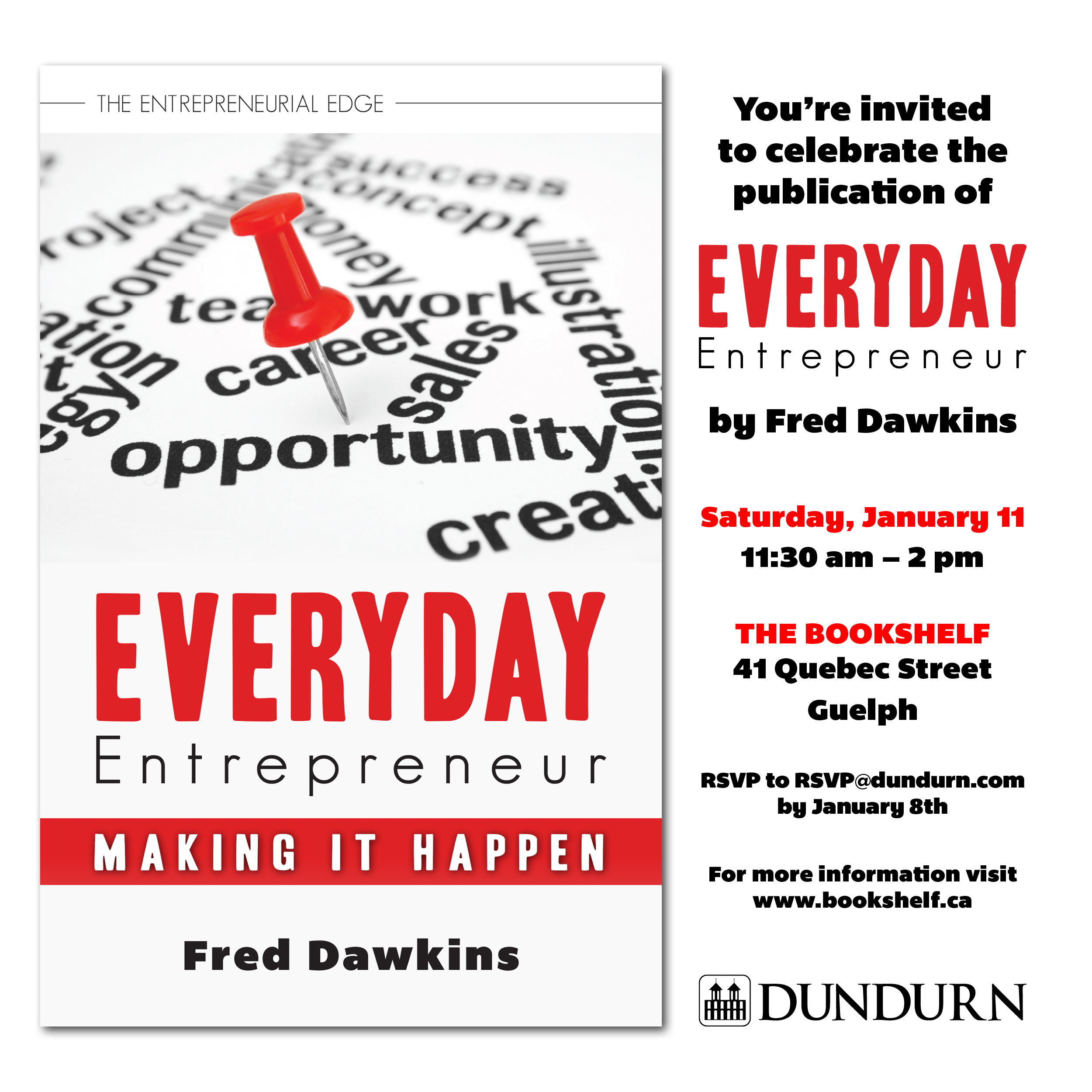
    Everyday Entrepreneur [Dundurn Press] is the first book in Dawkins’ Entrepreneurial Edge series, and is currently available at all booksellers, including Amazon.com, Amazon.ca, Barnes & Noble and Chapters Indigo. His novel, 2020 Hindsight, explores major contradictory trends in society in a compelling contemporary fiction narrative, and is forthcoming as an e-book on Amazon.com.
    Website: https://fcdawkins.com/

  • Here’s a quiz that everyone needs to take.

    1. Are you concerned about funding your retirement?
    2. Does the trend to precarious employment disturb you?
    3. Do you consider globalization to be a threat to you, your children and/or grandchildren?
    4. Are you having trouble getting your career underway?
    5. Do you have to extend your career?
    6. Are you struggling to find a succession plan for your business?
    7. Are you worse off financially than you were ten years ago?
    8. Do you have fewer opportunities than you expected at this stage of your life?
    9. Would you like more control over your financial future?
    10. Are your best years behind you?

    If you answered yes to any of these questions than you should read my series of three books The Entrepreneurial Edge. These books are The Wealthy Barber for anyone dealing with these issues and looking to embrace self-determination in a world conspiring against individual success

    Book 1: Everyday Entrepreneur – making it happen

    Book 2: Family Entrepreneur – easier said than done

    Book 3: Ageless Entrepreneur – never too early – never too late

    Don’t let the word entrepreneur scare you off. You don’t have to run a business to think like an entrepreneur and take charge of your life. Think entrepreneurially. Be resilient. Be adaptable. Make things happen. Embrace self-determination. Trade stability for agility!

    The most important skill to learn in the 21st century is the ability to create and manage your career!

    Each of us must be his or her own brand making good strategic decisions about life and career.

    Fred Dawkins

    Author

    fred@fcdawkins.com

    fcdawkins.com

    Everyday Entrepreneur dundurn.com/authors/fred_dawkins

    Follow me on twitter @dawkinsfred

    Follow My Blog The Entrepreneurial Edge https://fcdawkins.com/blog/


Leave a Reply