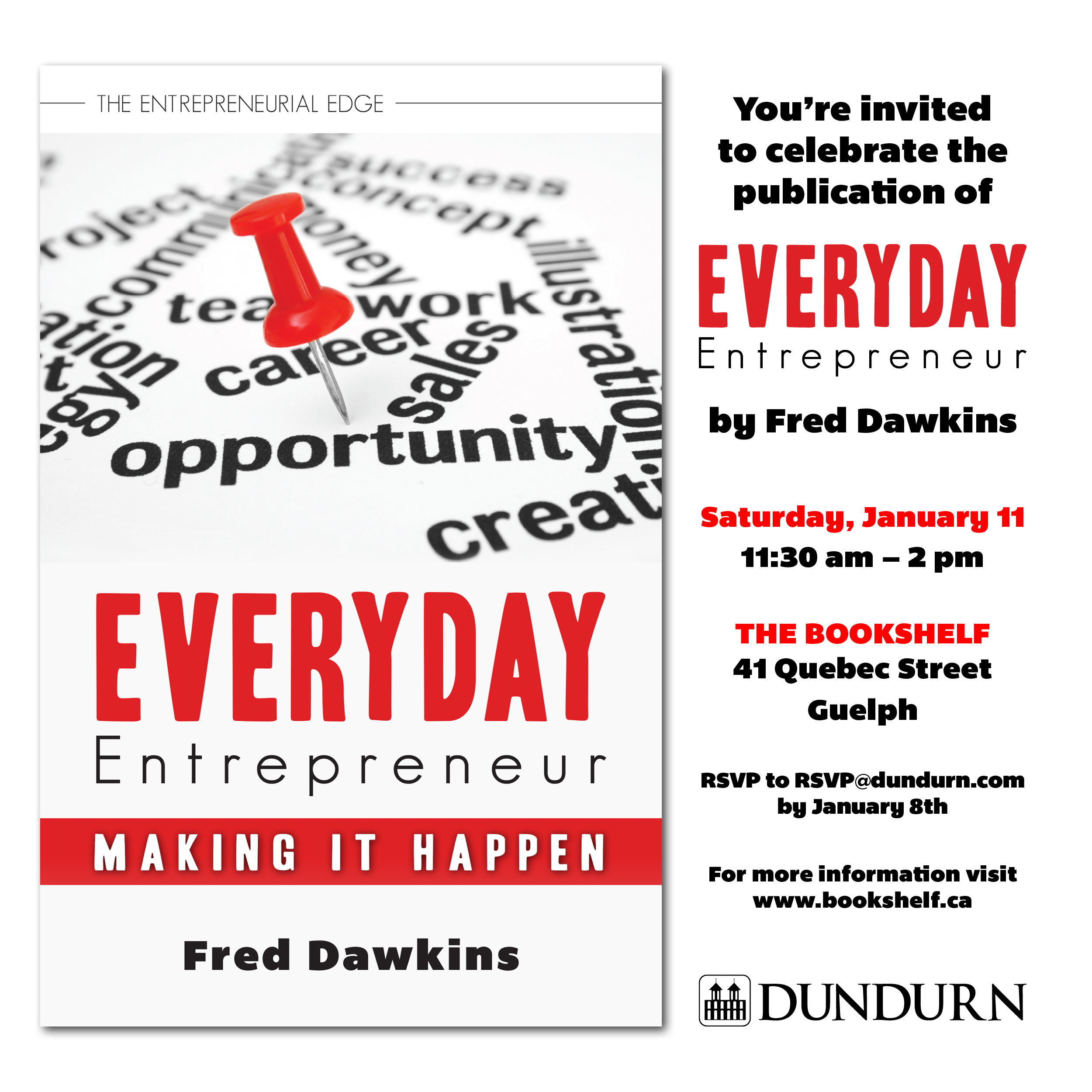
Invitation to Book Launch Rotman School of Management Tuesday January 28th 2014

Fellow Entrepreneurs listen up! I read almost a book a day and rarely do I fall this deeply in love with the entire book. A delightful exception to that rule has been Everyday Entrepreneur. Fred Dawkins has a simplicity that is accessible by entrepreneurs at every level, including those who are paving new ways within organizations, not just those of us out in the business wilderness. If you want a fast read that you’ll be able to convert into massive action that will undoubtedly improve the way you do business then drop everything and read this book.
Sherri J Griffin
20 Year Training & Development Professional
“`The most important skill in the 21st century will be the ability to create your own job.” Fred Dawkins Author of Everyday Entrepreneur – my favorite new book – a quick read with all the common sense through the stories of people whose experiences ring so true to life. I suggest all students and young engineers I have worked with pick up a copy! You won`t be sorry!”
Maryam Latifpoor-Keparoutis
Senior Development Manager
College of Physical & Engineering Science (CPES)
University of Guelph
Whatever happened to the optimum size of the firm? You know the size at which the company was it’s most efficient? most productive” most manageable? Economies of scale did dictate making the firm larger UNTIL the company hit the law of diminishing returns meaning the optimum size had just been passed. It seems that somewhere along the line it was decided that the best way to compete in an evolving global economy was to keep getting bigger regardless of inefficiency and loss of control. Ironic isn’t it. Free enterprise following the example of bureaucratic Big Government. Build behemoths. If you get big enough there’s no way to get rid of you. But how? Well in order to make this happen create a wage pyramid so that those at the top who have very little idea what’s going on below them make outrageous salaries well beyond any possible contribution they can make to the organization. Sound good so far?
But what happens if things really do get negative? Don’t worry as long as you get big enough your cousin Big Government will have to bail you out. If small companies or individuals get hurt in the process they’re, well, collateral damage, just not as important as Big Business is to the world-expendable. This approach is pretty much out of touch with reality. Businesses do not last forever. Just look at the original list of the Fortune 500 to see how many have survived. In this era of 24/7 hyper-connectivity manifested in an ever increasing rate of change their life expectancy is going down. Size does matter but it’s becoming “Too Big to Survive”. Flexibility and Adaptability are the essential traits of business today. Social media is critical to deal with this new fast paced reality. The real watch words should be “Too Small to Fail”. Entrepreneurs focused on opportunity, flexible enough to change quickly,, in touch with their business and all the key players are designed for the current environment.
Technology has opened up communication around the world making global business possible for small well lead companies who can gravitate to that desirable optimum size. For Big Business more independent divisions under a corporate umbrella, sized properly, will help but the era of domination by huge entities will weaken. Careers with one organization have already disappeared. We are a society of individuals. The most important skill for an individual will be the ability to create your own job. We are entering a New Age of Entrepreneurism.
Misconceptions about Entrepreneurship – Time to end the nonsense!
By Fred Dawkins, author of Everyday Entrepreneur
We are entering a New Era of Entrepreneurship where there is no room for prison thinking in a world dominated by rapid change. Embracing change requires resilience and adaptability which are key characteristics for all entrepreneurs. Unfortunately the existing stereotypes for entrepreneurs discourage countless people from embracing the role. These perceptions prevent too many from taking the leap of faith required to become one. The first step in breaking free is to dispel some of the myths that are holding capable people back at a time when they need to welcome the opportunity to create and manage their own careers.
Two of the most flagrant misrepresentations that discourage people are that entrepreneurs are gamblers who take reckless risks to achieve high rewards and that entrepreneurs need to fail in order to succeed. Many people are risk averse and most of us fear failure. These traits do not disqualify us as potential entrepreneurs. In reality entrepreneurship is not about the risk that you take but entirely about the results that you achieve. Being entrepreneurial relies on the determination to make things happen especially when many others don’t see that possibility. Becoming an entrepreneur is all about the mindset not the skillset. Entrepreneurs find the way to make things happen they don’t always know the way. Too many good opportunities die prematurely because people are risk averse. More people need to make the leap of faith based on their determination and the foundation of a viable opportunity.
However, being prudent prevents you from taking reckless risk and directs you towards managed risk which is the hallmark of free enterprise. Entrepreneurs are proactive and solve problems through determination not by taking unwarranted risk. Successful entrepreneurs always have a downside plan allowing for adjustment which mitigates risk. When they make plans they analyze a range of possibilities rather than marrying themselves up to a single goal or result. In this way they build a framework which helps them adjust on a timely basis. Put your best foot forward: at the very beginning establish the viability of your opportunity. Too much time, energy and money are spent trying to convert whimsical ideas into a sound business. A high tolerance for risk is not enough to make a bad idea succeed. This is the essence of the lean startup. Test your premise. Talk to your potential market. Get feedback and adjust. Manage your risk from the outset. Don’t plunge blindly ahead on the premise that risk is an integral part of the undertaking. To be sure there is risk but recognize it and manage it as best you can.
The concept that failure is a prerequisite for success is more nonsense and stems from rationalization by those who fail initially. Successful entrepreneurs abhor failure. For many of them the fear of failing is a powerful motivation. Most manage their risk effectively, anticipate problems, adjust quickly, bounce back from setbacks and manage to avoid failure – if they do fail they learn and move on. We all learn more from failure simply because we take the time to analyze it. In that sense setbacks do make you stronger and they only constitute a failure if we give up. On the other hand success is exhilarating and it masks our faults. Just as initial failure can set the stage for success to follow; initial success can lead to a sense of entrepreneurial infallibility. When that happens, as it does to too many, the critical things that built those initial achievements are often forgotten and ignored.
In order to break down these established stereotypes we have to understand how they evolved. Both derive from two specific types of entrepreneurs. First are the misfits or rebels who either cannot or will not conform; the gamblers to whom few of us can relate. Second and even more prominent are the tech entrepreneurs immersed in the world of venture capital where risk is high, failure is frequent and the rewards for success are dramatic. However Silicon Valley is not the center of the universe and these are not the definitive entrepreneurs; they are but two types of many, both removed from the traditional economy and the rock solid problem solvers that collectively form the engine that drives the economy. Those are the achievers that do make things happen especially creating jobs while big business is chasing lower costs around the globe.
In this new era, defined by constant and rapid change, we must all become more entrepreneurial. We can choose to establish an independent business or we can choose to become disruptors within the culture of big business or within the bureaucracy of big government. Collectively we are defining a new normal; one that is less stable and more dynamic. Regardless it is in our best interest to embrace the mindset of an entrepreneur, an attitude focused on action fueled by determination. We must indeed create and manage our own careers. Job stability is disappearing. The distribution of wealth is favouring capital not labour. Upward mobility is in decline. All of this means new and different opportunities. We can become the architect of our dreams or the victim of others’. Whatever you choose; don’t let misguided and outdated ideas limit your choices. .
Fred Dawkins is a serial entrepreneur with over 40 years’ experience and achievements in manufacturing, retail, land development, consulting and import/export. He holds a B Com in commerce and finance and a M.A. in economics from the University of Toronto. His business has allowed him to travel extensively, giving him insight into the emerging global economy and making him a passionate advocate of entrepreneurship in the 21st century.
Everyday Entrepreneur [Dundurn Press] is the first book in Dawkins’ Entrepreneurial Edge series, and is currently available at all booksellers, including Amazon.com, Amazon.ca, Barnes & Noble and Chapters Indigo. His novel, 2020 Hindsight, explores major contradictory trends in society in a compelling contemporary fiction narrative, and is forthcoming as an e-book on Amazon.com.
Website: https://fcdawkins.com/
Read More “My article: The Misconceptions about Entrepreneurship”
In one of my favourite and most thought provoking novels, Aldous Huxley used the future (2540 AD) as the setting and developed characters in his science fiction novel to express the fear of losing individual identity in the fast-paced world of that future. Unlike Orwell who offered a pushback to communism, Huxley focused more on technology and the ultimate impact of continuing the fast pace evolving out of the Industrial Revolution. So is that future almost upon us? Here are some of the key elements of Huxley’s Brave New World:
Abolition of natural reproduction – Children are educated via appropriate subconscious messages to mold the child’s self-image appropriate to their caste.- Discouragement of critical thinking – Discouragement of individual action and initiative – An abundance of material goods – (presumably because of advanced technology) conditions of work are not onerous – Citizens are conditioned to promote consumption. People enjoy perfect health and youthfulness until death at age 60. The World State is a benevolent dictatorship headed by ten World Controllers which has established a stable global society where the population is permanently limited. The basis of that stability is the conditioning of citizens to accept their station in life.
As a serial entrepreneur who values individualism driven by hope and accomplishment as essential to the human condition the weight of logic tells me that we are all too close to Huxley’s world and long before 2540. Here are more than enough reasons to be concerned. All of them relate to two dominant trends – rapid change and globalization.
1. The Era of Big Data is here – too much to know and digest
2. Wealth Disparity – economic rewards are accruing to capital – real wages are stagnant or in decline
3. Declining upward mobility – the middle class is in decline trending towards historical norms more limited chances for improvement – Huxley’s caste system?
4. Precarious employment – job stability is simply disappearing — those that don’t take control over their careers will flounder
5. Machine Learning- we are about to handle even more control of our research and knowledge creation to machines. Artificial Intelligence is the next big thing.
6. Cloning – the science exists – the implications are many
7. Stem cell development – we can already grow new organs – test tube babies are there for the taking. The key to perfect health may well lie in stem cell research.
8. World population is out of control – in Huxley’s world, a problem solved by limiting life
9. Control of knowledge – with Big Data and Machine Learning will we only know what we are told and will God simply become the internet? Look it up – it must be so?
10. Surveillance – Snowdon has shown that we are being watched – this will only get worse and soon
11. Corporatism – we don’t live under free market capitalism – large corporations control global markets and reap the profits – we can thank ourselves for embracing branding to facilitate this – Too Big to Fail puts a deadly premium on Big
12. Multi-nationals – these same corporations driven by profit maximization are pursuing interests that eliminate national interests as they build stronger global foundations for controlling markets. All the time individuals are being encouraged to consume at record rates.
I’m fairly sure I know what Huxley would think. How about you?
The more I write and speak about entrepreneurship the more I realize how mainstream the topic has become. Whether you know it or not you and everyone else has to become more entrepreneurial in their thinking. We live in a fast paced global society that requires all of us to be resilient and adaptable. Those are the critical attributes that make us entrepreneurial. Entrepreneurship applies to far more than business and business issues. We are talking about a mindset not a skillset. A mindset focused on solving problems. A mindset grounded in determination to make things happen. It’s about being proactive not reactive. Most important it is about self-determination!
In an extremely competitive global world, in the era of Big Data, we can never know enough and we will never understand much of what we know. We cannot have the answers but the answers will always be there for us to find. There is no time for prison thinking. If you think like an entrepreneur you will find the way and that’s just as true about your personal life as it is about your career. As for that part of your life, in the face of declining job stability and the entrenchment of wealth disparity, the most important skill you can learn today is the ability to create and manage your career. There is a very good reason that every college, every university and now even secondary schools are offering courses in entrepreneurship.
When I wrote my first book Everyday Entrepreneur I had the ambitious goal of doing for entrepreneurship what David Chilton did for financial planning with The Wealthy Barber – to write a book that applied to all of us in a form that everyone could read understand and enjoy. The jury is still out but the endorsements received are encouraging that I have come close. The second book in my entrepreneurial series Family Entrepreneur comes out later this month. Dealing with the dichotomy of family and business brings entrepreneurial thinking into both settings. Remember family was the first “crowd” and still offers funding and nurturing for many entrepreneurs in a startup situation.
I am extremely grateful for the opportunity to mentor and encourage would be entrepreneurs both in their business and private lives. It is really all about taking charge of your life in the midst of a roller coaster world. You have to learn to capitalize and enjoy the highs while defending against the lows. Entrepreneurial thinking is the tool to do it.
Fred Dawkins is a serial entrepreneur who is best known as one of the co-founders of the olde Hide House in Acton Ontario to which “it’s worth the drive”. He is a partner in The Creative Destruction Lab at the Rotman School of Management at the University of Toronto and is currently writing a series of books entitled The Entrepreneurial Edge published by Dundurn Press, which focuses on encouraging and preparing would be entrepreneurs for challenges in their careers and in their private lives.
No products in the cart.