Everyone Needs to Think Like an Entrepreneur!

The more I write and speak about entrepreneurship the more I realize how mainstream the topic has become. Whether you know it or not you and everyone else has to become more entrepreneurial in their thinking. We live in a fast paced global society that requires all of us to be resilient and adaptable. Those are the critical attributes that make us entrepreneurial. Entrepreneurship applies to far more than business and business issues. We are talking about a mindset not a skillset. A mindset focused on solving problems. A mindset grounded in determination to make things happen. It’s about being proactive not reactive. Most important it is about self-determination!

In an extremely competitive global world, in the era of Big Data, we can never know enough and we will never understand much of what we know. We cannot have the answers but the answers will always be there for us to find. There is no time for prison thinking. If you think like an entrepreneur you will find the way and that’s just as true about your personal life as it is about your career. As for that part of your life, in the face of declining job stability and the entrenchment of wealth disparity, the most important skill you can learn today is the ability to create and manage your career. There is a very good reason that every college, every university and now even secondary schools are offering courses in entrepreneurship.

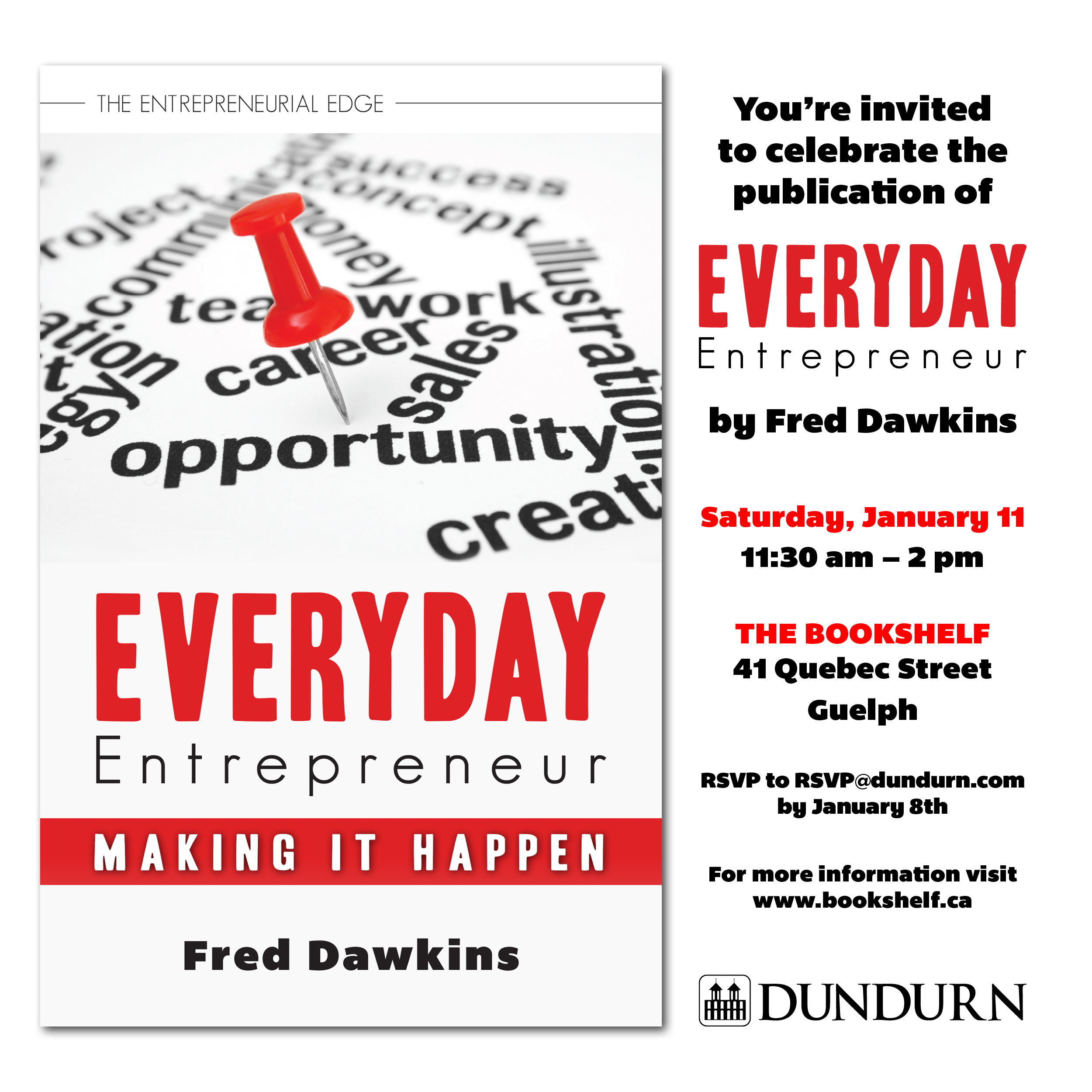
When I wrote my first book Everyday Entrepreneur I had the ambitious goal of doing for entrepreneurship what David Chilton did for financial planning with The Wealthy Barber – to write a book that applied to all of us in a form that everyone could read understand and enjoy. The jury is still out but the endorsements received are encouraging that I have come close. The second book in my entrepreneurial series Family Entrepreneur comes out later this month. Dealing with the dichotomy of family and business brings entrepreneurial thinking into both settings. Remember family was the first “crowd” and still offers funding and nurturing for many entrepreneurs in a startup situation.

I am extremely grateful for the opportunity to mentor and encourage would be entrepreneurs both in their business and private lives. It is really all about taking charge of your life in the midst of a roller coaster world. You have to learn to capitalize and enjoy the highs while defending against the lows. Entrepreneurial thinking is the tool to do it.

Fred Dawkins is a serial entrepreneur who is best known as one of the co-founders of the olde Hide House in Acton Ontario to which “it’s worth the drive”. He is a partner in The Creative Destruction Lab at the Rotman School of Management at the University of Toronto and is currently writing a series of books entitled The Entrepreneurial Edge published by Dundurn Press, which focuses on encouraging and preparing would be entrepreneurs for challenges in their careers and in their private lives.
Similar Posts

  • A New Year: Time to Consider Entrepreneurship

    Every New Year is a time for reflection – a time to review the past and a time to predict the future – a time  for assessment and a gateway to change. For many career change is the most important possibility to consider. Job stability is evaporating before our eyes. Inequity in the distribution of wealth in the western world  is returning to historical norms after a century of a growing and healthy middle class. So maybe this really is the time to consider becoming an entrepreneur.

    Entrepreneurship has become a hot topic and it should be. Why? Well here are a few reasons to consider. Globalization is great for consumption, not so wonderful for non-competitive labour in developed countries especially North America. Technology has accelerated the rate of change inherent in globalization making change itself the one constant we can expect in our economic future. Rigidity, structure and the status quo are the antithesis of change. We must constantly engage in a process of creative destruction, tearing down the old to renew with new and different products and approaches. The lifespan of the status quo is already much shorter as the rate of change accelerates. Stability in one’s life will depend on resilience and adaptability.

    The ability to create and manage your own career will be the most important skill you can learn.

    We are well into a New Era of Entrepreneurship. Governments have recognized this and the battle for talent is underway. Universities and Colleges around the world are introducing programs searching for the best ways to define and teach entrepreneurship. Is it economics? Is it business? Is it philosophy? Can it be taught? Must it be experienced? Everyone is searching for the formula to produce disruptors. Why? We need them to help bring about change at every level: To dig into the corners and find all the advantages that exist by opening up the global economy; To dig in the corners and create jobs in the face of comparative disadvantages because they are problem solvers and will invest locally when Big Business will run away; To challenge the status quo to bring about changes in the behemoths we call international corporations and Government. Society needs disruptors so that creates opportunity.

    But that’s not the reason to become one. Here are some personal reasons to take a long hard look at entrepreneurship: Independence; Upward mobility; Redefined security; Joie de vivre; Control and Satisfaction. Let’s face it in a 24/7 global world we are all taking risks and working long hours. Technology has us by the scrotum and is already squeezing. Why not take control of your career?

    Maybe our business schools have been working from a flawed model, focused on turning out executives rather than entrepreneurs. That is changing. Too Big to Fail is really to Big to Succeed. Big Companies rely increasingly on acquisition and outsourcing for their flexibility. Will that be enough?

    So as we approach 2014 there is much to consider. Entrepreneurship does not hold all the answers but it is moving into the forefront. Entrepreneurs are problem solvers at a time when we are generating new problems faster than ever before. Entrepreneurs act as a catalyst to stimulate the economy creating jobs out of chaos at a time when leadership is wallowing in a political quagmire.

    A New Year and a New Era – Definitely much to consider – Happy 2014 to all


  • An Important Canadian Initiative – Rotman’s CD Lab

    Did you know that more than 350,000 Canadians live and work in Silicon Valley. That’s right more than one percent of our population and a much higher portion of our intellectual capital have left us for the world’s most prestigious and most productive ecosystem. This is both a problem and an opportunity but not one that government can solve or even try to solve. So how do we stem the tide?

    It’s not a quick fix. When we are producing world class talent they are inevitably attracted to the epicentre of success, achievement but most of all opportunity. It is the opportunity that we need to focus on. The Creative Destruction Lab does that. It creates opportunity here in Canada. The leader Professor Ajay Agrawal is a dynamo. He is the living evidence that entrepreneurship can be taught, an academic with the drive and mindset that can match anyone in the business community. The stated goal of the Lab is to generate equity – specifically to create $ 1 billion in equity in the first ten years. After the first two years approximately $ 130 million has been achieved. However the real goal is to keep the best and most brilliant we produce here in Canada, helping to build our own world class ecosystem and offering a valuable example to others that “Canada’s Got Talent” and I don’t mean the variety acts we see on the American TV show.

    Ventures receive the very best of mentorship. It is amazing to see how they evolve in less than one year. Watch for results – they have already started but many more will follow in the years to come

  • Why Entrepreneurs must have an end game

    Much as we would like to, we never really love our parents as much as we do our children. Your business is exactly like a child. In the early or startup years it will depend completely upon you, looking to you for all the answers. You will always supply them with confidence, belying the uncertainty that you may feel as a first time owner just as you do as a first time parent. The child will look to you 24/7 in sickness and in health and as the parent you will always be there regardless of the problem, dropping everything else in the process. Your business and its components from customers to your team will do the same and like the parent you will be ready and willing to oblige. You cannot easily walkout on your children. Oh some due but for the majority it’s a non-starter. Same thing with your business. You are your business but try to remember your business is not you.

    The middle years are the best when you have become comfortable within your developing family and confident in the decisions that must be made. Neither your child or your business will question you during this peak period. Things do get into a groove on both fronts but then comes the maturing years, the transition from total dependence  to independence. Tough for the parent to admit it’s time to let go and let the child mature  developing all of it’s capabilities, finding new methods and learning new things that the parent doesn’t know or understand.  So difficult to do but you the parent do it willingly in the best interest of your child. And so you must with your business. At some point you will become the limitation in your business. The day will come when it has outgrown you. It will not mature and reach it’s potential unless you let go. Easier said than done but be ready.

    Like your first born that first business must move on to a new future. But then remember you can do it again. Maybe you already are. The second child is easier. There are tried and true practices that you know and understand. You can take that second child from gestation through birth to adolescence from startup to a thriving healthy entity. You can do this as many times as you can handle. And so you can with business. That’s what makes you a parent and that’s what makes you an entrepreneur. There are many mentors that can steward your child and your business into full maturity who cannot deal with the early years. You are the one who launches them from nothing and starts them along the path to maturity.

    So recognize the need for that end game- when it is time to move on and begin again. It’s what you do best. The child will ask for you opinion. The business may ask you to consult. You will learn to enjoy both, but you will find your happiness doing it all over again.

  • Reminder: Why I Love Entrepreneurship

    Thursday I attended the Demo Camp at the Creative Destructive Lab at the Rotman School of Management at the University of Toronto. The Lab is focused on converting innovation to entrepreneurship selecting concepts with merit and guiding the founders through the process of getting to market. In the process the goal is to encourage the brightest and best to stay in Canada. The first program was completed in June. It is a competitive environment as it should be. Last September when the Lab was in it`s gestation period there were 76 project submitted. Of these the G7 founding partners selected the 18 that they felt had the most merit. The groups were assigned specific targets to carry out over a six week period at which time they met with the partners again. The one with the weakest performance was dropped. By June on completion of the program there were ten projects left. In less than a year the survivors have created over $ 65 million in equity with more to come. Great performance for a program in its infancy. Great things are destined to come out of this program. It`s already started.

    I am very proud to have been invited to become a partner of the CD Lab. Not as one of the G7 partners who will continue to run the program in conjunction with the founders Professor Ajay Agrawal and Jesse Rogers but as one who is passionate about entrepreneurship and willing to help these people with phenomenal potential in whatever way I can. There are many levels and forms of entrepreneurship. The common bonds are the personal issues and fundamental business issues that every entrepreneur has to address from team building to funding. The transition from innovator to entrepreneur is difficult at the best of times but the pace at the Lab as for any accelerator is fast and furious. Understanding what to expect on these basic challenges can facilitate the transition and keep things in perspective.

    Which brings me back to the title of this post. The adrenalin of the Demo Camp was contagious. Ajay and Jesse along with the G7 partners are building a culture of success. The combination of seeing the progress that was made last year as reported by the charter participants along with over twenty new pitches to show what is on the horizon was compelling and just plain exciting. There is a developing worldwide race to attract talent. Keeping our own is critical. Attracting sources from other countries nearly as important. Canada has introduced a new visa program to attract innovators who can confirm capital to support their programs BUT the key to attracting others is to keep our own, build a world class ecosystem and foster the culture of success. The Creative Destruction Lab will be an important factor in the process. Very exciting !!!!

  • Why Entrepreneurship is critical on a microeconomic level

    Not long ago countries like Japan and Korea focused on a corporate policy based on loyalty. The concept was that employees stayed with a company for their working life. Companies nurtured this loyalty as a solid foundation to build on. North American companies flirted with this concept looking for ways to understand and replicate the quality assurance programs coming out of their Asian competitors. Enter globalization, the technology revolution and a rate of change that may be unsustainable for humans. In a blink job stability vanished.

    Large companies by nature are slower to react than their smaller compatriots but large scale permanent lay-offs have become a fixture of the corporate world. International companies are making record profits pursuing low labour costs around the world while paying those at the top record bonuses. Add the increasing wealth gap and a shrinking middle class in the developed world to the equation and you reveal a growing underpaid work force plagued by uncertainty.

    The result is that the most important skill you can develop today is the ability to create and manage your own career. The key to upward mobility is becoming entrepreneurial at any level. Technology is the greatest ally of the would be entrepreneur. It is less expensive to start a business today. Social networking provides an instant support group. Crowdfunding offers a potential source of funds. New careers are being created every year while traditional roles disappear. Entrepreneurs are the problem solvers that create these new opportunities.

    The best news: after you’ve done this once; after you made the initial leap of faith and become an entrepreneur, you can and will repeat the process again and again. Change is the one constant we can expect in our lives going forward. Change is the antithesis of stability. Seniors are doing startups out of necessity. Youth are doing startups to get into the work force. Mompreneurs are dealing with the difficulty of re-entering the workforce by creating new careers that encompass their lifestyle needs.Every startup has a multiplier effect through job creation. So the answer for a secure future no longer lies with embracing a career with one strong entity. A secure future can best be secured through the ability to adapt and recreate yourself according to new circumstances. The essence of entrepreneurship is adaptability and resilience – the ability and determination to face new circumstances. We are entering a new era of entrepreneurship.

Leave a Reply