Entrepreneurship and Globalization

Our economy can best be characterized as fast and furious. The combination of globalization and the technological revolution ensure that the one constant in our economic lives is change. This is an environment
well suited for entrepreneurs who by definition are flexible, adaptable and resilient, unlike big business which has become entrenched and slow to adapt. Big entities grow through acquisition increasingly depending on entrepreneurial enterprise to produce start-ups with potential to feed their growth needs.

Small business entrepreneurs need to get in on the action. Most think that global trade opportunities accrue to the large corporations that can deal in the volumes required by manufacturing giants like China. However there are large numbers of likeminded entrepreneurs in countries like India, Malaysia and Viet Nam that want to network and connect with entrepreneurs here in North America. Entrepreneurship starts with opportunity and there are many around the world that big business will miss or ignore. Oh they will capitalize on the obvious ones like cheap labour in certain countries but it will take energy and determination common to entrepreneurs who disrupt and challenge the status quo to find the myriad of less obvious opportunities.

‘Everyday Entrepreneur’ encourages entrepreneurs to strike out and look for these relationships. They are there to be had. Anecdotes outline experiences in dealing off shore and give insight into different economies and some of the advantages on which entrepreneurs can capitalize.

Praise for Everyday Entrepreneur:
“I just finished reading [this] book and enjoyed it immensely. [Fred has] pulled together a wealth of knowledge and advice crucial to the successful entrepreneur in a highly readable fashion. It is a
must-read for aspiring and seasoned entrepreneurs who are facing today’s complex, volatile, and uncertain world. I especially appreciate the emphasis on thinking globally and adapting proactively.
We have seen too many examples of yesterday’s winner relying on old models to their detriment. It isn’t easy … but it is exciting and gratifying to create your own business and work to see it flourish. The summary at the end of the book should be bookmarked on every entrepreneur’s computer.”
— Dr. Sherry Cooper, former executive VP and chief economist for BMO
and author of three books, including The New Retirement: How it Will Change Our Future.

Similar Posts

  • 10+ Reasons Why We are on the Doorstep of “Brave New World

    In one of my favourite and most thought provoking novels, Aldous Huxley used the future (2540 AD) as the setting and  developed characters in his science fiction novel to express the fear of losing individual identity in the fast-paced world of that future. Unlike Orwell who offered a pushback to communism, Huxley focused more on technology and the ultimate impact of continuing the fast pace evolving out of the Industrial Revolution. So is that future almost upon us? Here are some of the key elements of Huxley’s Brave New World:

    Abolition of natural reproduction – Children are educated via appropriate subconscious messages to mold the child’s self-image appropriate to their caste.- Discouragement of critical thinking – Discouragement of individual action and initiative – An abundance of material goods – (presumably because of advanced technology) conditions of work are not onerous – Citizens are conditioned to promote consumption. People enjoy perfect health and youthfulness until death at age 60. The World State is a benevolent dictatorship headed by ten World Controllers which has established a stable global society where the population is permanently limited. The basis of that stability is the conditioning of citizens to accept their station in life.

    As a serial entrepreneur who values individualism driven by hope and accomplishment as essential to the human condition the weight of logic tells me that we are all too close to Huxley’s world and long before 2540. Here are more than enough reasons to be concerned. All of them relate to two dominant trends – rapid change and  globalization.

    1. The Era of Big Data is here – too much to know and digest

    2. Wealth Disparity – economic rewards are accruing to capital – real wages are stagnant or in decline

    3. Declining upward mobility – the middle class is in decline trending towards historical norms more limited chances for improvement – Huxley’s caste system?

    4. Precarious employment – job stability is simply disappearing — those that don’t take control over their careers will flounder

    5. Machine Learning- we are about to handle even more control of our research and knowledge creation to machines. Artificial Intelligence is the next big thing.

    6. Cloning – the science exists – the implications are many

    7. Stem cell development – we can already grow new organs  – test tube babies are there for the taking. The key to perfect health may well lie in stem cell research.

    8. World population is out of control –  in Huxley’s world, a problem solved by limiting life

    9. Control of knowledge – with Big Data and Machine Learning will we only know what we are told and will God simply become the internet? Look it up – it must be so?

    10. Surveillance – Snowdon  has shown that  we are being watched – this will only get worse and soon

    11. Corporatism – we don’t live under free market capitalism – large corporations control global markets and reap the profits – we can thank ourselves for embracing branding to facilitate this – Too Big to Fail puts a deadly premium on Big

    12. Multi-nationals – these same corporations driven by profit maximization are pursuing interests that eliminate national interests as they build stronger global foundations for controlling markets. All the time individuals are being encouraged to consume at record rates.

    I’m fairly sure I know what Huxley would think. How about you?


  • An Important Canadian Initiative – Rotman’s CD Lab

    Did you know that more than 350,000 Canadians live and work in Silicon Valley. That’s right more than one percent of our population and a much higher portion of our intellectual capital have left us for the world’s most prestigious and most productive ecosystem. This is both a problem and an opportunity but not one that government can solve or even try to solve. So how do we stem the tide?

    It’s not a quick fix. When we are producing world class talent they are inevitably attracted to the epicentre of success, achievement but most of all opportunity. It is the opportunity that we need to focus on. The Creative Destruction Lab does that. It creates opportunity here in Canada. The leader Professor Ajay Agrawal is a dynamo. He is the living evidence that entrepreneurship can be taught, an academic with the drive and mindset that can match anyone in the business community. The stated goal of the Lab is to generate equity – specifically to create $ 1 billion in equity in the first ten years. After the first two years approximately $ 130 million has been achieved. However the real goal is to keep the best and most brilliant we produce here in Canada, helping to build our own world class ecosystem and offering a valuable example to others that “Canada’s Got Talent” and I don’t mean the variety acts we see on the American TV show.

    Ventures receive the very best of mentorship. It is amazing to see how they evolve in less than one year. Watch for results – they have already started but many more will follow in the years to come

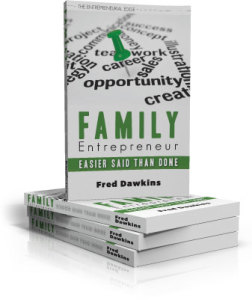
  • What Readers are saying about Family Entrepreneur book 2 in The Entrepreneurial Edge series

    family-entrepreneur“Fred Dawkins sure can tell a story. I really enjoyed his previous one: Everyday Entrepreneur. Again with Family Entrepreneur, he gives us a great story and a pleasant read. He provides wisdom, comfort and learning about entrepreneurship from a family enterprise point of view. I kept thinking of those I know in that situation that would have benefited from reading it earlier in their life. If you are part of a family enterprise, here’s a chance to learn from Fred, an accomplished family entrepreneur, and make your life much more effective and rewarding.”

    Brendan Calder Entrepreneur in Residence and Adjunct Professor GettingItDone
    Rotman School of Management U of Toronto.

    After reading Family Entrepreneur: “In the age of Twitter, it warms the heart that ‘smallbizpreneurs’ still rule the roost and family business remains the proven formula”

    Peter C. Newman – Legendary Canadian journalist and author

    Author Fred Dawkins has penned another winner with Family Entrepreneur. The third party narrative style of storytelling allows for a variety of opinions to be put forward while maintaining an entertaining read. Chalked full of real life scenarios and challenges that face every business, the Family Entrepreneur will engage all entrepreneurs from every generation, whether in a family business or not.

    David Wojcik Host and Executive Producer BiZ TV Canada

    “Working in the Financial Services industry for fifty plus years, twenty seven as an Independent Financial advisor, I dealt with high net worth clients & many successful family businesses. The first book in this series was very good but I believe that this second one ought to become the bible for every entrepreneur & budding entrepreneur as it is full of very valuable, helpful & vital advice & is very cleverly written. It is a book that should be read over & over & dipped into whenever there is a query or problem”

    Frank Weisinger – Past National President of the Life Insurance Association (UK)

    “Recently I was in the process of selling my historically significant commercial building. During the negotiations with realtors and prospective buyers, poring over lists, namely needs, wants, and conditions, I was overwhelmed and sought a diversion. In Fred Dawkins book, “Everyday Entrepreneur” I quickly became immersed in the text. His counsel on the key elements in negotiations in Chapter 18, Planning and Control, awakened in me an appreciation for what was most important for me as well as for the buyer, and the need for flexibility to reach an agreement. I accepted that it truly was a process that had to evolve, and because of his advice I felt empowered and confident to negotiate the sale.”

    Elaine Tucker, Independent Business Owner

    Fred’s book is thought provoking, highly entertaining while being truly insightful. Readers are challenged on their own beliefs and characteristics regarding entrepreneurship, mentors, career, and family. At times, I was laughing and other times intrigued by the business concepts subtlety being offered. It is full of rich ideas on how to develop and maintain an entrepreneurial mindset and how to build a business the right way, avoiding the issues that have caused others to stumble. As a serial entrepreneur and business coach I highly recommend Fred’s “Family Entrepreneur” for those in business or thinking about starting one.

    Bill Simmel CEO& Founder Phoenix ONE Sales, Marketing, Management + Communications Inc.

    In his second book Family Entrepreneur Fred Dawkins uses the same intimate discussion format that made his first book, Everyday Entrepreneur so informative and such a great text for seminars. Fred’s experiences as a successful family entrepreneur form the bases of real life discussion for concepts such as funding through leadership and the pitfalls and opportunities of personal issues, entitlement, rewards and succession that have special significance in a family setting. Best expressed in his own words “Entrepreneurship is a life philosophy grounded in opportunity, fueled by determination and focused on results.” Whether a beginner, well into an entrepreneurial venture, or a professor of business, this book is a must. It’s great stuff.

    Dr. Freeman McEwen Dean Emeritus, University of Guelph

    Reading Fred Dawkins book ‘Family Entrepreneur, Easier Said than Done’ is like having an experienced business coach who’s already walked down the same road you’re traveling, right there with you. While reading this book you’re bound to sigh with relief as he examines all the mildly crazy things we do as family entrepreneurs (we are not alone!). You’ll raise your eyebrows, smack yourself on the forehead and underline text reflecting his simple solutions and powerful observations and you’ll feel a surge of motivation as you put them into play immediately. So accurate are his examples of family business dynamics that you’ll feel such a familiarity with Dawkins’ writing you’ll swear he’s been reading your email. Written in a storybook format that’s enjoyably easy to read, you’ll want to take this book along with you on your next vacation. I have a hunch it’s going to be a book I return to and recommend on a very regular basis.

    Sherri J Griffin 20 Year Training & Development Professional

    “This book is an exceptional read that paints the bigger picture of entrepreneurship through easy but important dialogue. I recommend anyone interested in starting a business or entrepreneurship in general read this and take notes.”

    Douglas Lusted CEO Linkett, The Next 36, First Cohort The Creative Destruction Lab at the Rotman School of Management, University of Toronto, Velocity Venture Fund Winner University of Waterloo

    Utilizing his exemplary storytelling skills, Fred Dawkins has written an excellent book about entrepreneurship in a family setting environment and the the many challenges that it places on the entrepreneur and the family, as well. As indicated in his subtitle, it is easier said than done. The book clearly articulates a number of the issues involved in running a business so that the primary owner can prosper yet not conflict with family values, expectations, including physical, as well as financial and emotional needs. He cleverly exposes how frequently family members butt heads during the running of a family business and how difficult it can be to resolve differences among family members. If you’re a small business or entrepreneur working with your family in your business, I would highly recommend that you read Family Entrepreneur. It will provide you with valuable insights on how you might be better able to deal with the challenges in running a “family” business.

    Jeff Sheehan- author of HIRED! Paths to Employment in the Social Media Era

    Family Entrepreneur: Easier Said than Done by serial entrepreneur Fred Dawkins tells real-life stories that reveal the good, the bad and the ho-hum of family businesses. In an engaging, easy-to-read format, Dawkins shows you how to find your own solutions to questions about business controls, succession, dispute resolution, gender stereotypes, or decision-making.

    Traditional family businesses are being disrupted as baby boomers retire. What are the new models to keep a business competitive and family ties strong? In Family Entrepreneur, memorable maxims guide the conversation and bring the reader into the conversation. A sister who functions as the COO of her brothers’ company but doesn’t get the credit or financial rewards. A brother who runs a business but can’t make critical decisions because their father left one-half of his company to each sibling. A brother who started his own very successful business and is being pressured by his parents to take his brother and sister into his own business. A mother who started her own fashion company and is now being overrun by her daughters.

    Dawkins speaks to all entrepreneurs and ‘want-to-be’ entrepreneurs – those who start a business to provide for their families, to fulfill their dreams, to profit from their innovations, to be their own boss. Hear how they make their decisions – should they stay in the company? sell it? start a new business? In my own field of veterinary medicine, these situations are a recurring theme.

    Focusing on family business and family dynamics, the Family Entrepreneur will give you the courage to tackle your own situation. Family relationships are complicated in the best of circumstances and running a company means constantly adapting to changing environments. Dawkins provides sage advice for anyone in a family business, emphasizing how important it is to face the issues head on as rationally as you can and not to allow emotion to dominate the conversation.

    Dawkins celebrates the family business as the original business incubator and encourages would-be entrepreneurs to take the leap (after careful looking at all the options!). The valuable insights will guide you no matter where you are on the entrepreneurial timetable.

    Dr. Elizabeth A. Stone | Dean, Ontario Veterinary College (OVC) | University of Guelph

    In the fast paced age of corporations and global multi-billion dollar industries – Family Entrepreneur is a riveting road map for all readers, regardless of their desire to become an entrepreneur, or to simply learn key tools which will drive creativity, leadership and success in business and life.
    Who said you can’t teach entrepreneurship? Effective and cleverly narrated through the eyes of a young female entrepreneur, Family Entrepreneur showcases the challenges, rewards and opportunities within life and family business from varying timelines. It’s easy to find one’s self and relate to the characters throughout the book. It reads like a novel, but is a sneaky and fun way of teaching the tools of the trade of family entrepreneurship – or for that matter – entrepreneurship in general.
    Maryam Latifpoor-Keparoutis, Senior Development Manager, College of Physical & Engineering Science (CPES), University of Guelph

  • Today’s Graduate and Entrepreneurship

    You are educated. Now what? The most important skill you can add today is the ability to create and manage your career. On the surface this is not the best time to graduate. The cost of education is very high, bringing student debt to record levels. Job stability is in decline. The distribution of wealth is skewed in favour of those at the top. Upward mobility is in jeopardy. The rate of change is increasing. All this means that your future is dependent on self-determination grounded in awareness of the world in which you live. In this environment, you are your own brand and must plan on reinventing yourself throughout your work life. Start engaging in entrepreneurial thinking right at the outset of your career. Whether you start a business, become a solopreneur, work in a large entity or engage in social entrepreneurship, you have to become adaptable and resilient in a world dominated by change. Entrepreneurial thinking is about a mindset not a skillset. Success is about finding a way not knowing the way. In the era of Big Data this is essential. We will never know enough or understand enough of what we know. So abandon prison thinking and get started.

    Five ideas to reject:

    1. Education guarantees you a future. Sorry you don’t have it made: education never ceases and formal education just gives you more opportunities. There are no guarantees
    2. There are no jobs for graduates. There are barriers to entering the work force which are as insurmountable as we allow them to be. Resilience and adaptability start now.
    3. Government will solve the employment problem. Would you really choose government as your advocate to solve any problem?
    4. There is no future within small business. Life expectancy of all businesses is in decline. Strategic management of your career takes you where you can gain the most now!
    5. Millenials don’t make good hires. Maybe you place a higher value on social media contact and demand access during the day but technology is your ally making you more productive than older generations.

    Ten Reasons for Confidence:

    1. Technology, your ally, has lowered the cost of administration through the integration of many management tasks. A one pound portable laptop allows anyone to incorporate their accounting system, sales marketing network, all communication, research, collections and payments not to mentions a wide variety of personal needs. Add in mobility via a smartphone and you are always accessible and connected. You have the potential to do it all, as a disruptor within a large corporation or government agency or as an independent.
    2. Big Data is generating new problems at record rates. Every problem is an opportunity.
    3. Social networking, another ally, has increased the reach of individuals allowing market access on a much broader geographic scope. Services can be offered at great distance. Endorsements can be sought and received across the country or even worldwide. Credibility can be built quickly through performance. LinkedIn is a great tool to market your skills and pursue your career strategy.
    4. Websites can be both affordable and first class allowing an individual to build a professional image. Employee and entrepreneur alike can build their brand and market themselves.
    5. Outsourcing is an established practice by which governments and large corporations are achieving flexibility which rewards specialization right down to the individual level. Businesses may only want you part time so find several of them and keep them happy.
    6. Acquisition is a principal way for large entities to find innovation making startups, often founded on youth and enthusiasm a great opportunity if you can join the right team.
    7. Succession is a huge issue for hundreds and thousands of viable independent businesses in North America as the baby boom generation hits retirement depending on their business to fund their future. You can find a mentor leading you to acquire your own business through an earn out that funds his or her retirement.
    8. Size is simply becoming a liability – there are many small viable market niches that large companies and foreign sourcing will never fill. Adaptability, resilience and flexibility are essential in a world dominated by change.
    9. Opportunity is nowhere, opportunity is everywhere. Recognizing opportunity is the cornerstone of success in every aspect of your career.
    10. Determination was the key to graduating. It is also the key to managing your career.

    Starting your career is the first of many problems ahead. Every problem provides an opportunity. The solution to a successful career lies within your ability to create your own brand.

    Fred Dawkins is a serial entrepreneur with over 40 years’ experience and achievements in manufacturing, retail, land development, consulting and import/export. He holds a B Com in commerce and finance and a M.A. in economics from the University of Toronto. His business has allowed him to travel extensively, giving him insight into the emerging global economy and making him a passionate advocate of entrepreneurship in the 21st century.
    Everyday Entrepreneur [Dundurn Press] is the first book in Dawkins’ Entrepreneurial Edge series, and is currently available at all booksellers, including Amazon.com, Amazon.ca, Barnes & Noble and Chapters Indigo. His novel, 2020 Hindsight, explores major contradictory trends in society in a compelling contemporary fiction narrative, and is forthcoming as an e-book on Amazon.com.
    Website: https://fcdawkins.com/

  • Entrepreneurship: Disruption in the face of the “Era of Big”

    We are entering an increasing – no pun intended- age where size is dominant. Big Business, Big Government, Big Unions, Big Data and most damning of all “Too Big To Fail”. We have sacrificed the principles of micro economics such as the optimum size of the firm and the law of diminishing returns to build dominant global enterprises- behemoths more closely related to their bureaucratic enemy, government, than they will ever admit. These entities lumber around the world chasing low costs and cheap labour in the name of maximizing profits. If they fail they plead their case in a public forum that they are too significant to let die. They are pyramids paying outrageous rewards to those that scale to the top.

    What are the implications for individualism. Job stability no longer exists. Big data is generating information far beyond are ability to comprehend. The rate of change is staggering. 24/7 hyper-connectivity has us all chasing our tails, Are we headed for Big Brother? Globalization is both an opportunity and a threat. Small business is vulnerable to competitors around the world but at a time when things are moving at lightening speed entrepreneurs are flexible and adaptable giving them the opportunity to find a niche and move into it before others. The most important skill to learn in this new era is the ability to create your own job. Without it the threat is the loss of upward mobility for many and perhaps economic independence for most. The divergence of wealth between the rich and the poor and the eroding middle class are forewarnings. Entrepreneurship is critical for the individual.

    But it is also critical for these huge entities. Without the impact of disruption based on challenges to the status quo , sometimes referred to as ‘intrapreneurship’, governments and huge businesses will never come close to producing optimum results and solutions. The current conundrum in Washington shows a government that is not only dysfunctional but is mired in a malaise of mediocrity. There are no disruptors coming forward to challenge the party lines and find compromise. Optimum decisions are a pipedream in this environment.

    Entrepreneurs make things happen. They are problem solvers. The greater the problem the greater the reward. Regardless we need them at all levels. It is a skill that some are born with but many can learn. We are headed for a tsunami of Big Data that can swamp us. Machines will literally know more than any individual. It’s a scenario that science fiction writers have been portraying for generations. Individual success will be tied to entrepreneurial skills and attitude. Entrepreneurship has never been more important. We live in interesting times.

  • Entrepreneurship- Who’s The Boss?

    Quite a number of my friends are professionals. Often they let me know how lucky I’ve been to own and operate companies with employees who keep churning out results even when I am at the cottage or on the golf course. For them time is money-they generate the revenue. They have to be there or nothing happens. I don’t even have to show up.

    The traditional idea is that once you get to be the boss, you coast while others do your bidding. Maybe that idea’s grounded in the reality that most people get promoted to their level of incompetence where performance falls off. Of course it’s delusional to think that you start your own business and find a gravy train of financial success, freedom and success, all with little effort. This rarely happens but we do revere examples when it does like some the instant successes that have materialized in the tech world. Frankly that type of success is equivalent to winning the lottery which isn’t going to happen for many. Unfortunately this is the romantic side of entrepreneurship- rare but appealing.

    If your goal is to get to be the boss and then take it easy , perhaps you should look to the public sector where that is at least a possibility. Being a true entrepreneur means living in a revolving door with each turn bringing a new problem to solve. If this lifestyle is meant for you , it’s like getting the business equivalent of a runner’s high, every day, all day. If not welcome to chaos. The faster the problems come the more you must thrive on the process. The last thing entrepreneurs want to do is sit idle while others do the work and get all the fun of problem solving.

    That’s why they succeed in startups but struggle in managing established businesses even though they may have built those same businesses. No matter how great your innovation, converting that project to a successful business requires entrepreneurship. Success takes determination, adaptability, resilience, commitment and the certainty that you will take the project to completion and make that project happen. It is not the project that makes an entrepreneur. It is definitely the process! Very few are content to level their business and enjoy the fruits of success. So if you are all about power, money or prestige maybe entrepreneurship isn’t for you. Being the boss is just a necessary evil.

Leave a Reply