Today’s Graduate and Entrepreneurship

You are educated. Now what? The most important skill you can add today is the ability to create and manage your career. On the surface this is not the best time to graduate. The cost of education is very high, bringing student debt to record levels. Job stability is in decline. The distribution of wealth is skewed in favour of those at the top. Upward mobility is in jeopardy. The rate of change is increasing. All this means that your future is dependent on self-determination grounded in awareness of the world in which you live. In this environment, you are your own brand and must plan on reinventing yourself throughout your work life. Start engaging in entrepreneurial thinking right at the outset of your career. Whether you start a business, become a solopreneur, work in a large entity or engage in social entrepreneurship, you have to become adaptable and resilient in a world dominated by change. Entrepreneurial thinking is about a mindset not a skillset. Success is about finding a way not knowing the way. In the era of Big Data this is essential. We will never know enough or understand enough of what we know. So abandon prison thinking and get started.

Five ideas to reject:

1. Education guarantees you a future. Sorry you don’t have it made: education never ceases and formal education just gives you more opportunities. There are no guarantees
2. There are no jobs for graduates. There are barriers to entering the work force which are as insurmountable as we allow them to be. Resilience and adaptability start now.
3. Government will solve the employment problem. Would you really choose government as your advocate to solve any problem?
4. There is no future within small business. Life expectancy of all businesses is in decline. Strategic management of your career takes you where you can gain the most now!
5. Millenials don’t make good hires. Maybe you place a higher value on social media contact and demand access during the day but technology is your ally making you more productive than older generations.

Ten Reasons for Confidence:

1. Technology, your ally, has lowered the cost of administration through the integration of many management tasks. A one pound portable laptop allows anyone to incorporate their accounting system, sales marketing network, all communication, research, collections and payments not to mentions a wide variety of personal needs. Add in mobility via a smartphone and you are always accessible and connected. You have the potential to do it all, as a disruptor within a large corporation or government agency or as an independent.
2. Big Data is generating new problems at record rates. Every problem is an opportunity.
3. Social networking, another ally, has increased the reach of individuals allowing market access on a much broader geographic scope. Services can be offered at great distance. Endorsements can be sought and received across the country or even worldwide. Credibility can be built quickly through performance. LinkedIn is a great tool to market your skills and pursue your career strategy.
4. Websites can be both affordable and first class allowing an individual to build a professional image. Employee and entrepreneur alike can build their brand and market themselves.
5. Outsourcing is an established practice by which governments and large corporations are achieving flexibility which rewards specialization right down to the individual level. Businesses may only want you part time so find several of them and keep them happy.
6. Acquisition is a principal way for large entities to find innovation making startups, often founded on youth and enthusiasm a great opportunity if you can join the right team.
7. Succession is a huge issue for hundreds and thousands of viable independent businesses in North America as the baby boom generation hits retirement depending on their business to fund their future. You can find a mentor leading you to acquire your own business through an earn out that funds his or her retirement.
8. Size is simply becoming a liability – there are many small viable market niches that large companies and foreign sourcing will never fill. Adaptability, resilience and flexibility are essential in a world dominated by change.
9. Opportunity is nowhere, opportunity is everywhere. Recognizing opportunity is the cornerstone of success in every aspect of your career.
10. Determination was the key to graduating. It is also the key to managing your career.

Starting your career is the first of many problems ahead. Every problem provides an opportunity. The solution to a successful career lies within your ability to create your own brand.

Fred Dawkins is a serial entrepreneur with over 40 years’ experience and achievements in manufacturing, retail, land development, consulting and import/export. He holds a B Com in commerce and finance and a M.A. in economics from the University of Toronto. His business has allowed him to travel extensively, giving him insight into the emerging global economy and making him a passionate advocate of entrepreneurship in the 21st century.
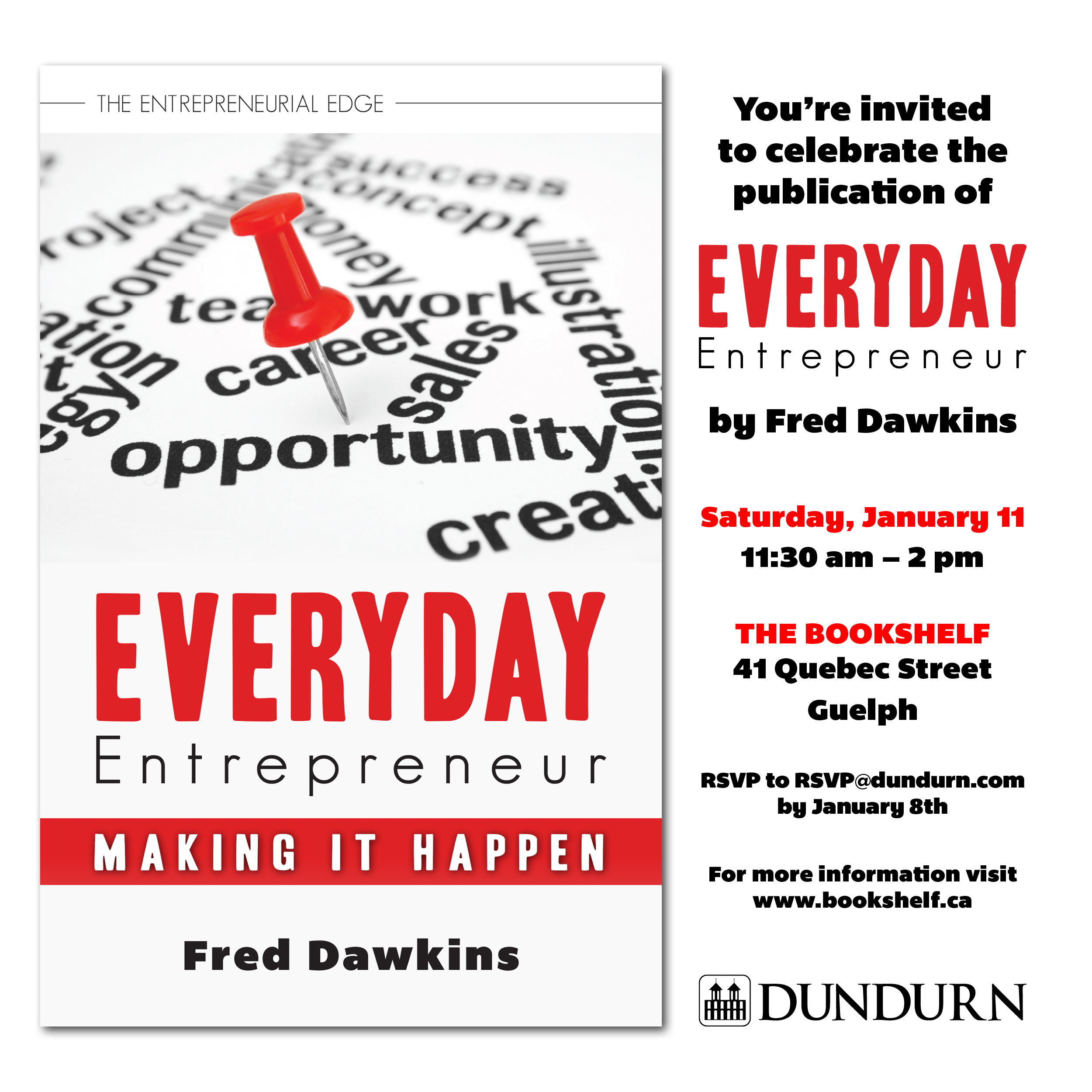
Everyday Entrepreneur [Dundurn Press] is the first book in Dawkins’ Entrepreneurial Edge series, and is currently available at all booksellers, including Amazon.com, Amazon.ca, Barnes & Noble and Chapters Indigo. His novel, 2020 Hindsight, explores major contradictory trends in society in a compelling contemporary fiction narrative, and is forthcoming as an e-book on Amazon.com.
Website: https://fcdawkins.com/
Similar Posts

  • The Disconnect between current Capitalism and Free Enterprise

    I am a serial entrepreneur who believes that the free enterprise system is the best alternative for creating upward mobility, a growing middle class, the most efficient allocation of resources and the least costly production of goods and services to the benefit of society as a whole. But free enterprise is based on the principal of a free and open market. Theoretically the ease of communication today should create more opportunity and much greater competition. Free enterprise does not thrive in a monopoly or oligopoly both of which limit competition but in many cases that is what we now have. As a result the middle class in the west is in serious danger of backsliding into the poor class from which it came over the past hundred plus years.

    Branding and Brand power are the main tools that are limiting competion, allowing capital to seize a much larger portion of the pie at the expense of labour creating the status of superrich and the growing disparity in the distribution of wealth. These are serious dangers because market control interferes with free enterprise and skews the results. Yes it is still possible to create a new brand but increasingly large organizations block the market and take advantage by acquiring up and coming companies and only then allowing them full market penetration.

    On an individual basis it is now critical to become an entrepreneur allowing for self-determination and upward mobility that is in decline for employees. The most important skill anyone can learn today is the ability to create and manage your career. The problem is much bigger for society. We have created a society in the west with very high expectations and a philosophy of entitlement. A large percentage of the population will not put forward the effort and level of determination required to succeed as an entrepreneur – not without first experiencing serious pain and a major economic correction. We are vulnerable but collectively we remain in a state of denial.

    The capitalist system which allowed the middle class to flourish in the west is broken. Rather than continuing to create opportunity it has begun to limit it. Rather than spreading the success to the developing world we are in danger of returning to a more rigid class system with the superrich having a disproportionate amount of economic power. Solutions are impossible as long as we remain in a state of denial compounded by governments which have become dysfunctional. A good start could come from consumers by becoming better informed and breaking the power of the brands. This should be happening through social media but it isn’t. Instead brand control of the market is being re-enforced by social media marketing.

    I am very concerned that I have lived and worked in an era that has been optimum for the individual but is no longer sustainable. I am very concerned that my grandchildren will be denied the opportunity that my generation has enjoyed. One of the great challenges of capitalism is to moderate the influence of greed. If we don’t find a way to level the playing field it’s difficult to predict how social unrest will manifest itself in a society where expectations cannot be achieved.

  • Entrepreneurs: Lessons from ‘Own the Podium’

    With the Vancouver Olympics on the horizon the Canadian Olympic Committee supported by the Government recognized a need to change the status quo – a need to disrupt the traditional methods and find a way to achieve the winning performances expected from the host country. The situation demanded an entrepreneurial approach based on opportunity and determination. The opportunity was hosting the games – the determination to win existed with the athletes but the momentum to surpass previous achievement came from the Own the Podium program that created an ecosystem promoting pride, confidence and results. It worked – in Vancouver the Canadian team set a record for the most gold medals won at a winter Olympics and collected more total medals than they had ever won in a single Olympics. The key was creating a culture that nurtured success and established that success as a new normal, an expectation. In the simplest terms a philosophy or mindset focused on making things happen- the essence of being entrepreneurial.

    On an individual basis this program is a great example of breaking free of prison thinking and letting your determination take you through to success. But Own the Podium is far more significant than that. It is a great example of the collective creating the support system that produces individual success to the benefit of the entire country. We must do the same in the business world. Did you know that over 350,000 Canadians live and work in Silicon Valley? Why? Because the Valley offers the most highly developed tech ecosystem the world has ever seen. Do you also know that there is a worldwide competition for talent going on? Governments around the world are building programs to attract entrepreneurs to their countries. Canada has already introduced a fast track system to provide visas and a path to citizenship for entrepreneurs/innovators who can attract venture capital investment from Canadians. However if we can just keep our best and most brilliant home we can do well in this talent war and improve our prospects and results. We need to Own the Podium in tech development and in entrepreneurship.

    We have a good start with programs like MaRS , Communitech and The Creative Destruction Lab at the Rotman School but we need the collective will and the support of government to build an ecosystem that is second to none and that brings out the very best from the natural ability that exists here. If one per cent of our total population representing a much higher percentage of our intellectual capital are living in California than we have the tools here but we are both losing them and underutilizing them. More or less like our Olympic performance prior to Vancouver. If we can do it in sport we can do it in business.


  • Give yourself the gift that keeps on giving

    Times are changing – in fact change is the operative word and it’s the one constant we have in every element of our lives.  Western society has been entrenched in the concept of stability since we entered the Great Depression. As businesses grew larger we embraced a culture of control and systems in order to achieve stability. We valued certainty and pensions for our retirement above self improvement and upward mobility. Oh we still strived for both but within the framework of those organizations that were stable. We came to expect easy entry into the work force and a life long job ending in the golden years of a well funded retirement. A great dream that no generation has achieved. Even the baby boomers received a setback with the recession of 2008 and reduction in their savings at a time when they needed them

    Now we live in an era where the largest organizations can and do fail or falter from GM to RIM we have learned the lesson that the status quo has become a fleeting allusion.

    It’s time to give yourself the gift of entrepreneurial thinking.

    Only you can do it. Abandon prison thinking. Ignore the reasons that prevent you from accomplishing things whether personal or professional. Approach your problems from the mindset of ‘how’ you are going to solve them not ‘if’ you’ll be  able to solve them.

    Entrepreneurial thinking can be applied to every element of your life and it leads to another gift: self-determination

    Frankly this is a must. In your business life the most important skill you can learn in the 21st century is the ability to create and manage your career. Is your personal life any different? If we don’t take control we will limit ourselves to a life of mediocrity with decreasing real wages. limited upward mobility, low satisfaction and increasing frustration

    It’s time to trade in stability for agility!

    The attributes that dictate success today are resilience and adaptability which happen to be the characteristics of entrepreneurs.

    So as you reflect on this holiday season consider giving yourself the gift of an open mind – one that is open to possibilities and determined to find solutions.

    All the best for the holiday season

    Fred Dawkins, Author of Everyday Entrepreneur and the just released Family Entrepreneur


  • My article: The Misconceptions about Entrepreneurship

    Misconceptions about Entrepreneurship – Time to end the nonsense!
    By Fred Dawkins, author of Everyday Entrepreneur
    We are entering a New Era of Entrepreneurship where there is no room for prison thinking in a world dominated by rapid change. Embracing change requires resilience and adaptability which are key characteristics for all entrepreneurs. Unfortunately the existing stereotypes for entrepreneurs discourage countless people from embracing the role. These perceptions prevent too many from taking the leap of faith required to become one. The first step in breaking free is to dispel some of the myths that are holding capable people back at a time when they need to welcome the opportunity to create and manage their own careers.
    Two of the most flagrant misrepresentations that discourage people are that entrepreneurs are gamblers who take reckless risks to achieve high rewards and that entrepreneurs need to fail in order to succeed. Many people are risk averse and most of us fear failure. These traits do not disqualify us as potential entrepreneurs. In reality entrepreneurship is not about the risk that you take but entirely about the results that you achieve. Being entrepreneurial relies on the determination to make things happen especially when many others don’t see that possibility. Becoming an entrepreneur is all about the mindset not the skillset. Entrepreneurs find the way to make things happen they don’t always know the way. Too many good opportunities die prematurely because people are risk averse. More people need to make the leap of faith based on their determination and the foundation of a viable opportunity.
    However, being prudent prevents you from taking reckless risk and directs you towards managed risk which is the hallmark of free enterprise. Entrepreneurs are proactive and solve problems through determination not by taking unwarranted risk. Successful entrepreneurs always have a downside plan allowing for adjustment which mitigates risk. When they make plans they analyze a range of possibilities rather than marrying themselves up to a single goal or result. In this way they build a framework which helps them adjust on a timely basis. Put your best foot forward: at the very beginning establish the viability of your opportunity. Too much time, energy and money are spent trying to convert whimsical ideas into a sound business. A high tolerance for risk is not enough to make a bad idea succeed. This is the essence of the lean startup. Test your premise. Talk to your potential market. Get feedback and adjust. Manage your risk from the outset. Don’t plunge blindly ahead on the premise that risk is an integral part of the undertaking. To be sure there is risk but recognize it and manage it as best you can.
    The concept that failure is a prerequisite for success is more nonsense and stems from rationalization by those who fail initially. Successful entrepreneurs abhor failure. For many of them the fear of failing is a powerful motivation. Most manage their risk effectively, anticipate problems, adjust quickly, bounce back from setbacks and manage to avoid failure – if they do fail they learn and move on. We all learn more from failure simply because we take the time to analyze it. In that sense setbacks do make you stronger and they only constitute a failure if we give up. On the other hand success is exhilarating and it masks our faults. Just as initial failure can set the stage for success to follow; initial success can lead to a sense of entrepreneurial infallibility. When that happens, as it does to too many, the critical things that built those initial achievements are often forgotten and ignored.
    In order to break down these established stereotypes we have to understand how they evolved. Both derive from two specific types of entrepreneurs. First are the misfits or rebels who either cannot or will not conform; the gamblers to whom few of us can relate. Second and even more prominent are the tech entrepreneurs immersed in the world of venture capital where risk is high, failure is frequent and the rewards for success are dramatic. However Silicon Valley is not the center of the universe and these are not the definitive entrepreneurs; they are but two types of many, both removed from the traditional economy and the rock solid problem solvers that collectively form the engine that drives the economy. Those are the achievers that do make things happen especially creating jobs while big business is chasing lower costs around the globe.
    In this new era, defined by constant and rapid change, we must all become more entrepreneurial. We can choose to establish an independent business or we can choose to become disruptors within the culture of big business or within the bureaucracy of big government. Collectively we are defining a new normal; one that is less stable and more dynamic. Regardless it is in our best interest to embrace the mindset of an entrepreneur, an attitude focused on action fueled by determination. We must indeed create and manage our own careers. Job stability is disappearing. The distribution of wealth is favouring capital not labour. Upward mobility is in decline. All of this means new and different opportunities. We can become the architect of our dreams or the victim of others’. Whatever you choose; don’t let misguided and outdated ideas limit your choices. .
    Fred Dawkins is a serial entrepreneur with over 40 years’ experience and achievements in manufacturing, retail, land development, consulting and import/export. He holds a B Com in commerce and finance and a M.A. in economics from the University of Toronto. His business has allowed him to travel extensively, giving him insight into the emerging global economy and making him a passionate advocate of entrepreneurship in the 21st century.
    Everyday Entrepreneur [Dundurn Press] is the first book in Dawkins’ Entrepreneurial Edge series, and is currently available at all booksellers, including Amazon.com, Amazon.ca, Barnes & Noble and Chapters Indigo. His novel, 2020 Hindsight, explores major contradictory trends in society in a compelling contemporary fiction narrative, and is forthcoming as an e-book on Amazon.com.
    Website: https://fcdawkins.com/
    Read More “My article: The Misconceptions about Entrepreneurship”

Leave a Reply