The Disconnect between current Capitalism and Free Enterprise

I am a serial entrepreneur who believes that the free enterprise system is the best alternative for creating upward mobility, a growing middle class, the most efficient allocation of resources and the least costly production of goods and services to the benefit of society as a whole. But free enterprise is based on the principal of a free and open market. Theoretically the ease of communication today should create more opportunity and much greater competition. Free enterprise does not thrive in a monopoly or oligopoly both of which limit competition but in many cases that is what we now have. As a result the middle class in the west is in serious danger of backsliding into the poor class from which it came over the past hundred plus years.

Branding and Brand power are the main tools that are limiting competion, allowing capital to seize a much larger portion of the pie at the expense of labour creating the status of superrich and the growing disparity in the distribution of wealth. These are serious dangers because market control interferes with free enterprise and skews the results. Yes it is still possible to create a new brand but increasingly large organizations block the market and take advantage by acquiring up and coming companies and only then allowing them full market penetration.

On an individual basis it is now critical to become an entrepreneur allowing for self-determination and upward mobility that is in decline for employees. The most important skill anyone can learn today is the ability to create and manage your career. The problem is much bigger for society. We have created a society in the west with very high expectations and a philosophy of entitlement. A large percentage of the population will not put forward the effort and level of determination required to succeed as an entrepreneur – not without first experiencing serious pain and a major economic correction. We are vulnerable but collectively we remain in a state of denial.

The capitalist system which allowed the middle class to flourish in the west is broken. Rather than continuing to create opportunity it has begun to limit it. Rather than spreading the success to the developing world we are in danger of returning to a more rigid class system with the superrich having a disproportionate amount of economic power. Solutions are impossible as long as we remain in a state of denial compounded by governments which have become dysfunctional. A good start could come from consumers by becoming better informed and breaking the power of the brands. This should be happening through social media but it isn’t. Instead brand control of the market is being re-enforced by social media marketing.

I am very concerned that I have lived and worked in an era that has been optimum for the individual but is no longer sustainable. I am very concerned that my grandchildren will be denied the opportunity that my generation has enjoyed. One of the great challenges of capitalism is to moderate the influence of greed. If we don’t find a way to level the playing field it’s difficult to predict how social unrest will manifest itself in a society where expectations cannot be achieved.

Similar Posts

  • Entrepreneurs: Lessons from ‘Own the Podium’

    With the Vancouver Olympics on the horizon the Canadian Olympic Committee supported by the Government recognized a need to change the status quo – a need to disrupt the traditional methods and find a way to achieve the winning performances expected from the host country. The situation demanded an entrepreneurial approach based on opportunity and determination. The opportunity was hosting the games – the determination to win existed with the athletes but the momentum to surpass previous achievement came from the Own the Podium program that created an ecosystem promoting pride, confidence and results. It worked – in Vancouver the Canadian team set a record for the most gold medals won at a winter Olympics and collected more total medals than they had ever won in a single Olympics. The key was creating a culture that nurtured success and established that success as a new normal, an expectation. In the simplest terms a philosophy or mindset focused on making things happen- the essence of being entrepreneurial.

    On an individual basis this program is a great example of breaking free of prison thinking and letting your determination take you through to success. But Own the Podium is far more significant than that. It is a great example of the collective creating the support system that produces individual success to the benefit of the entire country. We must do the same in the business world. Did you know that over 350,000 Canadians live and work in Silicon Valley? Why? Because the Valley offers the most highly developed tech ecosystem the world has ever seen. Do you also know that there is a worldwide competition for talent going on? Governments around the world are building programs to attract entrepreneurs to their countries. Canada has already introduced a fast track system to provide visas and a path to citizenship for entrepreneurs/innovators who can attract venture capital investment from Canadians. However if we can just keep our best and most brilliant home we can do well in this talent war and improve our prospects and results. We need to Own the Podium in tech development and in entrepreneurship.

    We have a good start with programs like MaRS , Communitech and The Creative Destruction Lab at the Rotman School but we need the collective will and the support of government to build an ecosystem that is second to none and that brings out the very best from the natural ability that exists here. If one per cent of our total population representing a much higher percentage of our intellectual capital are living in California than we have the tools here but we are both losing them and underutilizing them. More or less like our Olympic performance prior to Vancouver. If we can do it in sport we can do it in business.


  • |

    Creative Destruction vs Trump’s Destructive Reduction.

    Creative Destruction was a term first popularised by economist Joseph Schumpeter. The premise is that innovation and technology will ensure progress on the basis of replacing old industries, markets and economic structures with new more efficient concepts. The architects who accomplish this are entrepreneurs who think outside the box, question existing systems and introduce new ways and means. Never has this been more relevant with the impending impact of AI putting us on the cusp of what many believe will be a major revolution. Some believe it will bring about comparable change to that fostered by the Industrial Revolution. Regardless this change will be led by the key leaders that Schumpeter relied upon: entrepreneurs and tech genii.

    Enter Donald Trump, certainly a disrupter but only in a literal sense. The proverbial bull in the China shop. The antithesis of the dynamic innovators that Schumpeter championed. A man apparently stuck in the past. A strong proponent of returning to the ‘good old days’ of the 1890’s, his model for what the U.S. should be. Let’s call that ‘Destructive Reduction.’

    Subtraction by reduction. Attacking allies. Breaking trade agreements. Withdrawing from international organisations. Renouncing treaties. Axing social benefits. Deporting immigrants. Recklessly slashing jobs within the bureaucracy. Reductions without analysis in an ill-fated attempt reduce the national debt, offset quickly by tax cuts in his ‘Big Beautiful Bill’. The man hates complexity. Give him a one pager and a burger and he’s ready to act. Rationality be damned. Right to a fault? ON and ON Don!

    Admittedly AI may help him with the odd element in this quixotic attack on well, just about everything. Forgotten is that the firm foundation of growth for the past hundred years for the U.S. has been research and development. For the past fifty years and more the U.S. has spent roughly 40% of the amount spent on R & D across the entire world. It’s been a proven formula for wealth creation and economic success. So what does the Big D do? He cuts the funding for leading research institutions like Harvard. This is perverse logic but then logic had been abandoned in a flurry of executive orders with the size of the signature rivalling that of John Hancock.

    I wonder who will fill the many voids created by this executioner of trust? Trump’s drift toward isolationism, based on groundless economics, creates great opportunity for none other than China. A country that quietly invests in areas that the U.S. largely chooses to ignore like Africa and South America. Areas that have been insulted by the Big D. Projections show that by 2100 there will be twelve billion people on Earth. Nine billion of those will reside in Africa or Asia. Every continent but Africa will be facing ageing populations. China has a plan. It has a much longer window than anything America conceives. China will quietly encourage the decline of the American Empire, if you can call it one. Donald has given their plan a nice boost.

    The world is changing. Are we ready? These are the questions that make my novel The Noah Project a wake up call to action.

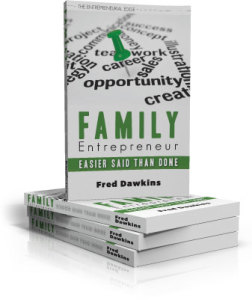
  • What Readers are saying about Family Entrepreneur book 2 in The Entrepreneurial Edge series

    family-entrepreneur“Fred Dawkins sure can tell a story. I really enjoyed his previous one: Everyday Entrepreneur. Again with Family Entrepreneur, he gives us a great story and a pleasant read. He provides wisdom, comfort and learning about entrepreneurship from a family enterprise point of view. I kept thinking of those I know in that situation that would have benefited from reading it earlier in their life. If you are part of a family enterprise, here’s a chance to learn from Fred, an accomplished family entrepreneur, and make your life much more effective and rewarding.”

    Brendan Calder Entrepreneur in Residence and Adjunct Professor GettingItDone
    Rotman School of Management U of Toronto.

    After reading Family Entrepreneur: “In the age of Twitter, it warms the heart that ‘smallbizpreneurs’ still rule the roost and family business remains the proven formula”

    Peter C. Newman – Legendary Canadian journalist and author

    Author Fred Dawkins has penned another winner with Family Entrepreneur. The third party narrative style of storytelling allows for a variety of opinions to be put forward while maintaining an entertaining read. Chalked full of real life scenarios and challenges that face every business, the Family Entrepreneur will engage all entrepreneurs from every generation, whether in a family business or not.

    David Wojcik Host and Executive Producer BiZ TV Canada

    “Working in the Financial Services industry for fifty plus years, twenty seven as an Independent Financial advisor, I dealt with high net worth clients & many successful family businesses. The first book in this series was very good but I believe that this second one ought to become the bible for every entrepreneur & budding entrepreneur as it is full of very valuable, helpful & vital advice & is very cleverly written. It is a book that should be read over & over & dipped into whenever there is a query or problem”

    Frank Weisinger – Past National President of the Life Insurance Association (UK)

    “Recently I was in the process of selling my historically significant commercial building. During the negotiations with realtors and prospective buyers, poring over lists, namely needs, wants, and conditions, I was overwhelmed and sought a diversion. In Fred Dawkins book, “Everyday Entrepreneur” I quickly became immersed in the text. His counsel on the key elements in negotiations in Chapter 18, Planning and Control, awakened in me an appreciation for what was most important for me as well as for the buyer, and the need for flexibility to reach an agreement. I accepted that it truly was a process that had to evolve, and because of his advice I felt empowered and confident to negotiate the sale.”

    Elaine Tucker, Independent Business Owner

    Fred’s book is thought provoking, highly entertaining while being truly insightful. Readers are challenged on their own beliefs and characteristics regarding entrepreneurship, mentors, career, and family. At times, I was laughing and other times intrigued by the business concepts subtlety being offered. It is full of rich ideas on how to develop and maintain an entrepreneurial mindset and how to build a business the right way, avoiding the issues that have caused others to stumble. As a serial entrepreneur and business coach I highly recommend Fred’s “Family Entrepreneur” for those in business or thinking about starting one.

    Bill Simmel CEO& Founder Phoenix ONE Sales, Marketing, Management + Communications Inc.

    In his second book Family Entrepreneur Fred Dawkins uses the same intimate discussion format that made his first book, Everyday Entrepreneur so informative and such a great text for seminars. Fred’s experiences as a successful family entrepreneur form the bases of real life discussion for concepts such as funding through leadership and the pitfalls and opportunities of personal issues, entitlement, rewards and succession that have special significance in a family setting. Best expressed in his own words “Entrepreneurship is a life philosophy grounded in opportunity, fueled by determination and focused on results.” Whether a beginner, well into an entrepreneurial venture, or a professor of business, this book is a must. It’s great stuff.

    Dr. Freeman McEwen Dean Emeritus, University of Guelph

    Reading Fred Dawkins book ‘Family Entrepreneur, Easier Said than Done’ is like having an experienced business coach who’s already walked down the same road you’re traveling, right there with you. While reading this book you’re bound to sigh with relief as he examines all the mildly crazy things we do as family entrepreneurs (we are not alone!). You’ll raise your eyebrows, smack yourself on the forehead and underline text reflecting his simple solutions and powerful observations and you’ll feel a surge of motivation as you put them into play immediately. So accurate are his examples of family business dynamics that you’ll feel such a familiarity with Dawkins’ writing you’ll swear he’s been reading your email. Written in a storybook format that’s enjoyably easy to read, you’ll want to take this book along with you on your next vacation. I have a hunch it’s going to be a book I return to and recommend on a very regular basis.

    Sherri J Griffin 20 Year Training & Development Professional

    “This book is an exceptional read that paints the bigger picture of entrepreneurship through easy but important dialogue. I recommend anyone interested in starting a business or entrepreneurship in general read this and take notes.”

    Douglas Lusted CEO Linkett, The Next 36, First Cohort The Creative Destruction Lab at the Rotman School of Management, University of Toronto, Velocity Venture Fund Winner University of Waterloo

    Utilizing his exemplary storytelling skills, Fred Dawkins has written an excellent book about entrepreneurship in a family setting environment and the the many challenges that it places on the entrepreneur and the family, as well. As indicated in his subtitle, it is easier said than done. The book clearly articulates a number of the issues involved in running a business so that the primary owner can prosper yet not conflict with family values, expectations, including physical, as well as financial and emotional needs. He cleverly exposes how frequently family members butt heads during the running of a family business and how difficult it can be to resolve differences among family members. If you’re a small business or entrepreneur working with your family in your business, I would highly recommend that you read Family Entrepreneur. It will provide you with valuable insights on how you might be better able to deal with the challenges in running a “family” business.

    Jeff Sheehan- author of HIRED! Paths to Employment in the Social Media Era

    Family Entrepreneur: Easier Said than Done by serial entrepreneur Fred Dawkins tells real-life stories that reveal the good, the bad and the ho-hum of family businesses. In an engaging, easy-to-read format, Dawkins shows you how to find your own solutions to questions about business controls, succession, dispute resolution, gender stereotypes, or decision-making.

    Traditional family businesses are being disrupted as baby boomers retire. What are the new models to keep a business competitive and family ties strong? In Family Entrepreneur, memorable maxims guide the conversation and bring the reader into the conversation. A sister who functions as the COO of her brothers’ company but doesn’t get the credit or financial rewards. A brother who runs a business but can’t make critical decisions because their father left one-half of his company to each sibling. A brother who started his own very successful business and is being pressured by his parents to take his brother and sister into his own business. A mother who started her own fashion company and is now being overrun by her daughters.

    Dawkins speaks to all entrepreneurs and ‘want-to-be’ entrepreneurs – those who start a business to provide for their families, to fulfill their dreams, to profit from their innovations, to be their own boss. Hear how they make their decisions – should they stay in the company? sell it? start a new business? In my own field of veterinary medicine, these situations are a recurring theme.

    Focusing on family business and family dynamics, the Family Entrepreneur will give you the courage to tackle your own situation. Family relationships are complicated in the best of circumstances and running a company means constantly adapting to changing environments. Dawkins provides sage advice for anyone in a family business, emphasizing how important it is to face the issues head on as rationally as you can and not to allow emotion to dominate the conversation.

    Dawkins celebrates the family business as the original business incubator and encourages would-be entrepreneurs to take the leap (after careful looking at all the options!). The valuable insights will guide you no matter where you are on the entrepreneurial timetable.

    Dr. Elizabeth A. Stone | Dean, Ontario Veterinary College (OVC) | University of Guelph

    In the fast paced age of corporations and global multi-billion dollar industries – Family Entrepreneur is a riveting road map for all readers, regardless of their desire to become an entrepreneur, or to simply learn key tools which will drive creativity, leadership and success in business and life.
    Who said you can’t teach entrepreneurship? Effective and cleverly narrated through the eyes of a young female entrepreneur, Family Entrepreneur showcases the challenges, rewards and opportunities within life and family business from varying timelines. It’s easy to find one’s self and relate to the characters throughout the book. It reads like a novel, but is a sneaky and fun way of teaching the tools of the trade of family entrepreneurship – or for that matter – entrepreneurship in general.
    Maryam Latifpoor-Keparoutis, Senior Development Manager, College of Physical & Engineering Science (CPES), University of Guelph
  • Entrepreneurs Wanted

    Entrepreneurship rests firmly on opportunity. But in the face of a rapidly changing global economy there is an overwhelming increase in entrepreneurship of necessity. Seniors need to extend their careers. Youth are struggling to launch theirs. Women are looking for flexibility to meet a combination of career and family needs. Individuals around the world are seeking freedom of opportunity. At the same time Big Business is pursuing profits around the world undermining the stability of employment markets. There is widespread decline in loyalty between employers and employees. Structural unemployment is a demoralizing prospect. One need only look to Detroit to see the impact.

    The result? The most valued skill in the 21st Century may well be the ability to create your own job. Job creation rests clearly on individuals -first for themselves and then for others. It reflects the difference between Localization versus Globalization – small scale entrepreneurs find their opportunities locally creating jobs in areas that Big Business has abandoned for offshore savings. To compound this the fast paced rate of change driven by technology favours small flexible and adaptable businesses that adjust to changing circumstances. Large companies find their growth through acquisition not startups.

    Around the world governments are finally recognizing the importance of entrepreneurs. Fortunately there is a great deal of talent that is suppressed and can be unleashed, whether through culture, education, gender , race, funding or other limitations. It will be up to government to remove the shackles Entrepreneurship has been the driving force behind the economic dominance of the Western world. It is the economic resource that puts other resources to work. Our economic future is moving to the hands of those who are driven to make things happen.


  • Globalization, Branding and The Entrepreneur

    The appeal and benefits of pursuing a global economy lie in the theory of comparative advantage whereby global completion will ensure that goods and resources will be allocated in the most efficient way, ensuring the most cost effective production of goods and services to the benefit of all. Yet the more we open ourselves up to globalization the greater becomes the discrepancy in wealth distribution which contradicts the theory. Oh to be sure there is a growing middle class in the highly populated eastern countries like India and China but in effect we are just averaging out the wealth of the poor – improving in the eastern world and declining in the west while those at the top accumulate huge fortunes. Upward mobility  on any kind of scale may be in jeopardy.

    Life should be getting better for all of us. Instead large corporations are controlling the marketing of most products largely through effective branding  which allows them to keep the lion’s share of the benefits of low cost production in the form of huge profits rather than either paying a fair price or passing along the benefits to the end user. At the same time the demand for labour is shrinking in relative terms through technology and mechanization undermining wage structures around the world. These large corporations have abandoned their identity as national firms in favour of becoming global entities. They are routed in a culture of control and increasingly rely on acquisitions and outsourcing to give them the innovation and flexibility needed in a fast paced world economy immersed in rapid change. As long as they can control the market they retain control of the profits.

    So how do we break this system and allow the mass sharing of the efficiencies being gained? The hope lies in entrepreneurs digging in the corners, finding comparative advantages and getting low cost products to market. The problem is that there are barriers to get products to market and if you manage to break through your company soon joins the club bringing in huge profits.  Rather than breaking the system, those that succeed are embracing it. Greed is a powerful motivation in the face of dynamic achievement. So as it stands now entrepreneurial success lies in pursuing startups and selling out or by leapfrogging through this stage and becoming one of the Bigs. Neither of these trends will break the current trend on wealth distribution which is moving back towards the historical norm.

    On a macro level entrepreneurs are the main hope to break the culture of control but there are no guarantees that will happen. On an individual level, pursuing a career as an entrepreneur may be the only ticket to upward mobility. That is why the most important skill anyone can master today is the ability to create and manage their own career. We must all adopt the mindset of the entrepreneur.

Leave a Reply