Invitation to Book Signing in Guelph on Saturday, January 11, 2014
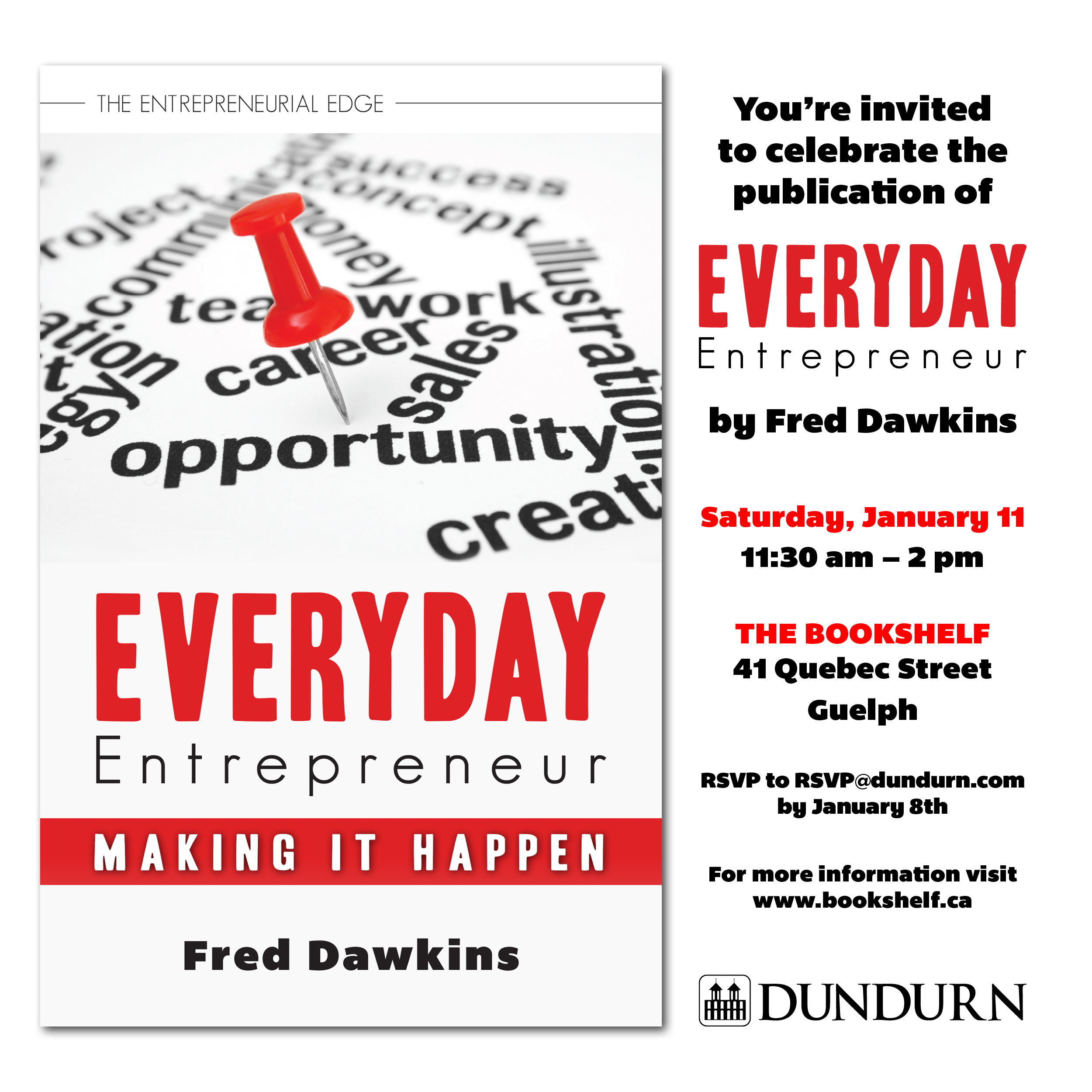
Every New Year is a time for reflection – a time to review the past and a time to predict the future – a time for assessment and a gateway to change. For many career change is the most important possibility to consider. Job stability is evaporating before our eyes. Inequity in the distribution of wealth in the western world is returning to historical norms after a century of a growing and healthy middle class. So maybe this really is the time to consider becoming an entrepreneur.
Entrepreneurship has become a hot topic and it should be. Why? Well here are a few reasons to consider. Globalization is great for consumption, not so wonderful for non-competitive labour in developed countries especially North America. Technology has accelerated the rate of change inherent in globalization making change itself the one constant we can expect in our economic future. Rigidity, structure and the status quo are the antithesis of change. We must constantly engage in a process of creative destruction, tearing down the old to renew with new and different products and approaches. The lifespan of the status quo is already much shorter as the rate of change accelerates. Stability in one’s life will depend on resilience and adaptability.
The ability to create and manage your own career will be the most important skill you can learn.
We are well into a New Era of Entrepreneurship. Governments have recognized this and the battle for talent is underway. Universities and Colleges around the world are introducing programs searching for the best ways to define and teach entrepreneurship. Is it economics? Is it business? Is it philosophy? Can it be taught? Must it be experienced? Everyone is searching for the formula to produce disruptors. Why? We need them to help bring about change at every level: To dig into the corners and find all the advantages that exist by opening up the global economy; To dig in the corners and create jobs in the face of comparative disadvantages because they are problem solvers and will invest locally when Big Business will run away; To challenge the status quo to bring about changes in the behemoths we call international corporations and Government. Society needs disruptors so that creates opportunity.
But that’s not the reason to become one. Here are some personal reasons to take a long hard look at entrepreneurship: Independence; Upward mobility; Redefined security; Joie de vivre; Control and Satisfaction. Let’s face it in a 24/7 global world we are all taking risks and working long hours. Technology has us by the scrotum and is already squeezing. Why not take control of your career?
Maybe our business schools have been working from a flawed model, focused on turning out executives rather than entrepreneurs. That is changing. Too Big to Fail is really to Big to Succeed. Big Companies rely increasingly on acquisition and outsourcing for their flexibility. Will that be enough?
So as we approach 2014 there is much to consider. Entrepreneurship does not hold all the answers but it is moving into the forefront. Entrepreneurs are problem solvers at a time when we are generating new problems faster than ever before. Entrepreneurs act as a catalyst to stimulate the economy creating jobs out of chaos at a time when leadership is wallowing in a political quagmire.
A New Year and a New Era – Definitely much to consider – Happy 2014 to all
Not long ago countries like Japan and Korea focused on a corporate policy based on loyalty. The concept was that employees stayed with a company for their working life. Companies nurtured this loyalty as a solid foundation to build on. North American companies flirted with this concept looking for ways to understand and replicate the quality assurance programs coming out of their Asian competitors. Enter globalization, the technology revolution and a rate of change that may be unsustainable for humans. In a blink job stability vanished.
Large companies by nature are slower to react than their smaller compatriots but large scale permanent lay-offs have become a fixture of the corporate world. International companies are making record profits pursuing low labour costs around the world while paying those at the top record bonuses. Add the increasing wealth gap and a shrinking middle class in the developed world to the equation and you reveal a growing underpaid work force plagued by uncertainty.
The result is that the most important skill you can develop today is the ability to create and manage your own career. The key to upward mobility is becoming entrepreneurial at any level. Technology is the greatest ally of the would be entrepreneur. It is less expensive to start a business today. Social networking provides an instant support group. Crowdfunding offers a potential source of funds. New careers are being created every year while traditional roles disappear. Entrepreneurs are the problem solvers that create these new opportunities.
The best news: after you’ve done this once; after you made the initial leap of faith and become an entrepreneur, you can and will repeat the process again and again. Change is the one constant we can expect in our lives going forward. Change is the antithesis of stability. Seniors are doing startups out of necessity. Youth are doing startups to get into the work force. Mompreneurs are dealing with the difficulty of re-entering the workforce by creating new careers that encompass their lifestyle needs.Every startup has a multiplier effect through job creation. So the answer for a secure future no longer lies with embracing a career with one strong entity. A secure future can best be secured through the ability to adapt and recreate yourself according to new circumstances. The essence of entrepreneurship is adaptability and resilience – the ability and determination to face new circumstances. We are entering a new era of entrepreneurship.
For the past fifty years our business schools have been working on a flawed model. We have focused on producing executives for large corporations; only recently have we introduced enthusiasm for entrepreneurship to our MBA programs. However we live in a world economy focused on globalization, revved up by the technological revolution and immersed in a 24/7 mindset. We have created an extremely fast paced environment requiring flexible management led by adaptable and resilient leaders – the essence of entrepreneurship.
The misguided emphasis on turning out high paid executives has led to politically motivated policies like ‘Too Big to Fail’ which can be more properly labelled “Too Big to Succeed” or simply “To Big”. Like their second cousin Big Government these monolithic corporations need the impact of entrepreneurs – people who are disruptors that challenge the status quo in the face of a new global reality. They are too slow and unwieldy and are led by overpaid executives far removed from reality, Increasingly they rely on growth by acquisition and flexibility achieved by contracting out. They are part of our reality but not the part that will have the greatest influence and guide the inherent change built into the global economy. Entrepreneurs will pursue opportunity around the world and find the many niches that will move us to more efficient allocation of resources and lower cost of production across the entire world. At the same time in the west where we have structural issues such as high unemployment levels among unskilled workers, entrepreneurs will invest locally finding opportunity and create jobs that will put these resources to work. Government cannot do this effectively and big business has no interest in doing so.
‘Everyday Entrepreneur’ encourages entrepreneurship at all levels, focused on preparing entrepreneurs for the challenges they will face through a wide range of anecdotes helping them experience the realities of life as an entrepreneur in this ‘New Era of Entrepreneurship’.
Praise for Everyday Entrepreneur
“Fred Dawkins employs a likeable cast of characters and the simple setting of Canadian cottage country in July to convey a complex set of ideas ranging from the nature-versus-nurture debate (are entrepreneurs born or made?) to a variety of essential how-to entrepreneurship skills to specialty topics such as gender, leadership, negotiation, and team formation, as well as the important role of entrepreneurship in the global economy. His casual, easy-to-read writing style belies the critical importance of his subject matter. Not just potential entrepreneurs but also governments, big companies, and business schools in the West must adapt to the new reality of an increasingly educated and ambitious middle class in so-called developing countries and take immediate steps to reinvigorate our large population of underutilized problem-solvers in order to remain competitive and continue to enjoy increasing prosperity. As Sam would say: It is not a question of if, but rather how.”
— Ajay Agrawal, Peter Munk Professor of Entrepreneurship at the University of Toronto’s Rotman School of Management, founder of the Creative Destruction Lab for entrepreneurs, and co-founder of The Next 36 entrepreneurship program.
Our economy can best be characterized as fast and furious. The combination of globalization and the technological revolution ensure that the one constant in our economic lives is change. This is an environment
well suited for entrepreneurs who by definition are flexible, adaptable and resilient, unlike big business which has become entrenched and slow to adapt. Big entities grow through acquisition increasingly depending on entrepreneurial enterprise to produce start-ups with potential to feed their growth needs.
Small business entrepreneurs need to get in on the action. Most think that global trade opportunities accrue to the large corporations that can deal in the volumes required by manufacturing giants like China. However there are large numbers of likeminded entrepreneurs in countries like India, Malaysia and Viet Nam that want to network and connect with entrepreneurs here in North America. Entrepreneurship starts with opportunity and there are many around the world that big business will miss or ignore. Oh they will capitalize on the obvious ones like cheap labour in certain countries but it will take energy and determination common to entrepreneurs who disrupt and challenge the status quo to find the myriad of less obvious opportunities.
‘Everyday Entrepreneur’ encourages entrepreneurs to strike out and look for these relationships. They are there to be had. Anecdotes outline experiences in dealing off shore and give insight into different economies and some of the advantages on which entrepreneurs can capitalize.
Praise for Everyday Entrepreneur:
“I just finished reading [this] book and enjoyed it immensely. [Fred has] pulled together a wealth of knowledge and advice crucial to the successful entrepreneur in a highly readable fashion. It is a
must-read for aspiring and seasoned entrepreneurs who are facing today’s complex, volatile, and uncertain world. I especially appreciate the emphasis on thinking globally and adapting proactively.
We have seen too many examples of yesterday’s winner relying on old models to their detriment. It isn’t easy … but it is exciting and gratifying to create your own business and work to see it flourish. The summary at the end of the book should be bookmarked on every entrepreneur’s computer.”
— Dr. Sherry Cooper, former executive VP and chief economist for BMO
and author of three books, including The New Retirement: How it Will Change Our Future.
There are many people who believe that you can’t teach entrepreneurship. They believe it is either inherent or a skill that has to evolve from experience. There is no doubt that as in any other skillset there are people who are naturals. Also experience is a tough taskmaster and the school of hard knocks leading to rejection and failure has produced some great success stories. Opportunity and determination are the cornerstones of entrepreneurship. Recognizing achievable opportunities and the commitment to find solutions and implement then are absolute prerequisites. There is a teachable philosophy involved that enhances both of these attributes. But there is something else we can do for our aspiring entrepreneurs. We can do a much better job of preparing them. We can help them understand the basic philosophy, the many personal challenges they will face and all of the fundamental business issues from team building to funding that are common to every business. The failure rate for entrepreneurs is too high. Some would have you think that this is merely the nature of the beast-part of the mystique. We must add a new word to opportunity and determination and that word is preparation. With preparation we can turn reckless risk into managed risk and greatly improve the success rate. Working with the Creative Destruction Lab at the Rotman School of Management at the University of Toronto I see many brilliant innovators anxious to start a business and get their project to market who lack this basic preparation. This lack extends much further to those entrepreneurs of necessity who will be trying to create and manage their own careers in our fast paced global economy.
Everyday Entrepreneur is written in a format that is relatable for anyone considering a career in entrepreneurship at any level. The focus is to use real anecdotes to put the reader in a business situation so he or she will recognize a similar issue when it develops. Preparation is an essential element of planning. The plan is not an outcome but rather a framework that allows us to anticipate and adjust as things evolve. Preparation and understanding are great assets for anticipation and adjustment. We need not build our businesses from the ground up. We can use the experience of others to prepare us. There are common bonds at every level of entrepreneurship. The goal of Everyday Entrepreneur’ which is coming out in December, is to convey as many ideas as possible that will make all our new entrepreneurs better prepared and help existing entrepreneurs put their challenges into prespective.
Praise for Everyday Entrepreneur
“Fred Dawkins has written a wonderful book about entrepreneurship unlike any other on the market. He brilliantly uses his storytelling skills to illuminate his subject in a way that makes the book a joy to read. You’re so wrapped up in the story that you may not realize how much you’re learning until you’ve turned that last page.”
— TERRY FALLIS, AWARD-WINNING AUTHOR OF THE BEST LAID PLANS AND UP AND DOWN.
One of the premises in the introduction of my new book Everyday Entrepreneur is that I wrote it to encourage entrepreneurs of every stripe across the spectrum. Since the high tech entrepreneurs have been getting the lion’s share of the attention and encouragement from the public and investors alike, they were far from my target market. Tech innovation was the creator of venture capital, setting a precedent for high rates of return that can’t be sustained in other areas. Virtually all other types of entrepreneurs have to struggle for funding because they simply don’t meet the criteria for venture capital. Those that have attracted VC funds often flounder to the detriment of the entrepreneur because the VC gets an agreed upon return which can sap a moderately successful business.
The Creative Destructive Lab at the Rotman School of Management at the University of Toronto (my alma mater) is focused on extreme success with a strong emphasis on taking tech developments from gestation to dynamic success on the international stage. On the surface this seems to be exactly the area that I previously suggested didn’t need my help or encouragement as people are lined up to help in almost every area to develop these type of businesses. So why did I choose to support these high achievers by becoming a partner of the CD Lab? Well here are my reasons:
1. I strongly support that we need to keep our brightest and best talent here in Canada – we are in the midst of a world wide competition to attract talent – success starts with keeping our own
2. Success at this level sets a terrific example for anyone in this country that wants to become an entrepreneur and start a business at any level
3. Both of these factors are critical for us to build a culture of entrepreneurial success to maintain a strong economy and bring in the new talent that every country is striving to attract.
4. If in the process I can influence some of the brilliant MBAs we are graduating to circumvent the conventional and lucrative path to becoming a business executive in favour of applying their abilities to becoming entrepreneurs who solve problems, make things happen, create jobs and provide the drive that leads to success, then my time and effort will have been well spent.
5. The very talented people who apply to the Lab are brilliant in their innovation but still need nurturing on the personal issues involved in becoming an entrepreneur, the fundamental business issues they will encounter and the overall philosophy inherent in being an entrepreneur.
My book will out at the end of November. In the meantime I am enjoying my involvement with the Lab targeting success in a global economy which I firmly believe will centre upon a New Age of Entrepreneurship.
We are entering an increasing – no pun intended- age where size is dominant. Big Business, Big Government, Big Unions, Big Data and most damning of all “Too Big To Fail”. We have sacrificed the principles of micro economics such as the optimum size of the firm and the law of diminishing returns to build dominant global enterprises- behemoths more closely related to their bureaucratic enemy, government, than they will ever admit. These entities lumber around the world chasing low costs and cheap labour in the name of maximizing profits. If they fail they plead their case in a public forum that they are too significant to let die. They are pyramids paying outrageous rewards to those that scale to the top.
What are the implications for individualism. Job stability no longer exists. Big data is generating information far beyond are ability to comprehend. The rate of change is staggering. 24/7 hyper-connectivity has us all chasing our tails, Are we headed for Big Brother? Globalization is both an opportunity and a threat. Small business is vulnerable to competitors around the world but at a time when things are moving at lightening speed entrepreneurs are flexible and adaptable giving them the opportunity to find a niche and move into it before others. The most important skill to learn in this new era is the ability to create your own job. Without it the threat is the loss of upward mobility for many and perhaps economic independence for most. The divergence of wealth between the rich and the poor and the eroding middle class are forewarnings. Entrepreneurship is critical for the individual.
But it is also critical for these huge entities. Without the impact of disruption based on challenges to the status quo , sometimes referred to as ‘intrapreneurship’, governments and huge businesses will never come close to producing optimum results and solutions. The current conundrum in Washington shows a government that is not only dysfunctional but is mired in a malaise of mediocrity. There are no disruptors coming forward to challenge the party lines and find compromise. Optimum decisions are a pipedream in this environment.
Entrepreneurs make things happen. They are problem solvers. The greater the problem the greater the reward. Regardless we need them at all levels. It is a skill that some are born with but many can learn. We are headed for a tsunami of Big Data that can swamp us. Machines will literally know more than any individual. It’s a scenario that science fiction writers have been portraying for generations. Individual success will be tied to entrepreneurial skills and attitude. Entrepreneurship has never been more important. We live in interesting times.
Indisputable: We live in a global work space – an economy where timing is everything and competition comes from every which direction, blindsiding us, especially where Tech is concerned. There is tremendous pressure to be first out to fill a market niche and tremendous pressure on innovators around the world to become instant entrepreneurs OR to give up the lion’s share of the economic benefit of their innovation to others who can get them to market in a hurry.
If there is a lesson from the Blackberry debacle it’s that being first gives you a head start but the pack quickly turns to finding ways to do it different and better. There is no time to rest on your laurels. Your advantage is short lived- even much less than ten years ago when Blackberry was first riding high.
Are the expectations of the market achievable or are we simply seeing a new reality where companies come and go with a greatly reduced life expectancy. Apple did fail once. How much longer will it stay at the top this time?
When you visit an incubator/accelerator you will often see tired young people committed to a 24/7 work ethic, working in small space shared with other start-ups focused on perfecting their innovation with little understanding of the fundamentals required to operate a business or build a foundation for a company that can last. Did Blackberry ever establish that foundation? After all it was always in a dynamic state of rapid change initially positive but for the past three years negative.
Can humans really continue to cope with the rate of change that technology allows? Are we being forced to abandon stability in favour of short term success? Overall we find ourselves in an integrated global economy, still wrestling with the ongoing effects of the Great Recession, managed by leaders who are challenged at best, incompetent at worst, where the only sure thing is uncertainty.
For all of these reasons becoming an entrepreneur is an important option. The economic world will place increasing value on resilience and adaptability. In the face of instability and uncertainty the most important skill we may develop will be the ability to create our own job. Big will not be better. Small and flexible will become the key to individual success.
No products in the cart.