On Canada Day – Celebrating the CDL: A Critical Canadian Initiative

With Joseph Rotman at the Creative Destruction Lab


Joseph Rotman invested a great deal to improve the future of this country. The Rotman School of Management at the University of Toronto is a lasting legacy showing both his commitment and what we as Canadians are capable of achieving. An important part of  that legacy is the CDL which is really just getting started.

It is both enlightening and alarming to discover that more than 350,000 Canadians live and work in Silicon Valley. More than one percent of our population and a much higher portion of our intellectual capital have left us for the world’s most prestigious and most productive ecosystem. This is both a problem and an opportunity but not one that government can solve or even try to solve. So how do we stem the tide? There is no quick fix. We are producing world class talent and such talent is inevitably attracted to the epicentre of success, achievement but most of all opportunity. It is the opportunity that we need to focus on. The Creative Destruction Lab does that. It creates opportunity here in Canada. The leader and founder Professor Ajay Agrawal is a dynamo.

Ajay is living evidence that entrepreneurship can be taught, an academic with the drive and mindset that can match anyone in the business community. When he approached the Rotman school to start this program he was told ‘you can use the facilities but you must find the funding yourself’. He has worked relentlessly ever since  to do just that in the process bringing in a very accomplished group of proven entrepreneurs to act as mentors. The stated goal of the Lab is to generate equity – specifically to create at least $ 1 billion in equity in the first ten years. After the first two years approximately $ 130 million has been achieved.

Financial targets are how we keep score but the greater purpose is to keep the best and most brilliant we produce here in Canada, helping to build our own world class ecosystem and offering a valuable example to others. Ventures receive the very best of mentorship. It is amazing to see how they evolve in less than one year. Watch for results – they have already started but many significant ones are ahead in the years to come.

As a partner of the Lab and member of the advisory board I am proud to point out that this program is not just another accelerator to help brilliant tech students bring their ideas to market. For me the Lab represents far more and has the opportunity to change and influence this country. We are traditionally small ‘c’ conservatives who let our brash cousins to the south take the outrageous risks and create the startling successes. We don’t lack for success stories but too often those successes happen outside our borders. Now when we are in an era where entrepreneurship is viewed as what I like to call the economic wonder drug of the 21st century, it is absolutely critical that Canadians embrace the mindset of an entrepreneur and become agents of change in a world where ironically change is the one constant. In that sense the Lab can be a leader and help change the narrative for Canada.

For me the Lab has three main purposes. The first as already outlined is to produce successful, scalable ventures flourishing as sustainable businesses right here. The second very unique goal and  achievement  of the Lab stems from the way in which students of the Rotman MBA program are engaged with the ventures and the  mentors. We need these talented business minds creating new businesses and making them succeed in Canada. The Lab immerses them in the startup culture and introduces the potential for success outside the world of investment banking. In this new era of entrepreneurship when every university and college around the world is trying to teach entrepreneurship this may be the most effective way any of these institutions has found to date.

The third and potentially greatest influence of the CDL program is as an example of what can be accomplished in Canada. We are building a pyramid of success. The ventures that go through the full program will be shining examples at the top of that pyramid. But there are many other levels of success below these which can be achieved and make an important contribution to our economy and our society. Not every success story relies on innovation. The potential multiplier of the Lab comes from encouraging all Canadians, at every level to adopt the mindset  that we can make things happen here and to apply innovation to a whole myriad of business solutions and applications. These potential ventures will be the foundation of the pyramid we hope to build and can have rippling effects across our economy for generations to come.

This is exactly what Joseph Rotman hoped to accomplish and thanks to him, it is a real possibility when we sorely need it.

With Joseph Rotman at the Creative Destruction Lab

Similar Posts

  • Why Branding is a threat to the middle class

    In theory as Globalization evolves resources will be allocated in the most efficient way possible ensuring that goods will be produced on the lowest cost basis to the benefit of all. In a perfect global system labour will shift around until the transition is complete and the rewards for labour will equalize around the global network. During the transition while wage rates in higher earning countries are frozen or rise slowly as wage rates in other areas catch up, those living in the higher wage countries will benefit from low cost goods during the transition. All of this takes place without impediments or barriers to free and open competition. Entrepreneurs will drive the progress by ferreting out opportunities across the global system.

    In practice as we continue to embrace such a global system, the rewards to labour in the low wage countries are lagging while much of the benefit of low cost goods are not reaching the consumer. Instead the rich are becoming the super rich while the middle class is facing the reality of returning to an historical norm with relative rewards well below those achieved in the west for the past sixty years during which consumerism has flourished. In an evolving era of Big Data where the status quo is becoming a moving target while character traits such as adaptability and resilience are becoming more critical, the business behemoths of the world are getting richer by controlling markets. Much of this control stems from branding and creating the allusion that branded goods are inherently superior. At the same time effective marketing has mislead us that these behemoths are so critical that they are ‘too Big to Fail’. Branding has effectively created near monopolies effectively providing barriers to entry for aspiring entrepreneurs in the process by limiting their upside and increasing their challenges

    Mammoth organizations operating on ten year plans are not appropriate for our fast paced Global economy. However control over markets allows them to achieve innovation and flexibility through outsourcing and acquisition. Oh these in themselves do create upside for entrepreneurs who can launch a startup and find an eager buyer for their initial success. However the odds against success are greater and fewer of us are likely to get there. It is certainly possible for a limited few to build new brands creating new members of the super rich club. However overall we have abandoned core economic principles such as the Law of Diminishing Returns and the Optimum Size of the firm in favour of uninformed consumerism and market control through brands owned and managed by what are effectively huge bureaucracies. Is there a tipping point ahead? Surely social media and instant communication are a threat to the dominance of brands – OR are they just additional instruments of control?

    Globalization has brought large numbers into the global work force, increasing the supply of labour. Technology through robotics and mechanization is reducing the demand for labour. Together these factors create downward pressure on wage rates. Upward mobility for the individual is in decline. Capital is securing the lion’s share of the rewards. Job stability is one of the status quos that is disappearing. For all of these reasons the individual must become his or her own brand. The most important skill you can learn today is the ability to create and manage your career.

  • A New Year: Time to Consider Entrepreneurship

    Every New Year is a time for reflection – a time to review the past and a time to predict the future – a time  for assessment and a gateway to change. For many career change is the most important possibility to consider. Job stability is evaporating before our eyes. Inequity in the distribution of wealth in the western world  is returning to historical norms after a century of a growing and healthy middle class. So maybe this really is the time to consider becoming an entrepreneur.

    Entrepreneurship has become a hot topic and it should be. Why? Well here are a few reasons to consider. Globalization is great for consumption, not so wonderful for non-competitive labour in developed countries especially North America. Technology has accelerated the rate of change inherent in globalization making change itself the one constant we can expect in our economic future. Rigidity, structure and the status quo are the antithesis of change. We must constantly engage in a process of creative destruction, tearing down the old to renew with new and different products and approaches. The lifespan of the status quo is already much shorter as the rate of change accelerates. Stability in one’s life will depend on resilience and adaptability.

    The ability to create and manage your own career will be the most important skill you can learn.

    We are well into a New Era of Entrepreneurship. Governments have recognized this and the battle for talent is underway. Universities and Colleges around the world are introducing programs searching for the best ways to define and teach entrepreneurship. Is it economics? Is it business? Is it philosophy? Can it be taught? Must it be experienced? Everyone is searching for the formula to produce disruptors. Why? We need them to help bring about change at every level: To dig into the corners and find all the advantages that exist by opening up the global economy; To dig in the corners and create jobs in the face of comparative disadvantages because they are problem solvers and will invest locally when Big Business will run away; To challenge the status quo to bring about changes in the behemoths we call international corporations and Government. Society needs disruptors so that creates opportunity.

    But that’s not the reason to become one. Here are some personal reasons to take a long hard look at entrepreneurship: Independence; Upward mobility; Redefined security; Joie de vivre; Control and Satisfaction. Let’s face it in a 24/7 global world we are all taking risks and working long hours. Technology has us by the scrotum and is already squeezing. Why not take control of your career?

    Maybe our business schools have been working from a flawed model, focused on turning out executives rather than entrepreneurs. That is changing. Too Big to Fail is really to Big to Succeed. Big Companies rely increasingly on acquisition and outsourcing for their flexibility. Will that be enough?

    So as we approach 2014 there is much to consider. Entrepreneurship does not hold all the answers but it is moving into the forefront. Entrepreneurs are problem solvers at a time when we are generating new problems faster than ever before. Entrepreneurs act as a catalyst to stimulate the economy creating jobs out of chaos at a time when leadership is wallowing in a political quagmire.

    A New Year and a New Era – Definitely much to consider – Happy 2014 to all


  • An Important Canadian Initiative – Rotman’s CD Lab

    Did you know that more than 350,000 Canadians live and work in Silicon Valley. That’s right more than one percent of our population and a much higher portion of our intellectual capital have left us for the world’s most prestigious and most productive ecosystem. This is both a problem and an opportunity but not one that government can solve or even try to solve. So how do we stem the tide?

    It’s not a quick fix. When we are producing world class talent they are inevitably attracted to the epicentre of success, achievement but most of all opportunity. It is the opportunity that we need to focus on. The Creative Destruction Lab does that. It creates opportunity here in Canada. The leader Professor Ajay Agrawal is a dynamo. He is the living evidence that entrepreneurship can be taught, an academic with the drive and mindset that can match anyone in the business community. The stated goal of the Lab is to generate equity – specifically to create $ 1 billion in equity in the first ten years. After the first two years approximately $ 130 million has been achieved. However the real goal is to keep the best and most brilliant we produce here in Canada, helping to build our own world class ecosystem and offering a valuable example to others that “Canada’s Got Talent” and I don’t mean the variety acts we see on the American TV show.

    Ventures receive the very best of mentorship. It is amazing to see how they evolve in less than one year. Watch for results – they have already started but many more will follow in the years to come

  • Ten Things These Books Will Do For You

    June-October 2014 including Family E 235Series: The Entrepreneurial Edge
    Book one: Everyday Entrepreneur – making it happen
    Book two: Family Entrepreneur – easier said than done
    Book three: Ageless Entrepreneur – never too early, never too late

    Ten Things These Books Will Do For You

    1. Get you out of a mental rut and into new opportunities
    2. Show you a path to self-determination
    3. Increase your earning power
    4. Enable you start a business, manage your career or accomplish your bucket list
    5. Make you a problem solver
    6. Enable you to build teamwork in your business and at home
    7. Explain the dynamic of the fast paced global economy we live and work in
    8. Prepare you for all of the fundamental issues you will face in a business
    9. Provide common sense solutions you can accomplish
    10. Inspire you to strike out, create your own brand and control your career

    “Fred Dawkins has written a wonderful book about entrepreneurship unlike any other on the market. He brilliantly uses his storytelling skills to illuminate his subject in a way that makes the book a joy to read. You’re so wrapped up in the story that you may not realize how much you’re learning until you’ve turned that last page.”
    — TERRY FALLIS, AWARD-WINNING AUTHOR OF THE BEST LAID PLANS AND UP AND DOWN.

    “Fred has pulled together a wealth of knowledge and advice crucial to the successful entrepreneur in a highly readable fashion. It is a must-read for aspiring and seasoned entrepreneurs who are facing today’s complex, volatile, and uncertain world. I especially appreciate the emphasis on thinking globally and adapting proactively. We have seen too many examples of yesterday’s winner relying on old models to their detriment. It isn’t easy … but it is exciting and gratifying to create your own business and work to see it flourish. The summary at the end of the book should be bookmarked on every entrepreneur’s computer.”
    — Dr. Sherry Cooper, former executive VP and chief economist for BMO
    and author of three books, including The New Retirement: How it Will Change Our Future

    Utilizing his exemplary storytelling skills, Fred Dawkins has written an excellent book about entrepreneurship in a family setting environment and the many challenges that it places on the entrepreneur and the family
    – Jeff Sheehan- author of HIRED! Paths to Employment in the Social Media Era

  • Reminder: Why I Love Entrepreneurship

    Thursday I attended the Demo Camp at the Creative Destructive Lab at the Rotman School of Management at the University of Toronto. The Lab is focused on converting innovation to entrepreneurship selecting concepts with merit and guiding the founders through the process of getting to market. In the process the goal is to encourage the brightest and best to stay in Canada. The first program was completed in June. It is a competitive environment as it should be. Last September when the Lab was in it`s gestation period there were 76 project submitted. Of these the G7 founding partners selected the 18 that they felt had the most merit. The groups were assigned specific targets to carry out over a six week period at which time they met with the partners again. The one with the weakest performance was dropped. By June on completion of the program there were ten projects left. In less than a year the survivors have created over $ 65 million in equity with more to come. Great performance for a program in its infancy. Great things are destined to come out of this program. It`s already started.

    I am very proud to have been invited to become a partner of the CD Lab. Not as one of the G7 partners who will continue to run the program in conjunction with the founders Professor Ajay Agrawal and Jesse Rogers but as one who is passionate about entrepreneurship and willing to help these people with phenomenal potential in whatever way I can. There are many levels and forms of entrepreneurship. The common bonds are the personal issues and fundamental business issues that every entrepreneur has to address from team building to funding. The transition from innovator to entrepreneur is difficult at the best of times but the pace at the Lab as for any accelerator is fast and furious. Understanding what to expect on these basic challenges can facilitate the transition and keep things in perspective.

    Which brings me back to the title of this post. The adrenalin of the Demo Camp was contagious. Ajay and Jesse along with the G7 partners are building a culture of success. The combination of seeing the progress that was made last year as reported by the charter participants along with over twenty new pitches to show what is on the horizon was compelling and just plain exciting. There is a developing worldwide race to attract talent. Keeping our own is critical. Attracting sources from other countries nearly as important. Canada has introduced a new visa program to attract innovators who can confirm capital to support their programs BUT the key to attracting others is to keep our own, build a world class ecosystem and foster the culture of success. The Creative Destruction Lab will be an important factor in the process. Very exciting !!!!

  • How do we prepare aspiring entrepreneurs?

    There are many people who believe that you can’t teach entrepreneurship. They believe it is either inherent or a skill that has to evolve from experience. There is no doubt that as in any other skillset there are people who are naturals. Also experience is a tough taskmaster and the school of hard knocks leading to rejection and failure has produced some great success stories. Opportunity and determination are the cornerstones of entrepreneurship. Recognizing achievable opportunities and the commitment to find solutions and implement then are absolute prerequisites. There is a teachable philosophy involved that enhances both of these attributes. But there is something else we can do for our aspiring entrepreneurs. We can do a much better job of preparing them. We can help them understand the basic philosophy, the many personal challenges they will face and all of the fundamental business issues from team building to funding that are common to every business. The failure rate for entrepreneurs is too high. Some would have you think that this is merely the nature of the beast-part of the mystique. We must add a new word to opportunity and determination and that word is preparation. With preparation we can turn reckless risk into managed risk and greatly improve the success rate. Working with the Creative Destruction Lab at the Rotman School of Management at the University of Toronto I see many brilliant innovators anxious to start a business and get their project to market who lack this basic preparation. This lack extends much further to those entrepreneurs of necessity who will be trying to create and manage their own careers in our fast paced global economy.

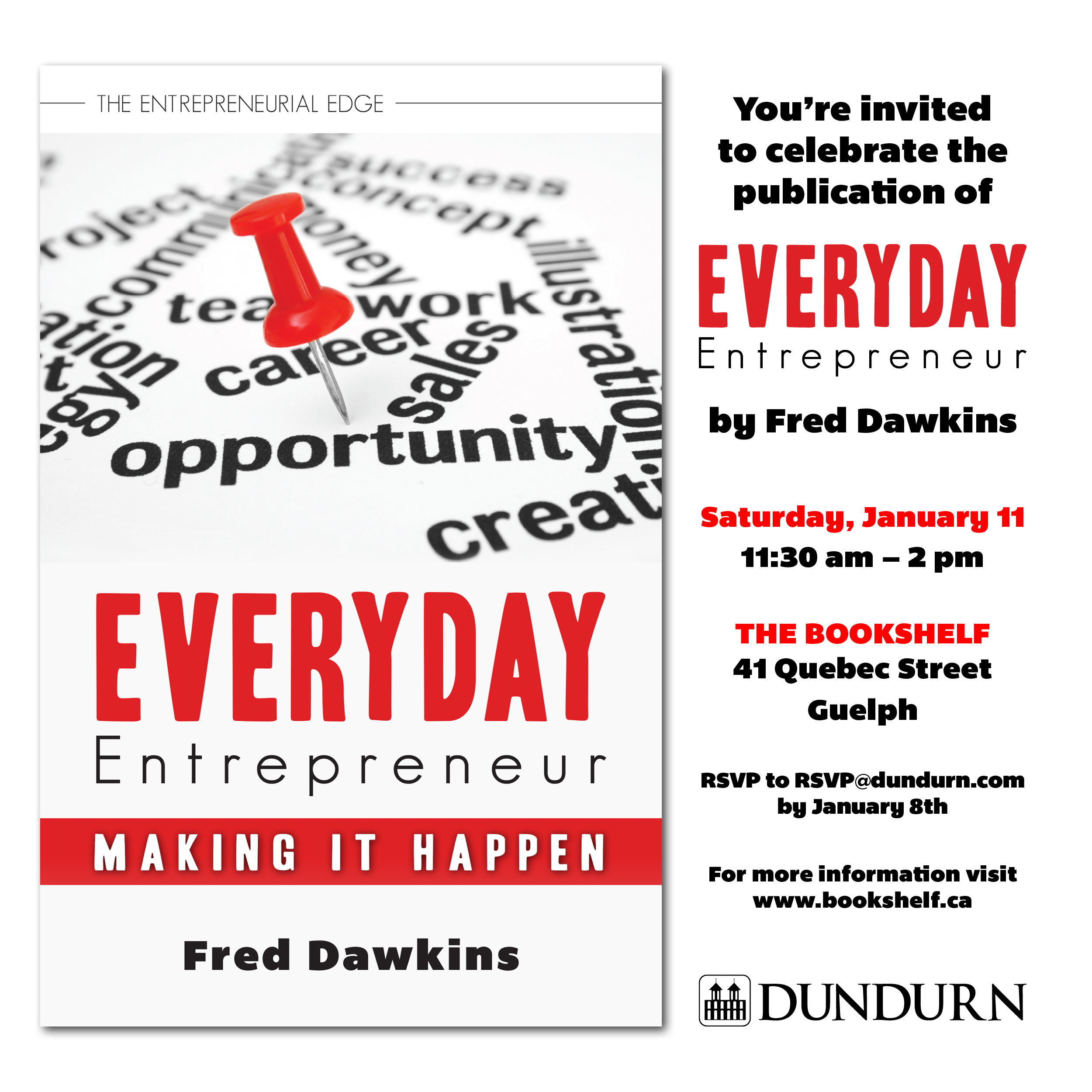
    Everyday Entrepreneur is written in a format that is relatable for anyone considering a career in entrepreneurship at any level. The focus is to use real anecdotes to put the reader in a business situation so he or she will recognize a similar issue when it develops. Preparation is an essential element of planning. The plan is not an outcome but rather a framework that allows us to anticipate and adjust as things evolve. Preparation and understanding are great assets for anticipation and adjustment. We need not build our businesses from the ground up. We can use the experience of others to prepare us. There are common bonds at every level of entrepreneurship. The goal of Everyday Entrepreneur’ which is coming out in December, is to convey as many ideas as possible that will make all our new entrepreneurs better prepared and help existing entrepreneurs put their challenges into prespective.

    Praise for Everyday Entrepreneur
    “Fred Dawkins has written a wonderful book about entrepreneurship unlike any other on the market. He brilliantly uses his storytelling skills to illuminate his subject in a way that makes the book a joy to read. You’re so wrapped up in the story that you may not realize how much you’re learning until you’ve turned that last page.”
    — TERRY FALLIS, AWARD-WINNING AUTHOR OF THE BEST LAID PLANS AND UP AND DOWN.

Leave a Reply